Pages

Showing posts with label historical fiction. Show all posts

Thursday, 3 January 2019

Bring Up The Bodies by Hilary Mantel

Reviewing series is weird. Sometimes I've said almost all I have to say about the first book, and it isn't that the second book is bad, it's just that I don't have anything to add. Often, the later books are just as good, it's just not shiny and new! (Don't get me wrong, I love series, a lot. They're just hard to review.)  It's weirdly compounded when we're in Hilary Mantel territory, where this is all terribly literary, and it's not like a series where a new book is going to get pumped out every year or so. This is high brow, people, and yet.

And yet, while I enjoyed Bring Up the Bodies a whole hell of a lot, I feel like a lot of this review might be rehashing what I thought of Wolf Hall. For context, Wolf Hall made it into my Top Ten of the year in which I read it, so please, don't take this as a complaint. Bring Up the Bodies is really, really fucking good. The conceit where Thomas Cromwell is only referred to as "he" was barely noticeable by this time, and of course, this book covers the downfall of Anne Boleyn and her retinue, so you'd probably have to do a pretty crappy job to make that uninteresting.

It's more than that, though. Mantel paints her Tudor world with such skill, giving us people who are recognizable as fallible human beings without ever trying to make them 21st-century in their actions or speech. What's more impressive is that there is quite a cast of characters here, and yet I never felt at sea in their midst. That is a feat and a half. But Mantel introduces who she needs to, adds a few pertinent comments, and then links back on their next appearance so skillfully that I felt like I had a general handle on the players and situation.

She makes all these long-dead Tudors come to life. We can't know how accurate she is, but it's enough to say that it feels real, like it could have happened just like this. We see as Henry grows dissatisfied with his ten-year marriage to Anne, and grows attracted to Jane Seymour, her very reticence alluring him. Katherine grows ill, and the opportunity grows that some day soon, the dismissed Queen will die, leaving Anne's position (or, more pertinently, the position of Queen) open for a marriage that will be recognized by the Pope.

Anne can't believe that Henry's straying eyes will be permanent - she's won him back before. And likewise, her brother and those she has preferred have grown accustomed to the liberties they've enjoyed at the court. (Whether or not those liberties included the Queen's bed Mantel cleverly leaves up to reader to decide. We hear what the evidence was, both the parts that might support it, and those that might have been trumped up to free a king of a marriage he wanted to leave.)

All this comes through Cromwell, and his uneasy position in court, still disdained by those born to the nobility.  He has increasing power that could, with Anne's fall, be toppled. Or by Anne's success, threatened. There's a needle he has to thread to get himself and his household through, and he never stops scheming to do it, reading Henry as few others could, understanding all the venal and virtuous motives (mostly venal) of those around the court.

This is not a potboiler, but there's always something going on to hold the attention, and subtly, hints of something more. I enjoyed Bringing Up the Bodies a lot. If you haven't read Wolf Hall yet, you might want to, and then traipse happily along to this one.

Wednesday, 7 November 2018

Hild by Nicola Griffiths

I remember reading another review of this book, years ago, probably not long after it came out. That reviewer found the prose almost unendurably turgid, and I remember reading the sample she'd given and shuddering in agreement. Still, when Hild popped up on one of my lists, I still figured I'd give it a chance, although I was ready to give it up more quickly than I might in other circumstances. When I sat down to read it, though, I found that I had little trouble sinking into the prose and reading. It was just difficult enough that I never lost awareness that I was reading, but not so difficult that I tossed the book aside.

This is going to be a review of damning with faint praise, I'm afraid. This book was better written than I was expecting, but what got me was the plot. This book took an awfully long time to get where it was going, and I'm still not sure it knows. It read to me a lot like an author writing to find out, writing around her topic to flesh out the world for herself, doing the work on the page that authors frequently do in their heads, to make the world pop into life.

Unfortunately, all those long sections that don't seem to be there for any real purpose other than to explore some other small piece of medical life are all in this book, and this is a long book. It's not that she's wrong about anything - the research, as far as I can tell, was very well done. And it's exhaustive.

And it is all, all, on the page. On many pages. On page after page after page. It's hard to ding a book for completeness, but oh my goodness, there were so many sections here that felt like they weren't necessary in the final product, as necessary as they might have been for the author to root herself in the setting. It takes so long to get anywhere, and while it's hard to pick out quite which moments could have been trimmed away, it does feel like this could have been so much shorter.

If what you want to read is a very slow trek through medieval life if you're part of a royal family, in a world where who is in power changes frequently, and go with agonizing detail through the years of young Hild's life, in the years before she founds a sanctuary and becomes St. Hilda, before she becomes Christian, when she's seen as a prophet to the king, and grows tall and learns to fight, and card wool, and spin wool, and travel with the retinue, and endure all the politicking of twenty years in minute detail...well, that's what this book is.

It's not terrible. It's just too much, like the author couldn't tell the difference between what was important and what wasn't, and so presents absolutely everything like it's the same level of urgent. There's no real sense of forward momentum of the plot, no sense that we're driving towards anything, because it's all moment to moment, and even in Hild's life, it's hard to tell which thing is most important to her. We know all the things that are important, but even those seem to have such an even distribution of interest and passion that it's hard to parse them out.

I'm good with complex. I am. I like meandering. But this story doesn't seem to know what it is, and where it ends up, there's never a moment where it feels like anyone was in any real danger, even though Hild as a character certainly thinks that there is danger around every corner. But the story is weighted down by so many details that her urgency doesn't come across on the page.  I made it through the more than 700 pages. I didn't hate it while I read it. But I have no interest in finding out what happens on every day after to Hild, not if every day is given the same attention they get here.

Friday, 27 January 2017

The Mistress of Nothing by Kate Pullinger

I am procrastinating on starting this review, because it's one of those books I struggle to write about. If there's lots to love, I am effusive. If there's lots to hate, I rant. Then there are those books that are just fine, but that's all they seem to be, and you try to sit down to find enough words to make up a review worth writing, and they prove to be elusive little buggers.

Right. So. This is a book. It is pretty good. I am writing short sentences because it's hard to think of anything longer. Try harder, Megan.

Fine. This is historical fiction about Lady Duff Gordon, who travelled from England to Egypt to try to prolong her life when she had what appears to be tuberculosis, although neither that nor consumption are ever spoken by name. The dry hot air is expected to help whereas England's damp climate exacerbates her disease. Her faithful ladies' maid Sally travels with her, and the two enjoy life in Egypt, dressing with less concern for European fashion than other foreign visitors, Lady Gordon adopting Egyptian men's clothes, and Sally women's.

It is not, however, a story of a relationship between the two, but rather Sally's love affair with Lady Gordon's Egyptian manservant, and the consequent difficulties, including being dismissed immediately when Lady Gordon finds out Sally is pregnant. (To be precise, she finds out when Sally goes into labour.)

There are things that Pullinger does right. She has obviously researched her subjects (based on real people) and time period well, but does not data dump. I have a pet peeve when writers end up showing all their research instead of synthesizing it organically into their books. So, no problems there.

That's kind of a negative recommendation - this book doesn't do something that irritates me. And the thing is, there's nothing wrong with it! The story didn't annoy me, the characters were fine, the setting well done. But also the story didn't really grab me, the characters didn't weasel their way into my affections. I didn't mind reading this, but I was never champing at the bit to get back to it.

I think it's because the pacing feels so slow. I get that there's not a ton of exterior incident (although they are there during some fairly significant riots and dissatisfaction), but does that mean that domestic incident needs to be lacking as well?

The feeling of lassitude, of long days with not much happening - and more so, that even when exciting things are written about, they aren't done so in a manner to incite excitement. The promise of riots coming near didn't make me worried, the epidemic that sweeps through their area and Sally and Lady Duff Gordon end up nursing people through is written about as calmly as long days of nothing much happening.

If you want something pleasant, and enjoy historical fiction, this might be the book for you. I like the books I read to be a little more keen.

Thursday, 3 March 2016

The Heretic's Daughter by Kathleen Kent


People recommend books to me a lot. It's hard to know when or how to fit them all in! And then there's the worry I won't like a book that is very dear to a dear friend's heart. For a long time, I just avoided reading books that had been recommended to me, unless someone pushed a physical copy into my hot little hands. (This is still the fastest way to get a book to the top of my list.) So I started a new list to read of books friends recommended. If you want to get in on this, you can recommend a book on this post.

This book was recommended to me by Melissa

This is a story about how I eventually came to mostly like this book.

This book and I got off to a rocky start. The letter that opens up the novel just felt so completely wrong, like exactly what someone in the 21st century thinks someone in the 19th century would write. It's so over the top and melodramatic and mea culpa about things that the book will then explain to us very reasonably...I was put off.

Then there was the cover. Look at it. Do we see anything weird about the word 'heretic?" Like, for instance, the inexplicable capitalization of the first three letters? This then meant that every time I thought of the book, it rang in my head as the HER-etic's daughter, weird stress and all, and oh, for goodness sake. It's not anywhere in the book itself, including the title page, but it's SUCH a wrong-headed choice for the cover. As if to suggest that this time, only this time, the heretic is a woman. Except, you know, they often were. 

Next thing wrong with the title is that it's wrong. Sarah's mother isn't a heretic. She's accused of being a witch. These are very different things. The word "heretic" actually means something, and when the book itself explains heretics in the context of their world as Quakers, I kept expecting the mother to be revealed as a secret Quaker. She is not. She is not a heretic. She is accused of being a witch. Do we see how those two things are different? Precision, people. Some words actually have specific meanings.

These are really fairly minor things, but they made me grumpy every time I picked up the book and looked at the cover.

So, this book had an uphill battle when it came to winning me over. So take that for what it's worth when it settles in to be really not a bad look at suspicion and paranoia in a small town near Salem, touched by the witch hysteria in the same way. Kent does a good job of showing how anything could be used as evidence, and how small grudges and small lies could be suddenly blown into huge consequences. 

Sarah, the main character, is a young girl when her mother comes under suspicion, fostered by resentment that her grandmother left property to her instead of other family members. Like her mother, Sarah has a temper, and neither are popular where they move, particularly when they bring smallpox in their wake.

In the end, I enjoyed this book, although I'd never say it reached the level where I'd be running out and telling people to read it. One of the most interesting possibilities was skipped over - stories have been written of the witch trials before, of course. But they all end with someone being hanged, or the fever subsiding and people being released. I'd be interested to see someone write about the third act - what happens after.

When you know your neighbours could turn on you. When your neighbours know they did things unspeakable. How do you live? What do you do? Does it ever go away? Does it fester? While The HERetic's Daughter did the paranoia well, it feels like paths that have been tread before. They're tread well here, but nothing feels particularly new.

In other words, if this is something you like to read about, it's a good entry into that niche. It's just not revolutionary.

Monday, 6 July 2015

Katherine by Anya Seton

When I started reading this book, my husband looked at the cover and asked if I'd picked it to read based on that alone. I used to have this poster over my bed before we moved in together, then later, above the couch in our living room. I said no, as I'd had no idea what the cover would be when I went to pick it up. But it is a nice piece of synchronicity.

Of course, the significance of The Accolade to the story of Katherine Swynford is perhaps tenuous. She never knighted anyone, never ruled anyone, is important in as much as she is because of her proximity to power, not the official wielding of it. But perhaps I'm being pedantic.

The reason I did pick this book up is because it's on the BBC Big Read, which I believe I am now about 5 books from finishing in its entirety. It doesn't surprise me, therefore, that this is a historical romance about Katherine Swynford, long-term mistress to John of Gaunt, father of Henry IV.

I'd be interested to read more about Katherine. While I believe Seton has done a lot of research on the dates and events, her Katherine's character is one that I would like to know if the evidence in any way supports. As she stands in this novel, she's not interested in power, or politics. She just wants her lover and to hide away from the eyes of the world, frequently wracked with religious guilt over her sinning.

Looking at the wiki entry, looks like at least one book has been written about her as a mover behind the scenes, which might be more interesting than this guilt-wracked lover. She's remarkably powerless in this, and while women had less and different access to power in this period, it doesn't mean they're utterly helpless. Katherine in this book is irritatingly so, at times.

It also brings the reason she and John of Gaunt have a long affair and eventually marry when his wife dies down to sheer physical attraction, which is great to start, but there had to have been more once the fires had been banked for the night.

Still, it's not a bad read, and it's fun to run into Geoffrey Chaucer. The practicality with which the people involved regard marriage are interesting, as is the overall sense of grime to the world, leavened by the relatively easier lives of the extremely well-off nobles. If you're looking for historical romance, I think you could certainly do worse.

However, the main character is just so angsty and powerless. It's a choice, to make her whole life be about whether or not she gets to sleep with John of Gaunt, but the author's choice to take her out of all but one of the major events of the times, for her to be content to never ever know what her lover's doing, or how it might affect her until she's forced to...it just feels like a missed opportunity. There's definitely an interesting story here. There's just that little voice in the back of my head that tells me this book would have been better if there had been some speculating on oblique ways of influencing the course of events. She calms him down once. Was that all she ever did?

Read as part of the BBC Big Read

Monday, 23 March 2015

The Virgin Cure by Ami McKay

New York in the 19th century, the slums, and prostitution. That is the milieu McKay is trying to invoke in this book, and, well, it's not bad. I was never eager to get back to reading this book, but I never minded picking it up, either. If it feels a bit superficial, it also is stronger when it comes to villains than McKay's earlier work.

My main complaint about The Birth House was that while the good characters were likeable, the bad characters were beyond caricatures. She's gotten better at that. At the same time, there's still just something lacking here. It's not terrible, but this feels like it's a book written to be a bestseller, if that makes any sense. But for all that, it's good at what it does.

The main character is a girl named Moth (strangely, that's the same name we gave to our street urchin (male) character in a story-by-email two friends and I have been writing.) She's sold by her mother to be a ladies maid, but finds her new employer to be rather sadistic and obsessed with wrecking Moth's good looks so that her husband can't pay attention to them.

Moth escapes and runs back to her old home, to find it empty, and in the process of trying to survive on New York's mean streets, ends up in the house of a woman of moderately ill repute, who specializes in high-end whores, well-off clientele, and specifically, in selling the virginity of her charges for a hefty fee. Moth is pampered and taken care of and paraded in this place, while the female doctor who sees the prostitutes tries to convince Moth to escape before that day can come.

So I guess, in as much as there are themes, it's about relations between women, help and sabotage both, but I never really felt like there was anything deep there to say. Moth is an interesting character, and her intense need to survive and thrive are well done. There's a digression into a high-class freakshow that is interesting as well, but are we trying to say that independent women are themselves the freakshow at the time? Sometimes it seems to be the case.

I don't know. I feel bad that I don't have anything deeper to say about the book. There are books that I read that spark a million ideas a minute, that make me sit my husband down and prattle on to him about books he's never even read and probably never will. They provoke thought. This book does not. It's an enjoyable read, despite the fact that it's about fairly horrible practices. But it's all surface.

For surface, it's good, and if you want to read a book that doesn't make you think more deeply about this than to say "wow, poverty in the past was horrible, and these people did horrible things", then this is the book for you. It's not a book, though, that will provoke you to think about how that might compare to poverty in the present, or sex work and its exigencies, or the persistence of practices, or really, anything.

I'm being hard on Ami McKay for having written a book that I think is probably a crowd-pleaser. It's because it's good at what it does that I want to to be better. I want it to make me think, instead of trying to fill me up all by itself.

Monday, 26 January 2015

Death Comes To Pemberley by P.D. James


P.D. James tries to combine her mysteries with Jane Austen. There has been a great division of opinions on this book. The blurbs try to make it sound like the most amazing book ever. Most of the people I know who've read it dislike it intensely. I don't feel that strongly one way or another - at most, it awakens in me a sense of slight disappointment. This isn't that good, and it isn't that good on both the mystery and the Jane Austen novel levels. On the other hand, it isn't abhorrently bad. It's just bland enough that I don't have a strong reaction to it.

Let's take those two elements in turn. It feels like here, P.D. James is trying to show us how policing and the justice system has changed. But it's not really a mystery. It's missing a detective, or really, anyone who is looking at the evidence, trying to ferret out the truth. I realize that being a detective as such is anachronistic, but even without having that formal position or informal undertaking, the mystery part falls flat.

The story just sort of happens, and that would be okay, if it were a little more lively. This is sedate without being interesting. Austen may have been sedate at times, but she was also always interesting.

The answer to the mystery arrives by carriage at the end of the mystery, and so, without lifting any fingers, it is solved. This is less than satisfying. Other authors, writing before the advent of detectives, have still found ways to give us that central character who is trying to get to the truth. It might be an experiment to see if you can do without them, but it's not that successful of one.

As for it being an Austen book, ten years after Pride and Prejudice, it's not terribly successful at that. The faux-Austen prose is clunky, and that's almost an unforgivable sin. It calls attention to itself, and there is too much of a data dump about what they're eating, or what the rooms look like, and it seems to be there to prove that James has done her research, rather than for good effect. If she's trying to ape Austen, it's done without grace. Also, you're P.D. fucking James. You should know you don't have to show all your research.

The biggest problem, though, is that the characters are boring. Elizabeth Darcy should not be boring. She may have changed, but you can't make her boring. That's ridiculous. Also, you know how Austen always has that one character who chatters on and on and you kind of want to kill her, but she's also so vibrantly alive that somehow she needs to be there? There is nothing like that. At all.

Lydia ends up being more interesting than Elizabeth, and a) really? And b), if that's the case, give us more of her than just having her go into hysterics once. We keep hearing about her being overbearing, annoying, hysterical, and quite frankly, that makes her the most interesting character in this book, but we barely get to see her. There is scarcely a scene that I didn't think would be improved by her presence. If you've made a vibrant character, why would you banish her to the spaces between the pages?

As far as I can tell, the book is missing feeling. With it, I could have forgiven the rather lackadaisical mystery. In Austen, there is a distinct difference between what the characters are doing and what they are feeling. They may be acting proper, but man, is there stuff roiling beneath the surface. And there is really none of that. They all seem to be pretty much as sedate as they act, although mildly perturbed at what has gone down in the woods near Pemberley. That is not enough to make a book out of, and it certainly doesn't do justice to Jane Austen.

Oh, P.D. James. I do like your mysteries. But this one, while it wasn't atrociously terrible, missed on virtually every aspect I would have wanted out of this book.

Wednesday, 10 December 2014

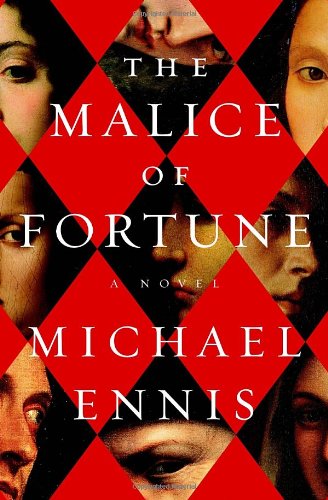
Malice of Fortune by Michael Ennis

People recommend books to me a lot. It's hard to know when or how to fit them all in! And then there's the worry I won't like a book that is very dear to a dear friend's heart. So for a long time, I just avoided reading books that had been recommended to me, unless someone pushed a physical copy into my hot little hands. (This is still the fastest way to get a book to the top of my list.) So I started a new list from which to pick, of books friends recommended. If you want to get in on this, you can recommend a book on this post.


When I started reading this, my first reaction was that this seemed to be a more literate Da Vinci Code. In a historical setting rather than the present, and with da Vinci as an actual character rather than the architect of the puzzle. Still, people being killed in a theatrical manner and left in patterns for the pursuers to solve? It does sound a bit familiar, does it not?

Luckily, it is more literate and somewhat deeper, overcoming most of my early worries. I can't say that this is one I'm running out to recommend to people, but I am glad someone recommended it to me. I doubt I would have run across it otherwise, and it was an interesting read.

Ennis has obviously done a lot of thinking about the Borgias. I mean, a lot. Also about modern theories of sociopaths, and not a little about serial killers. All of these get pulled together to create the setting of Malice of Fortune, where Damiata, a courtesan who was a lover of the elder Borgia's younger son, and mother of his son, is sent to find out who killed her former lover. Otherwise, she herself will be presumed guilty. Her son is held hostage to enforce compliance.

This book presumes all the most lurid stories about the Borgias barely do them justice. I know nothing of the scholarly debate on the issue, as this is definitely not my period or continent of specialty. I do think there's a debate, though, on how many of those stories are true, and how many are gossip and invention designed to discredit them. But for the purposes of this book, every orgy, every murder, every blasphemy that can be committed in the Vatican probably is.

The first third of the book is told through letters from Damiata to her son. The rest comes from the man she meets while searching for the truth. You may have heard of him. No, not da Vinci. Well, also him. But mostly Machiavelli. I am puzzling over what this change in narrators adds. It adds something to the comfort of Machiavelli and the reader, I guess, knowing Damiata's true feelings and motivations. It makes her a more understandable character. However, the book might have been more tense by making her a bit more opaque. Be that as it may.

While searching, Damiata and Machiavelli keep coming across bits of women, scattered in patterns that make particular sense to da Vinci. I am not the fondest of serial killer books, so I will pass over this lightly. It wasn't done with extreme detail, but still, more dismembered women? Not my favourite topic.

Remember how, last week, I was saying there was a post about colonialism and contact and science fiction percolating but not quite ready to come out? There's another one here, about using courtesans and well-off prostitutes as main female characters in historical fiction/fantasy. Similarly, that idea is composting. At some point (as in, after I get this last chapter of my dissertation finished), I will hopefully have some time to sit down and think about them and write down my ideas.

Malice of Fortune is pretty good, despite my serial killer reservations. I couldn't speak to the history, but the story moves along, and the denouement is satisfying. Thanks, Cinz, for recommending this one!

Wednesday, 29 October 2014

The Siege of Krishnapur by J.G. Farrell

Yet another book that I liked but didn't love. There were times when I found it hard to go back to - there was never, for me, any drive to see what happened next.

The book takes a curiously meandering approach to the English under siege in Krishnapur. Maybe that's what a siege is like - long days of nothing, followed by attacks, followed by more nothing, all the while slowly running out of food and people.

The Siege of Krishnapur also takes long detours into late-Victorian fads and theories, including phrenology and the causes of cholera. (For the record, Dr. McNab is right.)

But it is a good look at the inexorable decline of a group under intense pressure, and is bookended by the opposing journeys of two of the main characters - the Collector, who starts out believing fully in English civilization and its gadgets, and ends up losing his faith both in Empire and in civilization itself; and Fleury, who initially believes that all the emphasis on things and gadgets and creation obscures the true wonders of the universe, and ends up believing he can invent almost anything to keep him alive in combat (although, notably, none of his gadgets work.)

If you need drive to your books, and something to make you keep turning the page, this is probably not the book for you. But if you don't mind a good meander, The Siege of Krishnapur has many subtle delights.

Tuesday, 21 October 2014

The Luxe by Anna Godbersen

Gossip Girl meets The Age of Innocence. Except that there's not really any Age of Innocence here.

I tried with this book, because my sister recommended it as enjoyable fluff. I tried to think of it as light and fluffy and inconsequential, a book to read as a break from heavier things. It didn't work. I know that I have biases as a history grad student. But I don't demand absolute historical accuracy, as long as it's a good story, well told. This was beyond the pale.

First of all, when you start your fricking book with a quote from The Age of Innocence, one would think that you had absorbed a little bit from that book, other than thinking it would be hilarious to cast Edith Wharton as a dotty old aunt with much of the history of Ellen Olenska. Also, when said quote is the very famous one about "the way of people who dreaded scandal more than disease, who placed decency above courage," etc, etc, then you would have to have characters who ever, ever, ever placed face above personal interest. Who were in any way worried about scandal. Who tried not to commit scenes.

Apparently, "scenes" and "scandal" don't include vomiting in public, public female drunkenness, or every single young woman character sneaking out (often through the streets) for a rendezvous with their secret lovers. No one is ever concerned that they'll be caught. There are no repercussions.

To add to that, every young man of the upper crust of New York society is sleeping freely with young women of the same class, and not sexually harassing the maids or going to prostitutes? Yeah, right.

This is what really drives me crazy - it commits one of the two cardinal historical fallacies. One is to see the people of the past as utterly alien, consumed by crazy superstitions and irrationalities, people we can barely understand. The second, and the one to which The Luxe falls prey, is that the past is populated by people who are EXACTLY like us, just in different clothes.

Neither is true. The past is both alien and familiar, and both the strangeness and the familiarity crop up in absolutely unexpected places.

So, jet set mores of our time period are not the same as the upper crust mores of Gilded Age New York. Sure, I'm sure there was premarital sex going on, but it was much more likely to be outside of one's own class (if you were male.) And there may have been premarital sex going on within a class, but it would have been bloody discreet, and very dangerous. Nothing had repercussions in this book. I didn't even believe the threat of financial ruin, and in the end, it didn't matter to the characters either. Not that it happened - it was just brushed off.

But mostly, I just hated the characters. They were self-absorbed, petty, and solipsistic. I would have hated them in a modern setting and I loathe them as supposed representations of a different time period as well.

Wednesday, 30 July 2014

The Scottish Prisoner by Diana Gabaldon

When I started this book, I quickly became annoyed at the Scottishisms in the writing - not in the dialogue, but the way they cropped up in the descriptive text. They felt rare and out of place and smacked of shouting "look at me! I've done my research!"

Eventually, I stopped noticing them. But there is a bit of the self-conscious researcher about this book. It's well written, interesting, and mostly the details don't overwhelm the story, but on occasion, that line is skirted.

This is also the first Diana Gabaldon I've read, which may be an odd place to start, given the fervour of the following of her Outlander books. (Screw you, spellcheck, I'm Canadian, we spell it fervour.) Based on this, I will probably go on to read those books, but I'm not in any particular hurry. It made me interested, without making me eager.

Also, for a book that started out with desperate masturbation, and went on to a sex scene shortly thereafter, the rest of the 500 pages were remarkably devoid of sexy times. After that beginning, I was looking forward to it being more of a bodice-ripper. Or...what's the male equivalent of a bodice?

At any rate, the first 50 pages notwithstanding, this is more a political intrigue, following Jamie Fraser and Lord John Grey on their quest to bring a military monster to court-martial, and then later, to foil a Jacobite plot.

They travel to Ireland, find their quarry, find themselves hunted, return to England, and fight a duel. The narrative sometimes lacked urgency, but it was entertaining to read.

Monday, 21 July 2014

The Borgia Betrayal by Sara Poole

Wait, this is a mystery? Really? How does that work? It seemed like straight-up, not very good historical fiction to me.

What is the mystery?

Anyway, getting beyond my bafflement at reading the name of the series, we get to my biggest issue with this one.

STOP. TELLING. ME. HOW. TO. FEEL.

I started exclaiming out loud every time the main character told me how I must be judging her, or must be feeling this way about her or must be thinking this thing. There were a lot of exclamations. I had to avoid reading this in public. It might have been embarrassing.

Look, main character-and-by-extension-author, you don't get to dictate how people react to your words. You just don't. And by constantly trying to predict them, you just irritate the fuck out of me. Mostly because you were almost always wrong. I was never the Miss Judgey-judgey, on-my-moral-high-horse you seemed to assume your readers would be, and thus had to apologize to about every 20 pages. Have your character be herself, with any of the complexity that you want to give her, and let your readers draw their own conclusions. They'll all be different anyway. But every time she apologized for her "darkness" and knew I was judging her, I was really judging Sara Poole. And not kindly.

Also, what darkness? She has an uncontrollable urge to kill, which she can totally control all the time, except the two times she was being attacked and killed in self-defense? Yeah, that's really uncontrollable. Yes, she's a poisoner, yadayadayada, but if you're going to have a main character who is a poisoner, fucking own it. And don't make this "darkness" that sets her apart from all other people in the world be expressed in killing in self-defense, and then, in the flush of adrenaline, not being sorry she did it. That's not sociopathy. That's...I don't know what it is, but it doesn't work.

And she's not a sociopath. From all the apologizing, you'd think so, but no. She is full of all the emotions. She is connected to and affectionate about all of the people. She just has idle thoughts of killing some of them. If that's what makes you dark and evil, well, most of people I know must be pretty damn dark.

Did I mention she's the Pope's Poisoner? Tell me that wouldn't have made a more entertaining title. Not a good title, per se, but funnier. She's the poisoner to Borgia. She's sleeping with Cesare. She's friends with Lucretia. They're all "dark" in the same way she's dark. They talk a good game, but they act in surprisingly predictable, not really all that bad, ways.

This is not a great book. But it wouldn't have gotten two stars if there hadn't been all that apologizing. You want to write about a female poisoner to the Pope, write about a female poisoner to the Pope. Stop saying you're sorry.

Tuesday, 15 July 2014

Fall of Giants by Ken Follett

As you may imagine, people recommend books to me a lot. It's hard to know when or how to fit them all in! And then there's the worry I won't like a book that is very dear to a dear friend's heart. So for a long time, I just avoided reading books that had been recommended to me, unless someone pushed a physical copy into my hot little hands. I decided I needed to be a little more flexible on that one. So I started a new list from which to pick, of books friends recommended. If you want to get in on this, you can recommend a book on this post.

This book was recommended to me by Steph.

This is the second Ken Follett book I've read, and it thankfully avoids the major flaw of The Pillars of the Earth, the one that irritated me so consistently. There is no absolutely cartoonishly evil villain who adds nothing to the story except by being a horrible person and wanting to rape everyone.

I have little patience for such characters. Once you've established that they're horrible, where do you go? There can be no development, no changes, no different menace. And when your menace is all about rape? That's not that fun for the better part of a thousand pages.

This is a major step forward. There is no such thin master villain here. There are some other issues with the book, but none of that magnitude, and so I enjoyed it quite a lot more. It's an easy read, for one, for all that it is also the better part of a thousand pages.

It is the story of the Great War, told through a Russian family, a German family, an English family, and an American family. Well, family is a bit of a misnomer. This is the story of four or five young men, and makes occasional references to their parents, their sweethearts, their children. The English setting gets two more complete female characters, and the Russian and American settings about half of one each. (They're not in the book much.) So although this promises to be a family saga over multiple books, for this one at least, it is mostly focused on the young male experience, although there is quite a bit about female suffrage in England.

The story covers the lead-up to the war, the war itself, and the immediate aftermath. It's fairly interesting, and there were times when it seemed like Follett had done his research well. But then we came to the part I actually do know inside out and backwards (military history is not that topic), and he got it wrong, and so now I'm not sure.

It's a minor point, but it's mine, so:  in Toronto in 1920, there is no way in hell you could go around perfectly legally buying liquor. The Ontario Temperance Act was in force from 1916 to 1927, and buying alcohol was just as illegal here as 18th Amendment made it in the states.

Yes, I know there was massive smuggling of liquor over the border. This was due to the division of powers in Canada. Prohibiting the sale of alcohol was a provincial matter. Prohibiting the manufacture of alcohol was in federal jurisdiction, and except for a very brief period near the end of the war, the federal government declined to do so. So, we have the strange situation where it was perfectly legal to manufacture alcoholic beverages in Canada, but it was absolutely illegal to sell them. Hence why there was a supply to be sold illicitly in Canada and smuggled over the border.

The point is, walking around Toronto and going into a liquor store (post-prohibition invention, by the way) and buying cases of whiskey perfectly legally and openly? In 1920? Nope. Nope, nope, nope, nope.

Pedantic research nitpicking over. For the areas I don't know that well, nothing jumped out at me as glaringly wrong. But when we got to the stuff I do know, problems. On the other hand, this was recommended to me by a First World War historian, so maybe his military research is better than his prohibition research.

But here's my main issue with the book. As I said, it's very readable, it's fairly interesting, but if one of the representative young men was shown to have caused a major turning point in their country's history once more, I was going to throw something. Forrest Gump works by having him present at turning points, and even that doesn't work that well. This one has the young men actually being the power behind the scenes, present at and causing major events. It strains credulity, to say the least.

Let's take the Russian main character, for instance. His father is hung by Russian nobles for poaching. He is with his mother at the gates of the Winter Palace on Bloody Sunday. His mother is killed. He is in the first Russian military unit to see service in the Great War. He is the first soldier to lead a revolt in the Russian revolution. He dictates the first pronouncement of the new government. He meets Lenin at the station when he re-enters Russia. He warns Lenin to get out of town when things become difficult. He's the one who brings Lenin back to the Parliament to cement the Bolshevik victory.

Really? I mean, really? It's kind of okay to want all those things in there. It's even okay to want your own characters somehow involved. But for one individual character, utterly unnoticed by history, apparently to be instrumental in so many things? It isn't poignant, it's just irritating. Similar massive improbabilities cluster around each of the other nationally representative young men. At times, I wanted to investigate this supernatural phenomenon.

It's far too much. The stories themselves are interesting, but shoehorning your five young men into EVERY. SINGLE. EVENT. of the First World War is not only massively unlikely, it's ludicrous.

If you can overlook that, then this is a fun read. I mostly enjoyed it, although it got to the eyerolling stage pretty quickly every time a historical issue came up and somehow one of our five young men was right in the middle of it. Again.

Friday, 7 March 2014

The Winter Palace by Eva Stachniak

Warning: Some Spoilers Below

This is the other historical fiction I was reading while I was reading Wolf Hall, and musing about my reactions to both. I would still say that Wolf Hall is a step above most historical fiction I've ever read, but this wasn't bad. It wasn't earth-shattering, either. But not bad.

The Winter Palace is about a young woman employed by the Empress Elizabeth of Russia as a spy on the rest of the court, (officially, a lady-in-waiting, of a sort). But she becomes friends with the future Catherine the Great, and turns coat to report to Catherine as well, particularly when Catherine seems to be isolated and alone.

Wow, I seem to have run out of things to say fairly early in this review. Why is that?

I think it's because, while The Winter Palace is a fun read, there's little that sticks with me. Normally, I'm bursting with themes, or characters, or ideas, or moments to explore, either good or bad. In this case, very little sticks out. Varvara, the main character, never really won my affection, but she never alienated it either. I guess, in the end, I don't really care about her that much.

Oof. That's a problem. I hadn't really been fully cognizant of how little the book struck me. It was a pleasant read, but there is so little more. The court politics in the book are fine, but not that acute. In fact, many of the emotions seem muted, even the ones surrounding children being taken away. There is one good crying jag, and then a lot of bitterness - but the bitterness itself seems washed out and distant instead of burning. The book talks about grand passions, but I felt little of them. Possibly because they were supposed to be of the characters Varvara was watching, but mostly from a distance.

And the crux of the betrayal at the end seems slight. Varvara is devastated to learn she wasn't the only spy Catherine had? After a lifetime of living at court and being told be absolutely everyone that everyone has multiple spies everywhere? "I thought I was special but now I find out I'm not" just seems rather toothless in this particular circumstance.

I couldn't tell you why that is, though. Stachniak certainly shows us the repercussions for one other discovered spy, but there's no real sense of danger around Varvara. She seems to skillful at what she does, and the suspense is not effectively communicated. There's just something lacking here, a real sense of urgency and the ability to make emotions keenly felt.

I think this is an issue of the writing, which is otherwise quite competent. It just needs that extra edge to make this story compelling. As it is, it's an enjoyable read, but very little of it really distinguishes itself for me.

Thursday, 27 February 2014

Wolf Hall by Hilary Mantel

I was reading Wolf Hall and another historical fiction at roughly the same time, and while doing so, I was trying to put my finger on what makes Mantel's go at historical fiction so different. And then, which I like better. And whether or not I was unconsciously affording Wolf Hall more respect because it's about a guy, which would upset me, if it was something I was doing. On the other hand, I think it is demonstrably a better book than, say, Philippa Gregory's incursions into Tudor territory, but I do think people sometimes unconsciously dismiss books with female protagonists as automatically less serious. And it's troubling

That's a lot of thoughts. Let's see if I can put them in any kind of reasonable order.

So yes, there's the male protagonist problem. Or rather, the unconscious dismissal of female protagonist problem. Which I don't think I do generally, but if I'm not sure whether or not it's different when it's historical fiction. Something to pay attention to, anyway.

But Wolf Hall is also just a more challenging book, in a good way. Most historical fiction I read, of any stripe, is very descriptive. No, that's the wrong word, because Wolf Hall is wonderfully descriptive. More...this is driving me crazy. More...overt?

A lot of historical fiction comes from inside the head the main character, who narrates constantly what they are thinking and why they are doing what they're doing. This isn't necessarily a bad thing, depending on how it's done, and how much infodumping is happening, but Wolf Hall is a refreshing change. With third person narration, Cromwell is sometimes interestingly opaque. And added to this is Mantel's practice of layering in some issues only subtly, so you catch on slowly, over time, but without being overtly told, say, that Cromwell is participating in the spread of Protestant thought in England. The spread of Protestantism in England is a main theme, but Cromwell's participation is alluded to, rather than described outright. So you have to be on the ball, or you could miss it. I find that fascinating. And there are many ways in which it could fail miserably, be put in too obliquely or too overtly. But Mantel has just the right touch to make it difficult, but not impossible.

Also difficult, but not impossible is one grammatical trick Mantel uses, but I'm less enthused about this. I don't hate it, but it does make reading at times, weirdly difficult. She uses "he" to refer to Cromwell all the time. I get not wanting to have "Cromwell" every second line, but in paragraphs about two men, who the "he" is can switch suddenly and become Cromwell without any indication. You have to realize the sentences have started to become nonsensical, go back, figure out when the "he" switched to Cromwell, and read forward from there. It's an odd affection, and while I got used to it, I never stopped having to pause, figure out when she had switched the subject of her sentence and press on.

But the plot is really interesting, intricate, and relies more on showing and letting the reader fill in the spaces than it is in holding the readers hand and making sure they only get out of it what the author wants them to get out of it. It is the first volume in the life of Thomas Cromwell, fixer first for the Archbishop of Canterbury, and later, Henry VIII, through the marriage crisis, the ascent of Anne Boleyn, and ends just as her star is on the wane. The eponymous Wolf Hall, interestingly, is the seat of the Seymours, as in Jane Seymour, which, as soon as I realized that, adds an interesting tone to the whole book - you know who is waiting in the wings, and if you know your Tudor history, what happens. That little nudge of the title keeps historical awareness floating over everything that is done, and knowing some of the outcomes gives a strange poignancy.

Thomas himself is a fascinating creature - practical, devious, yet capable of surprising warmth to those he brings into his extended household. He claims to eschew religion while playing a surprising role in the spread of a new version of Christianity. He will bend the law to the king's will, while always remaining his own man. It's a curious tightrope walk, and Mantel makes it convincing.

I am very much looking forward to the further adventures of Thomas Cromwell, and of reading more Hilary Mantel. This was well worth the read.

Wednesday, 13 November 2013

The Painted Girls by Cathy Marie Buchanan

I have been making a self-conscious effort to keep reading some bestsellers, mixed in among my other lists. I like knowing what people are reading, and increasing my chances of being able to discuss books with anyone I meet. Given that a lot of what I also read is obscure, classics, or science fiction, it seems like a necessary ingredient in my overall reading mix.

It has also, on occasion, been disappointing. I've read those books that make me arch an eyebrow and go "Wait, this is a bestseller? Why?" There have been others that have been passable, but really nothing special. Well, I have to tell you, this is one of the best bestsellers I've read in a while.

It's not so wonderful that I have immediately become evangelical about it, but it's a damned solid historical novel, and avoids many of the pitfalls that have made me a little wary of some historical fiction. This is a good book, with interesting characters, and Buchanan weaves in threads of intellectual history that I know did exist at the time into the lives of her characters, not always with subtlety, but with purpose. I might not have always completely bought exactly the reactions of her characters, but I appreciated her research!

And, thank goodness, she avoids infodumps. So many writers of historical fiction feel the need to shower upon their readers page after page showing how familiar they are with their settings. This is not necessary, and at worst, it's very irritating. Writers need to do their research, know their setting intimately, and then avoid the temptation to show that knowledge off, and merely use it when it is pertinent to the story, when it actually elucidates something, when it enriches a scene or is essential to the action.

She also avoids melodrama, which I appreciate. But that's a lot of talking about the kinds of historical fiction that make me frustrated, so let's talk about what this book is instead of what it isn't.

The Painted Girls is a novel about three sisters in Paris, one of whom really was painted and sculpted by Degas. They are exceedingly poor. They are not, thankfully, commensurately saintly. They are not cute, or precious, or symbols of anyything. Buchanan succeeds in making each girl only herself. The oldest, Antoinette, used to be one of the petit rats, one of the little girls hired by the ballet. Now she does walk-on roles in the Opera, trying to help her mother, an absinthe-addicted laundress, support her younger sisters. She's also in love with a young man who her sister thinks is dangerous, but she believes loves her truly. (And honestly, I got suckered on how this one turned out. Good work!)

Her younger sister Marie is just starting at the ballet as a petit rat, with obvious talent, but few looks to match her dancing ability. She is the one Degas wants to paint, and the author's note at the end about the exhibition in which her sculpture was shown, and the discussions that have gone on since about why Degas might have included it in that particular show shed some interesting light on some of her overall themes.

The youngest sister, Charlotte, is least integral to the story, but she is young, an excellent dancer, and arrogant about it. She has the kind of talent and shamelessness about showing it that might not endear her to anyone.

The actual story goes back and forth between chapters narrated by Antoinette and Marie, and we follow their efforts to survive,  to keep going, to have enough to eat. The book wisely picks a middle path. It doesn't whitewash how hard it is, but it also has no sense of outraged bourgeois morality. These are the decisions these girls might make, and Buchanan does an excellent job of showing why. She also does not make the mistake of having her characters be irredeemably ruined by their actions, and that rings true in the fiction, but also mirrors nicely what we know about women who sold sex in the 19th century.

Interwoven with this are contemporary notions of heredity and eugenics, and these are used in interesting ways, although I was not always convinced that Marie would take them as gospel truth in quite the way she did. That was the one note that seemed a little off to me. But otherwise, they provide a tapestry that also, subtly, influenced the range of reactions of people to the poor, the limits it helped put on how they could imagine the lives of those who survived on so little.

It's not a perfect book, but I love the research, the characters are excellently done, and the setting is used to great effect and not to batter me about the ears with how much the author knows. Consequently, I am far more convinced of her mastery of her subject than I would have been if she'd felt the need to show it off.

Monday, 23 September 2013

The Birth House by Ami McKay

Warning: This Review Contains Spoilers

Mark this down as another book that I enjoyed, but didn't quite love. Something kept me separated from the story, kept me from falling head over heels for the characters (although the "women from away" stole my heart quite a bit.) It felt at times like I could see the story engine grinding too much behind the scenes, could see the way things were going to go.

The writing is really quite lovely, so the predictability wasn't as big a problem as it could have been in the hands of a lesser wordsmith. But there were no real surprises in this book. Of course the midwife wasn't supposed to end up with the handsome but mean and drunken man and was supposed to end up with his kind, injured brother instead. Of course, when she was accused of causing a woman's death, it turned out the woman's husband had pushed her down the stairs instead. All of these things felt quite predictable, and I would have liked non-obvious things to happen.

The one thing I did enjoy was that, at the end, she didn't marry the nice brother, kept her own house, but they stayed together for thirty years. The reaction to this rang very true for what I know of small-town life, where a relationship like that is scandalous and causes talk and some ostracism, but may, in the long run, just fade into the scenery.

Dora, as a young woman, is taken up by the local midwife, and taught her craft. She becomes the sole midwife in her mountain maritime area just as a new doctor comes into town, offering pain-free hospital births, hell-bent on putting Dora out of business, and preferably, in jail. She has to battle the changing tide of medical opinion, her place as an oddity in a community that is trying to forget where they all were birthed, and a questionable marriage. And eventually, a murder charge, when a woman is found dead in her home, and her death is blamed on Dora's ministrations.

Ami McKay has a real gift for creating sympathetic characters, but her antagonists are a little bit thin. The "women from away" who have married into this community, and form the basis of Dora's female support network are lovely. Dora is interesting, although I can't say I ever quite got attached to her. Brief sketches show the depth of feeling between Dora's mother and father, and I loved that.

But the aunt falls a little too much into the stereotype of the religious hypocrite. I'm not saying these people don't exist, but could we have a little variation once in a while? The doctor is also never really fully developed. There are signs of him having a creepy obsession with Dora, but that's not fully explored.

And this is not something I'm blaming the author for, as I think it's a logical assumption to make based on the name of this group, and there's very little written about them out there, but the Sons of Temperance are one of three groups I'm writing my dissertation on, and every time she talked about the Sons of Temperance, and the nights when all the men were off at those meetings, giving the women the night to themselves, it gave my eye a little bit of a twitch. By the 1910s, the Sons of Temperance had admitted women as full members in their organization for over 50 years. It was not a "no-girls-allowed" club. That's actually one of the things that makes them unique on the fraternal order scene.

That's a very minor quibble, and comes directly out of my extremely specialized knowledge of the group. I try not to be a stickler for historical accuracy. But still, because that's one of the groups I spend my days writing about, it bothered me a bit.

In short, The Birth House is well-written, has an interesting if somewhat predictable story, and likeable sympathetic characters, if cardboardy unsympathetic ones. I enjoyed it while I read it.

Saturday, 27 July 2013

Outlander by Diana Gabaldon

I was working in a bookstore when this book first started to be hugely popular. I have had friends who loved it practically swoon when they heard I hadn't read it. I've heard other people dismiss it out of hand. So, eventually, in absolutely no hurry, I had to check it out myself.

And the verdict? Meh. It's okay. Parts of it are interesting, but other parts (particularly the ones that are supposed to be suspenseful) are far too repetitive, and the narrative dwells on sexual violence in much more detail than I have any interesting in reading.

It is mostly a light romance, and I did enjoy that Gabaldon avoided the route of having Claire fleeing from an unhappy marriage. But you know what I enjoyed most about the book? The moments when not much of dramatic significance was happening. Or at least those moments when peril-to-life-and-limb was not the focus of attention.

The moments of jockeying for power, of the running of a castle or an estate, the quieter moments - those were the ones I enjoyed. I thought the characters were well drawn and intelligent at those moments, and I wished the book were a) shorter or b) had more of those.

Because every time the author worried that there wasn't enough tension, someone got captured by the goddamned English. I can't even count the number of times this happened. Find some other way of creating tension, or have it happen once or twice, and cut your narrative in half. Because around the time we got to the seventh or eighth capture, I was so fed up. Claire or Jamie were captured by the English and threatened with rape or actually experienced torture and rape. Over and over and over and over. And then, at the end, after the most horrific events, it gets recounted. Once. Then twice. Then thrice. And I think even a fourth time, in increasingly horrific detail, and this starts to feel like torture porn.

While I'm glad the author wanted real consequences, as opposed to the lightweight vague threats most romance novels have, I don't need to hear about it in such loving detail. I just don't.

And what was with the Geillis subplot? It seemed like there was something interesting there, but which the author decided to keep to herself instead of sharing. Without any kind of payoff, why include it? She's obviously a complex character, but we got so little in return for so many hints.

So, yeah. The political intrigue stuff was interesting, the quiet moments of life were good, the capture by the English was overused, and the details of sexual violence far, far too complete.

Monday, 27 May 2013

The Midwife of Venice by Roberta Rich

Welcome to another edition of Megan's Damning With Faint Praise!

This book is fine. It is readable, it didn't piss me off, I enjoyed it while I was reading it. These are things I almost always say about books I liked but inspired me to no passion, one way or another. And it's true in this case as well.

But the main problem of this book is that I don't feel the urgency - she creates a situation that should make me anxious, but I wasn't feeling it. I was wondering if it was me, but then I picked up and read about 20 pages of Guy Gavriel Kay's latest, from a section near the end, and realized, no, it's not just me. Those 20 pages contained more tension than the entire book of The Midwife of Venice. And so, partly by comparison to a truly great work of sort-of historical fiction, this book falls flat.

I think I know why - the author tells us many times that the Jews are in constant danger in the ghetto at Venice, but nothing ever happens to make that threat real. We are told that enslaved men on Malta often die from maltreatment before they are ransomed, but that never happens either. We are told that babies frequently die in childbirth, and mothers, despite the skill of the midwife, which Hannah most certainly is, but they never do while in our sight. All these threats are told about, not shown to occur, not even to characters we have no connection to. 

Telling, in this case, does not work that well. We need to see those consequences, feel them keenly, dread them happening again. 

The characters are, for the most part, well-drawn, although they did suffer at times from inconsistentitis - you know, where characters do something entirely out of character, because it's what the plot demands. The main character, Hannah, when her sister reproaches her for something entirely reasonable, and for which Hannah has already held herself responsible, decides that this is outrageous, the straw that broke the camel's back, her sister is now dead to her! Sorry? Come again? 

So that's a problem - not a huge one, for it doesn't happen that often, but a problem. 

Yet, the characters are interesting, the book held my attention while I was reading it, it was a fast and non-taxing read. It's just not more than that, and it aspires to be more. I hope Roberta Rich writes more, and puts more on the line in future books, because she has skill, but not yet craftmanship.