Pages

Showing posts with label mainstream fiction. Show all posts

Friday, 8 February 2019

Elizabeth and After by Matt Cohen

Back, many many years ago, when I worked at Indigo in Kingston, I remember this book coming in, and selling a butt-ton of them. I never got around to reading it at the time, even though it was a local author and all the things I heard about it were good. Now, in my early forties, I finally settled down to read Elizabeth and After, and I have to say that I enjoyed this just as much as I thought I might. It doesn't hurt that it's set in the near environs of Kingston - it's always nice to see your places reflected on the page.

In a weird coincidence, I was reading Elizabeth and After, in which one of the main characters ends up working at a local video store for a while, at the same time I was reading Universal Harvester, in which the main character works at a local video store. It meant I had to remind myself every once in a while that this was the book that was not horror, and probably added a strange frisson to my reading.

Instead of horror, we have straight Canadian literature, and it's just really, really well done. Elizabeth and After is set in West Gull, north of Kingston just far enough that the people who live there tend to only drive into the city on occasion. (And Kingston is not itself a big city, but it's the closest one to these people.)  It's a community where most have known each other for most of their lives, with occasional new arrivals, but just as many people leaving.

The book starts with a man in the old age home stealing a brand new Cadillac from the local Big Man's car lot, and joyriding it into the lake. It's a really wonderful introduction to the area, the people, and the eccentricities we're going to meet. He's not just a charming old man who likes joyriding, though. He's an alcoholic. He's a widower (Elizabeth's husband, and we get introduced to the car crash that killed her years ago.)  He's semi-estranged from his son. Nobody in this story is a flat characterization, and I think that's what I enjoyed most.

This book slips back and forward in time, bringing new aspects of the characters to light, and it's always done so well. The old man's son returns to town when his agreement with the police (probation?) finishes - he beat up the man his wife was cheating on him with. The wife asks him to come back to the small town where he is known far too well, to be in his daughter's life. He does. This has more levels though, than the trope about everyone in a small town knowing everyone's business. People are more likely to come to conclusions about their neighbours, perhaps, but it is not as simple as that.

There's a man in town, old now, who everyone quietly assumes is gay, as he's never had a relationship any of them have ever known about. As we go back and forth to the past, though, a quite different reason for never displaying a partner comes to light, as do more details about Elizabeth's accident, and the holes it left in many people's lives. We also learn about Elizabeth and how and why she came to live in this small eastern Ontario town, since she was definitely not born there.

We also get the childhood histories of Elizabeth, of her husband, of the other older man in the town. We do not get so close to the men who are the antagonists to various characters - those who want power in this small town, to be seen with power, and who react to losing it badly. There are some nice subtle things on the limits and abuses of power in this small town.

Most of the story comes back to Elizabeth as a touchstone - what she was, what she promised, what was lost, who is to blame. (Everyone thinks they are to blame.)  This isn't the story of people yearning to leave their small town. It's about people trying to be who they are where they are.

Tuesday, 22 January 2019

The Ambassadors by Henry James

*Spoilers Below*

I just spent a review trying to figure out why I didn't like a book that was very similar to a "classic." It was kind of a relief to go from that to this book, which is undeniably by someone who is literary and wrote classics, and to be able to say that I really enjoyed The Ambassadors quite a lot. I think I enjoyed it more then A Portrait of a Lady, which had some aspects that grated on me. Phew! I'm not an entire Philistine, after all!

It's funny. This book spends quite a lot of time not saying things directly, even though they're fairly obvious, but it's so indirect that you're not even sure what's not obvious. And yet, it works. It feels like this should drive me crazy, that I should want someone to say what they mean, for once, and yet that is the point of the book. It's about a culture, a place, where things are said and not said in different ways, clashing with another culture in which the things not said are slightly different, but so are the ways in which you interpret things that are not done.

Look at me, I'm turning into Henry James. I'm very sorry if the previous paragraph was oblique. I could narrow it down by giving a spoiler that certainly isn't revealed in these terms in the novel: Yes. They're fucking.

Of course, you can say that, but what does it mean? This is really the great delight of The Ambassadors, that it takes a sexual and emotional relationship so seriously and with such tolerance of ambiguity. What does it mean emotionally, if it means anything at all? What does it mean materially? What does it mean physically? What, oh what, does it mean socially? Sex, after all, does not happen in isolation - it's as much a part of the culture as anything else, just one with heavily charged meanings and interpretations. Oh, Henry James, I sort of love you for this book!

So, we have as a main character Strether, a man in his fifties, editor of a minor literary journal in a small town in New England. He is provisionally engaged to a rich widow of that town, but before they get married, she dispatches him to France to find her wastrel son and convince him to come home and take up the family business.

Once he gets there, though, Strether finds that he rather likes Chad as he is now, that whatever he has been up to in France suits him rather more than not, and whereas he was quite a callow jerk before, now he's charming and altogether polished. Strether also enjoys his own time in Paris very much, but a lot of it is trying to figure out what exactly is going on between Chad and a married woman and/or her daughter.

It is here that no one will give a straight answer. Strether has to observe and become part of Chad's circle to discover who Chad might be romantically attached to, and what that means. Strether is more than willing to let that float as ambiguity, and in fact, seems to prefer it that way. If he doesn't know the exact details of what's going on, he can see the effects, and there is no need for moral judgement. He can simply enjoy Chad as he is now, and be delighted to get to know Marie de Vionnet and her daughter.

So, instead of urging Chad to return to the United States, he encourages him to stay longer, until his mother sends over her daughter and daughter's husband to check up on both Chad and Strether. At that point, Strether must face that the ambiguity he relishes will not be tolerated by New England society, or the daughter, or the mother, and he is being found wanting for not passing harsh moral judgement, immediately.

This isn't all in praise of ambiguity, though. The very looseness of what's been going on has also meant that Strether has been able to tell himself some romantic stories which, it turns out, may not be borne out by the evidence. Chad's attachment may not be quite as firm as it first appears, and he might revert to the New England-style more easily than Strether himself.

All in all, this is a fascination book on the role of cultural context, ambiguity, and judgement in differing societies, and I had a lot of fun reading it. I frequently didn't understand any more than Strether, but that meant I got to discover as he did. It's an interesting read decades on, when the issues that would pop to my mind are not those that would come to others.

Thursday, 17 January 2019

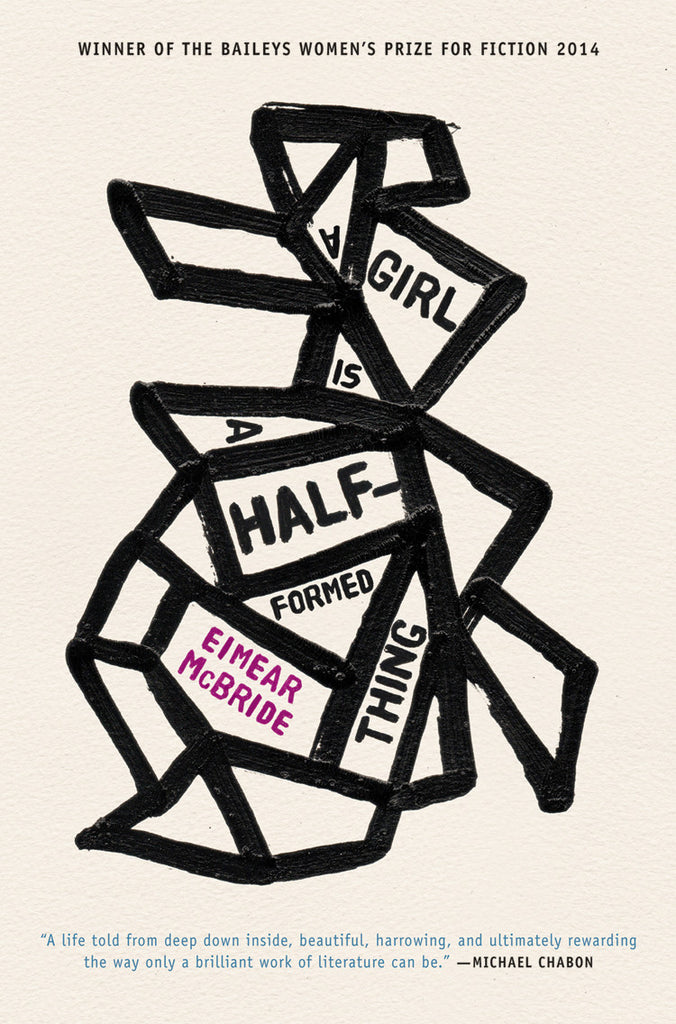
A Girl Is A Half-Formed Thing by Eimear McBride

*Some Spoilers Below*
*CW: Rape, Child Abuse* 

I struggled with this book. Oh, how I struggled with this book. You see, this is one of those self-consciously "literary" books that, when you're just not enjoying reading, seem to carry with them a sneer of "well, you just didn't understand." It was a big book a few years ago. It's trying to be Joyce and Beckett, and the writing is stream-of-consciousness jagged and not coherent. It's also a slog, ugly, mean, and as one review I read put it, it felt like the book wanted to punish the reader for having the temerity to continue.

And yet, there are the accolades. People praising it to the sky as the next big thing, a stark look at reality, and I end up wondering if I'm just too squeamish for "realism." If I want a prettier world and push away the difficult. But then, that's bullshit. I like difficult books, even books where difficult things happen - but not when it's just there to be misery porn. If this were a genre book, I'd call it the grimiest of grimdark. Grimdark has been rightly called out for pretending that horrible = real, whereas anything with hope or love or friendship is somehow fluffy and unrealistic. That is not generally the way the world works. There are difficulties. There are kindnesses too.

Let's take this in two parts - what happens in this book, and how it is expressed. For the first part, there are some things that I can absolutely see happening - turning to physical vices to cope with the pain of the terminal illness of a family member. Yup, no problem. It gets dwelt on a lot, and we get a lot of detail, and for good measure, the ongoing sexual relationship between the main character and her uncle. I am not, oh I am not, denying that such things happen in real life, nor am I saying that they can't be written about. But I am very picky in how such things are written about, and this is just one more horrible brick in a load of horrible bricks that make a horrible wall, and there's nothing more to it. There's nothing I'm seeing McBride say here that goes beyond the litany of misery.

I mean, when you have the main character raped twice (once by a stranger, once by a family member) on the day of her brother's funeral, I think we can safely say we've gone beyond realism. And if it's not trying to be realism, what is it trying to be? It's not a faithful reconstruction of the world as it is. It's not a literary evocation of the universality of women's experiences. I'm just not sure what it is.

So let's talk about how it is expressed. Most of the writing about this books talks about how it's a new version of James Joyce. (One perplexing blurb said that this was Joyce with an Irish lilt, which would be...Joyce?) And yeah, maybe. I mean I haven't read Finnegan's Wake, but I have read Ulysses, and I suppose you could make some comparison to the stream of consciousness thing, but Joyce flows differently. This is so very choppy. Then I read an article that talked about McBride being blown away by Beckett, and it clicked. Yes, this is very, very much like the Beckett I read and didn't like: How It Is. They're similar both in writing style, and in content.

Writing that review was very much like writing this one - struggling with feeling incompetent because I didn't like the book (am I missing it entirely or is this legitimately an Emperor's New Clothes situation?) and feeling put off by the sheer cynicism and pessimism of what's going on. The writing style is similar, and Beckett is trying less to capture something about life than he is about misery and it's not realistic, and it all clicked. This is so close to Beckett it's less an homage and more borrowing a voice.

So, yeah. If you've read and loved some of Beckett's more obscure work, the stuff that's really out there, then yes, you might enjoy A Girl Is A Half-Formed Thing. But I didn't like either one, and this is definitely a style or its own little genre that is not for me.

Friday, 11 January 2019

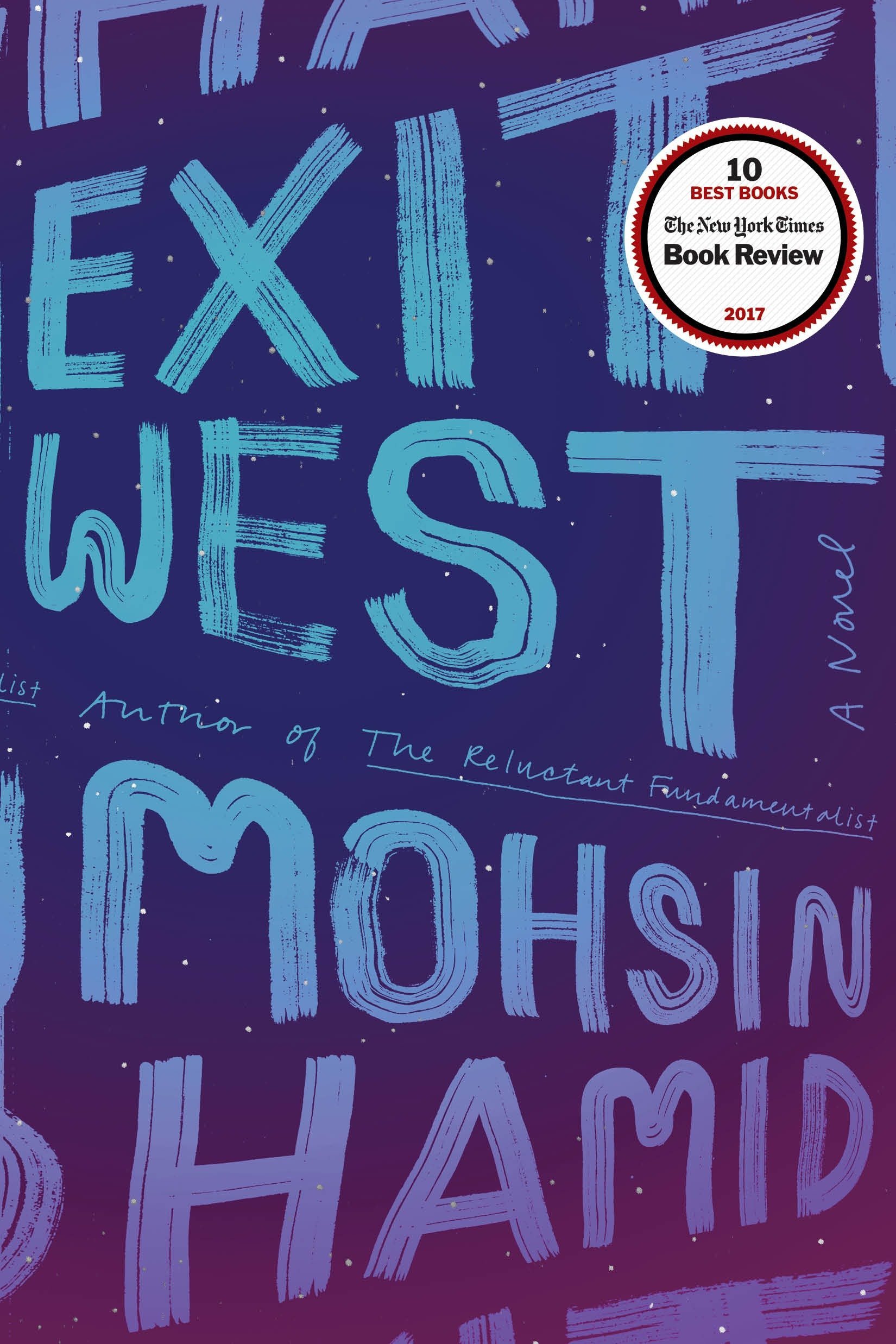
Exit West by Mohsin Hamid

It's rare that you find a book that you want to call enchanting, and probably much rarer that you'd want to apply that term to a book that is, in very real and difficult ways, about refugees and the feeling of crisis that has been developing around them. Yet, Mohsin Hamid has done that, written something that feels like a parable or myth for the modern day, with a sense of detachment that is nonetheless warm and kind. I really enjoyed Exit West, from beginning to end.

From what I remember from a few of the reviews, some people stubbed their toes on the one element of the book that is not strict realism, but since I'm a genre reader at heart, I didn't have a problem with it at all. More than that, I think it's necessary to show some aspects of this experience that Hamid would have had trouble accessing otherwise. I'll talk more about that in a minute, but I really do think that it is integral, not tacked-on or superfluous.

We start in an unnamed city, probably in the Middle East, given what we know of names and customs. Saeed and Nadia meet before the situation in their city gets too bad, at a computer class. Nadia always wears a full robe covering her, although she rides a motorcycle and is noticeably less religious than Saeed - she wears it because she lives by herself and feels it offers her protection as she travels the city. They fall for each other almost immediately.

Then the city starts to become more unsafe - militants take over parts of it, behaviour becomes more strictly policed, cell phones start not working. Without them, Saeed and Nadia have several nervewracking days when they don't know how to find each other. Bombs fall. They reunite, and Nadia ends up living with Saeed's family for a while.

Then enters the strangeness. There start to be rumours of doors that open to other places on the planet. Once they are discovered, they appear to be fixed. There is no particular rhyme or reason to where they appear, just that when you pass (with difficulty) through a door, you come out somewhere else. Because they are fixed, these can become ports of entry to other countries. In Saeed and Nadia's case, this holds the potential to take them away from the war that has taken their city. But because they are fixed, other countries can discover them too, and if you aren't one of the lucky few to get through before they are discovered, they will not necessarily lead you to an entirely new life.

In fact, when Saeed and Nadia make their way through one to their first port of call, they find themselves in a refugee camp, kept to one part of the island, the way back to their origins left open by a government who really wishes they would disappear. From there, they make two more jumps, discovering nativism and potential violence in England, and a ramshackle community being built in California, which is neither hostile nor particularly welcoming.

This all unfolds more or less gently, with Saeed and Nadia's relationship developing through it all. They are not married, the only ties those of love and the country they left behind. Saeed's father, before they left him, asked her only to help his son get to safety, not to stay with him forever. As they move through new experience after new experience, Nadia, still in her voluminous robes, paradoxically finds it easier to find herself a place in each new country, while Saeed turns more and more strongly to things that remind him of home.

This is all told sparely, but with a warm detachment rather than a cold clinicalness. Because it is all sketched so lightly and so distantly, it takes on the feel of a myth, of a legend, of a parable about our world, about where home is, what being a refugee means, how we close borders, and what might happen if we opened them.

Thursday, 10 January 2019

Swing Time by Zadie Smith

I generally really love Zadie Smith's books. They're delightful, interesting, they make me think and sometimes make me laugh. She's got such an eye for aspects of London, and how Englishness and race collide or intersect, and how the two might be negotiated. That said, though, I don't feel like I loved Swing Time quite as much as I have some of her others. It's not bad - I had fun reading it. But it's already starting to fade in my memory, which is not a great sign.  While I was reading it, I was sure I'd have lots to talk about in this review, and I've already forgotten what all those things were, which is a pity.

I don't know what I'm having trouble connecting with. I felt much more engaged in the early parts of the novel, when we were with the two leads, Tracey and the unnamed narrator, growing up in a relatively poor part of London. Both girls have one Black parent and one white one, but their living situations are starkly different - the narrator's mother is bent on learning all the theory she can, aiming at eventually going into politics (and doing so.) She is driven, and pushes her daughter hard, not necessarily seeing the spots where theory doesn't meet practice all that well. But still, it's a loving family situation, rounded out by the narrator's father, who is caring and unambitious.

Tracey's mother is more detached, more permissive, and Tracey's father is only rarely part of her life. Tracey tries to say that that's because he's one of Michael Jackson's backup dancers and on tour, but the truth is that he's often in jail. The two girls bond over a dance class, where Tracey shines, and the narrator does not. The narrator has a good singing voice, but there's no encouragement for her to pursue it.

Perhaps it's where the book veers into the narrator's adult life as an assistant to a pop star that failed to hold me. The world of pop music is not one I feel particularly close to, and this version of Madonna/Kylie Minogue/whatever is fine, but I didn't feel like it wormed its way inside me. In a lot of ways, this section feels very much like how the narrator describes this decade-long interlude in her life - detached from the rest of the world. But while the narrator is wrapped up in Aimee and Aimee's sense of self, I didn't connect with it, so when she returns from that land of the very rich and very famous, it didn't stick with me.

At any rate, much of book centers around the narrator's work as Aimee's first personal assistant, including a bunch of trips to West Africa to set up a girls' school. Aimee is heavily invested in this project, but impatient to cut through both red tape and the advice from those with experience in non-governmental organizations in the region. The narrator ends up spending quite a bit of time there in advance of each of Aimee's trips, meeting the villagers as well as the advisor to the project, a man who is frustrated by Aimee's intent to pretend that what is complex is actually simple.

Meanwhile, Tracey's life initially resulted in a few roles in musicals in the chorus, dancing, but later changes into motherhood and sending increasingly angry and unhinged emails to the narrator's mother, who is now an M.P., dating a woman, and also trying to bring her concerns to Aimee about the school, through her daughter. Everything for the narrator falls apart, as we're told in the first couple of pages it will, and she is back in London, back in a world that she's been out of for a decade, with her mother in hospice, and no friends.

It really does feel like there are a lot of good elements here, but somehow, still, I don't like it quite as well as Smith's other books. It's still immensely readable, but it's not sticking to me. I wish I hadn't forgotten those things I wanted to write about, but so it goes.

Thursday, 3 January 2019

Bring Up The Bodies by Hilary Mantel

Reviewing series is weird. Sometimes I've said almost all I have to say about the first book, and it isn't that the second book is bad, it's just that I don't have anything to add. Often, the later books are just as good, it's just not shiny and new! (Don't get me wrong, I love series, a lot. They're just hard to review.)  It's weirdly compounded when we're in Hilary Mantel territory, where this is all terribly literary, and it's not like a series where a new book is going to get pumped out every year or so. This is high brow, people, and yet.

And yet, while I enjoyed Bring Up the Bodies a whole hell of a lot, I feel like a lot of this review might be rehashing what I thought of Wolf Hall. For context, Wolf Hall made it into my Top Ten of the year in which I read it, so please, don't take this as a complaint. Bring Up the Bodies is really, really fucking good. The conceit where Thomas Cromwell is only referred to as "he" was barely noticeable by this time, and of course, this book covers the downfall of Anne Boleyn and her retinue, so you'd probably have to do a pretty crappy job to make that uninteresting.

It's more than that, though. Mantel paints her Tudor world with such skill, giving us people who are recognizable as fallible human beings without ever trying to make them 21st-century in their actions or speech. What's more impressive is that there is quite a cast of characters here, and yet I never felt at sea in their midst. That is a feat and a half. But Mantel introduces who she needs to, adds a few pertinent comments, and then links back on their next appearance so skillfully that I felt like I had a general handle on the players and situation.

She makes all these long-dead Tudors come to life. We can't know how accurate she is, but it's enough to say that it feels real, like it could have happened just like this. We see as Henry grows dissatisfied with his ten-year marriage to Anne, and grows attracted to Jane Seymour, her very reticence alluring him. Katherine grows ill, and the opportunity grows that some day soon, the dismissed Queen will die, leaving Anne's position (or, more pertinently, the position of Queen) open for a marriage that will be recognized by the Pope.

Anne can't believe that Henry's straying eyes will be permanent - she's won him back before. And likewise, her brother and those she has preferred have grown accustomed to the liberties they've enjoyed at the court. (Whether or not those liberties included the Queen's bed Mantel cleverly leaves up to reader to decide. We hear what the evidence was, both the parts that might support it, and those that might have been trumped up to free a king of a marriage he wanted to leave.)

All this comes through Cromwell, and his uneasy position in court, still disdained by those born to the nobility.  He has increasing power that could, with Anne's fall, be toppled. Or by Anne's success, threatened. There's a needle he has to thread to get himself and his household through, and he never stops scheming to do it, reading Henry as few others could, understanding all the venal and virtuous motives (mostly venal) of those around the court.

This is not a potboiler, but there's always something going on to hold the attention, and subtly, hints of something more. I enjoyed Bringing Up the Bodies a lot. If you haven't read Wolf Hall yet, you might want to, and then traipse happily along to this one.

Friday, 7 December 2018

De Niro's Game by Rawi Hage

Unfortunately, this was another book from the CBC list of the "100 Novels That Make You Proud To Be Canadian" that I really didn't like. At this point, the tally is a few books I've liked a lot, several that were meh, and almost as many that I strongly disliked. Unfortunately, De Niro's Game was one of the latter, and I can say that whoever compiled this collection has vastly different taste from mine. I'd drop the list, but I'd like to keep some Canadian content in my reading cycle. If you know of a better list of Canadian books, send it my way!

This was a book that I pushed through to the end based on spite, wanting to write this review. And also because it was relatively short.

My problems with the book are pretty much twofold. One, there are an absolutely inordinate number of references to women's tits, for no particular reason. Also legs. Also some sexual coercion and possibly rape. And none of that was the point of the book, taken seriously by the book, it was just background noise in the lives of these young men. I get that they're young men. I get that they're horny. Just trust me that even by those standards, it was excessive, like the author worried we'd forget that they were horny, even in the middle of a war zone, if he didn't mention women's breasts or thighs every other page.

The second problem was just the writing. This was so overwritten, folks. So, so, so overwritten. Sentences that had so much unrelated imagery, it practically gave me a headache. Here's an example:

"White and red meat fell from above, pieces were cut, crushed, banged, cut again, ground, put in paper bags and handed to the women in line, women in black, with melodramatic oil-painted faces, in churchgoer submissive positions, in Halloween horrors, in cannibal hunger for crucifix flesh, in menstrual cramps of virgin saints, in castrated hermetic positions, on their knees and at the mercy of knives and illiterate butchers."

I mean...I don't even know what to do with this. I just don't.

The topic of this book is interesting, but unfortunately how it is about it is all tits, thighs, and prose that made me wince. It's unfortunate. I've been told that a friend really liked a later book by this author, so maybe Hage got it all out of his system with this one?

It's the story of two young men in wartorn Beirut. Many members of their families have been killed by shelling. The city itself has its own dangers, with the militia willing to enforce itself with guns and violence, and the young men doing no less. One, George, joins the semi-military group, the other, the narrator does not, and dreams of leaving Lebanon for France. He doesn't really do a lot to do that, though, just talks about it a lot. The two try to defraud the casino controlled by the military, that doesn't go well. Other things don't go well.

There are ways in which this could have been really compelling. There are ways that this could have engaged with paralysis in the middle of overwhelming odds. There are ways this could have talked about breasts less and still left us in no doubt that this was a young heterosexual man. But no.

This book was not for me. Many books on this particular list of Canadian novels have not been for me. Someday, I'll do my own, although I certainly don't specialize in Canadian fiction.

Friday, 30 November 2018

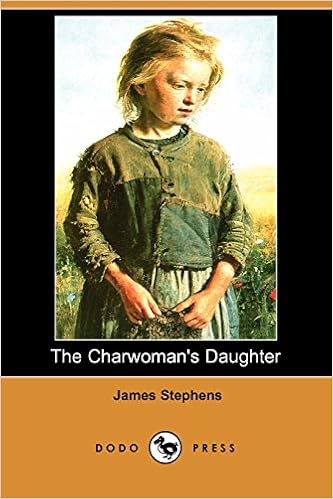
The Charwoman's Daughter by James Stephens

Sometimes, my lists just throw the strangest books in my lap. Mostly, if I'm pulling from one of the many editions of 1001 Books to Read Before You Die, I get why they're on the list, whether or not I like them. (I'm around 20% done with that one.)  This book, though, I am a little baffled by. It's not very long, and it feels like there's not a lot too it. As a look at poverty, it's no Ragged Trousered Philanthropists. As a slice of life in Dublin, it's no Ulysses. As a novel about the plight of women, it's...well, it's just a bit strange.

It does not help that the main character is named Mary Makebelieve.

I just did some research on the author, and it sounds like James Stephens is best known for retellings of Irish myths and legends, and frankly, I would far rather have read one of those. Unless this is supposed to also be one, but I'm not sure which myth or legend it would be. He also claimed to share a birthday with James Joyce, who was a friend of his, but he was likely wrong. In the end, I didn't mind reading this, but I didn't get it.

Mary is a sixteen year old girl. She does not seem overly prone to fabulizing, despite her name. She is not particularly educated, nor does she work. Her mother, as the title of the book indicates, is a charwoman, but frequently gets fired from her housecleaning jobs because she does not like employers who look down on her. She makes enough so that Mary doesn't have to work. While she is at work, Mary wanders the streets of Dublin, in a fairly innocent way.

That's pretty much her whole life - evenings with her mother, days looking in shop windows and at people as she promenades.

The first thing that changes is that she notices a burly policeman, which leads her to a fairly disturbing moment where she asks her mother if it is nice to be hit by a man. Which...kind of makes her a little dull - her mother is profoundly upset by the question, and I'm not sure what in Mary's life was supposed to give her the impression domestic violence was awesome.

She's innocent of sex, pretty much, but it doesn't seem due to religion, but more that her mother wants to keep her a little girl. She meets the policeman a few times in the park, but nothing much happens other than that he talks and she listens. He gets a bit more aggressive when she has to fill in for her mother cleaning and he sees her class, but that causes her to pull away, causing him to propose.

But that scene isn't that stressful either - Mary's mother leaves it up to her, she says she doesn't want to marry him, that's about it. The policeman does go and beat up the other young man he's seen her with, but that's about the end of it. Mary seems like she'll end up with the other young man, and that seems like it would be okay.

I have been saying "seems" a whole lot, and that's because we don't get much inside these characters, nor is the action particularly compelling. I'd guess it's supposed to be a slice of life in Dublin, but it's a pretty mundane one. And the writing isn't enough to propel me through - there's no engrossing prose to make this daily life mean something more.

In the end, I don't get it. I just don't.

Thursday, 22 November 2018

All My Puny Sorrows by Miriam Toews

This book broke me apart, numerous times. Every time I read some of it, there was a turn of phrase that just flayed the skin off my bones. Once, I sat stuffing my fist into my mouth and silently screaming, because the feelings it provoked were so intense. This is probably not a book you want to read if you've recently lost someone or are dealing with the prospect of losing someone. Unless you need that process to be seen, to find your experience reflected. This book does that. I do not think I could have read it a year ago, but I'm very glad I read it now.

Look, if you'd asked me a month ago what my top book of the year was going to be, there would have been only one candidate: N.K. Jemisin's The Stone Sky. Now there are two candidates and I do not know which one I will pick.

Miriam Toews is always an amazing author, one who frequently brings me to tears, and so it is with that in mind that I say that this is the best book of hers I've read. It is so raw, so visceral, so mundane in its capturing of the strange twilight world of hospitals and of dread and of grief. There were things I recognized on a molecular level. There were aspects of it that were not part of my experience, but which she captured so clearly and so unsparingly that I ached.

I have grief in common with the narrator (and there are certain similarities to Toews' own experiences, but I am not going to psychoanalyze what is fictional and and what is not. I'm not sure it's a useful distinction here, and at any rate, it's a fool's game.)  I have had days that rotate around the hospital, around a hospital bed.

I do not have in common the experience of being with someone I love dearly when they are suicidal. I do not know what it is like to watch them try, again and again and beg you to help them by taking them to Switzerland where they could kill themselves legally and peacefully. I do not know what it is like to be so pulled between a desire for the person to stay and a desperate knowledge that they will never want to. (I mean, I know the desire for the person to stay, but every time it's been a process where nobody's wishes had anything to do with the outcome.)

Yoli, the main character, a novelist, is with her sister, Elfrieda, intermittently, through suicide attempts. So is their mother and her sister's partner. They all struggle with wanting her to live without being able to do anything to get her to want to live. And this is not a book where it's about volition or selfishness. It's not simple at all. It's desperately complex, and the knotting up of the main character over whether or not to help her sister is brutal. To be asked to do something that would remove someone you love most from the world, to be asked in the process to damage all the relationships you would be left with afterwards, if you helped a loved one die by suicide without their knowledge. I cannot see a good answer, and it is awful.

Elf's struggle to find a way to die is juxtaposed with other sudden health crises, as the world does not patiently wait for one catastrophe to resolve before another happens. And there is a similarity and yet a difference between Elf's experience in hospital and that of Yoli and Elf's aunt. The body betrays us. The mind betrays us. The world is inexorable, and what you want has so little to do with it. Except for Elf, who wants above all to die.

It is the medical professionals who treat Elfrieda like she's being selfish, who reproach her for not getting better, not her family. Yoli and Elf have already lived through the suicide of their father, they know the terrain. Yoli's mother weathers all these losses, and one of her daughters trying desperately to leave the world, and it hurts.

It is how clear and how direct Toews' prose is that makes this devastating. It isn't flowery, it isn't trying to make this more tragic by piling on poignant details. It relies on little observations, the ways in which real life continues, in which the world is what the world is, the way the times when you are not at the hospital coexist with the times that you are. And every one of those observations is a knife that cuts.

Near the end, Yoli talks about her mother moving to live with her in Toronto, and there's a line about three women circling the wagons and coping with their dead, and I lost it. I'd lost it before, but this line cut right through everything in the world, all the grief I'd been able to carry more lightly, and made me want my sisters, made me want the women of my family and our partners, and to have us all together. We've been together, online, but I wanted so strongly to have them here, right now.

And then, of course, there's watching the Blue Jays as a grieving technique, and I know that so intimately as well. So much of this resonated, despite the different circumstances. I have rarely read a book this powerful. I don't know that my heart could take reading a novel like this often, so that might be a good thing. It is so good, and so painful.

Tuesday, 20 November 2018

Nora Webster by Colm Toibin

When you lose someone central to your life, who you are changes. It's not on purpose, not precisely, and it's not to suggest that you deformed your life around that person, but there is a truth that the people you are around do have an influence on what you do, and where you go, and who you are. It's not necessarily negative, it's just life. It's part of being part of a family  When they are gone, it's not that you flower or blossom, it's that the way you grow is going to be fundamentally different from the way you would have were they still there.

That's where we are with Nora Webster, the eponymous character in Colm Toibin's novel. Living in Ireland in the late 1960s, right around the start of The Troubles, she is a mother of four, none of them very small children, who has recently lost her husband. We only meet him through her memories of him, and one encounter that was either a dream or a ghost.

This is not a book fully of overflowing emotion and grief. It is a smaller, quieter grief, a numbness that doesn't ever entirely go away, even though Nora gradually gets to a point where it is less on her mind. Her husband died in an illness that took a few weeks, but no more. She doesn't angst over it, but that doesn't mean it doesn't cause her pain. She doesn't want to go back to the cottage they spent happy summers in, so she sells it. She doesn't agonize over it, she just does it. More on her mind is the judgement she might face from family and neighbours over disposing of the property.

We quietly go with Nora as she faces her new life - getting a job, or rather, getting back an old job, with a supervisor who hates her, working for people she went to school with, who do not know how to approach her. We see as she gradually enlarges her social circle, as well as seeing her discomfort around her own sisters, and greater comfort around her in-laws, who were there as her husband was dying, and with whom she shares the knowledge that they all know all there is to be said about that.

Her older daughters are already away from home at school and college, and figuring out what their own lives look like, while her two sons are younger, although still old enough to be left on their own if necessary. There are no stereotypical struggles here. These relationships are not always easy, but they are not always hard, either.

Nora is invited out to help score a trivia night in a nearby town, and through that, is invited to both a music appreciation society that her husband would have scoffed at, and singing lessons. She finds both difficult and satisfying, and again, I like it about the book that everything is quietly complex. Not emotionally or disproportionately difficult, but just a little bit complicated.

We also get the ways in which women in this world navigate the people around them, and how that differs from men. Everyone seems to go through a local nun, for one, if they need something communicated that, for whatever reason, they can't say themselves. Then there are divisions of class power that govern relationships, and far away, are the start of the Troubles in Northern Ireland, protests in support of which Nora's younger daughter gets involved.

This is one of those slice of life books, but it's a very particular life, in a very particular moment. It made me think about my mother, and her experiences after my father died. I think there was more obvious emotion there, but there were all the small moments that were her figuring out what her life was going to look like without my father, and although my parents had complemented each other amazingly, there were things she could then do that were not what she would have done before, and were part of her figuring out her new day-to-day. It's not an easy process, but it goes on all the time, and it's not something we think about.

Friday, 2 November 2018

Lincoln in the Bardo by George Saunders

Whenever I sit down to read the book that appeared on the most Top Ten and Best of lists of the previous year, I am a little unsure whether or not knowing the hype will harm my experience of the book. It's certainly been the case that sometimes my expectations have been sky-high, and the book merely competent. While that might have been a delightful surprise if I'd happened upon the book by accident, when bearing all the weight of the accolades, it ends up being disappointing instead.  I'm very glad to say that that is not what happened with Lincoln in the Bardo.

It took me a little bit to get into it, which is no surprise, given how experimental the book is in many ways. It is all told through voices, but not presented as lines in a play, but more like long quotes that are popped out from a text, with the speaker noted beneath. Indeed, this is introduced with snippets from histories of Lincoln's administration. I was never entirely clear on whether or not all these snippets were real or fictional, but it didn't matter to me while I was reading, as I grasped what Saunders was doing.

What we get through these historical snippets is a widely varied account of the days leading up to the days of Lincoln's son, or of Lincoln himself, They disagree on nearly every point, leading to a cacophony of opinion on the man and the events around his son's death. This is unsettling, in a very good way that destabilizes the notion of an objective account.

Then we flip to interspersed chapters in the graveyard where Willie Lincoln has been laid to, well, not quite rest. While most people who are dead disappear quickly, there are those who have not relinquished their hold on the material world, who, indeed, seem often not to realize that they are dead, because the act of realizing that would be the start of a movement away from the world, and they cling to something about what they were so strongly they will not be moved. Not right away, anyway.

These sections look very similar to the historical snippets, and for some reason, once I recognized the form of this book was going to take, it was like the whole thing clicked into place, bam, and I was in. We hadn't even gotten to most of the themes, but it didn't matter. It was that incredible feeling you get sometimes when you're reading a story or watching a movie, and this utter certainty that the creator knows what they're doing and will in no way fuck this up settles over you. It doesn't happen often. (These are often difficult stories! It's not about content, it's about this strange feeling I get sometimes that this storyteller will lead me through these events just perfectly.)

From here, the book is about grief, about shock, about the difficulties these shades have in giving up their lives. (One keeps referring to coffins as sick-beds, and other euphemisms to disguise the fact he died many years before.) In the process, they are no longer whole beings, whittled down to an idee fixe that is keeping them tied to the ground of the cemetery. Willie, being a child, should have left right away, but does not. This is partly because his father keeps coming to visit him, and even pulls the child's body from the coffin in the mausoleum to cradle him, thus shocking and impressing the ghosts.  The long-term ghosts have incorporeal bodies that are distorted to reflect what they have become, exaggerated features that evoke both obsession, and, in some strange way, the way our memories of the dead get shaped by the years.

Willie is in danger of being enclosed in some ethereal stone, trapped, and the ghosts try to free him. At the same time, we get glimpses of the Civil War, and the racism that attends even the dead, with the separate burial ground for Black men and women, and the ways in which prejudices do not disappear. In many ways, to speak no ill of the dead is to do them a disservice in all their complexity.

We also have elements of the Tibetan Bardo, as the spirits are bombarded by voices, pulled by winds, tempted to go beyond by voices that are likely not those of their loved ones. Some succumb, no one knows what waits after, and with one exception, none have the faith to make that move. (The one who has faith also has knowledge and is terrified of what lies beyond.)

Lincoln in the Bardo is such a weird and wonderful book, and I was completely engrossed the entire time I was reading it. There's so much here, so much complexity, that I will want to read it again at some point. And then possibly again.

Monday, 22 October 2018

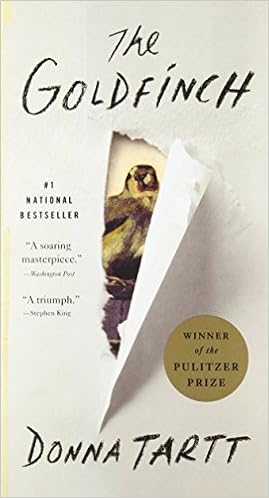
The Goldfinch by Donna Tartt

It has been a few weeks since I finished The Goldfinch, and that is not going to help in this review. I sat down and wrote a review yesterday in which the length of time was no issue, but I'm finding that this particular book is fading in my mind. That's what happens when you go on vacation with five book reviews backed up, and no real drive to write them instead of visiting friends and relaxing and doing some cross-stitching. Some books stay vivid, some start to fade.

The thing is, I enjoyed every minute of The Goldfinch while I was reading it, yet when I wasn't and had time to think about it, the less and less I felt like I liked it. The writing is good, and enjoyable, but when you stop and ruminate, not that much happens, or at least, not that much in which the main character is actually involved. And this is a huge doorstop of a book. Good writing is great, but as far as plot and character go, it gets a little rockier.

Does that make it like certain paintings? Great up close, but not so great from a distance? Or am I reaching for a metaphor to suit the plot?

This is another Donna Tartt book about the world of the rich, or rather, the outsider in the world of the rich, who is there, but not of, who doesn't have a lot of money, who is desperate to stay there, but keenly aware of the vulnerability of his position. She's good at this, and it's interesting. But it also feels a bit repetitive.

The main character is in his early teens when his mother dies in a terrorist attack on a museum of art in New York City. (I haven't retained the name of which museum.)  He was there too, and woke up after the explosions to find a world of bodies and dust, where an old man was dying. He shared the last moments of that man's life, gave him water, and was given a painting that apparently the old man had taken off the wall. Before the explosion, presumably, because he didn't seem able to move afterwards.

As Theo learns to live without his mother, first with the wealthy family of a school friend, then with his con artist/gambler dad and dad's girlfriend. He makes a friend in Las Vegas, a Russian boy  named Boris, with an abusive, mostly-absent father, and they do a lot of drugs together. Actually, after this point, you can pretty much just assume that Theo is probably doing a lot of drugs. Then his father dies, and he runs away from home so he can't be placed in the foster care system.

He makes his way back to New York City, a place that is practically a character here, and eventually, to the home and shop and workshop of the business partner of the old man who gave him the Goldfinch painting that he's been hiding since the attacks that killed his mother. The business partner is terrible at business, a kind, gentle man who makes and restores beautiful furniture. Theo lives with him, eating his heart out about the granddaughter of the dead old man, who was also present in the museum at the time of the explosions. She and Theo are both scarred mentally, but she also carries physical scars.

Theo also reintegrates into the sphere of the wealthy family he stayed with in the immediate aftermath of his mother's death, putting him closer to the world of the wealthy, while always feeling slightly insecure himself. And this is all interesting, really it is, but it's all wrapped in a bookend of an art heist gone wrong, of big things happening that...do happen, but Theo doesn't have much to do with them. In a meditative tome on loss and insecurity and trauma, do the parts with guns really add much? I mean, they do bring Boris back in, and he's an interesting character, but overall I'm not convinced they add to the narrative, which may point to there being something off about how it is structured.

This book is made up of very short chapters, but it doesn't move quickly. It lingers, and the lingering could work, I think, does work in some ways. But the juxtaposition with blood and guns doesn't do the book any favours. It's such a small part of the narrative, so little of what's going on, and when the ending does arrive, it's not as satisfying as the process of reading was.

Monday, 24 September 2018

Homegoing by Yaa Gyasi

Homegoing feels like it's both a good book (a very good book) and an Important Book, capital letters intended and all. There are ways in which that makes it a little harder to figure out how to approach a review, whereas, fluff is generally something about which I easily dash off a bunch of words. Or if a book is right in my wheelhouse and I have something to expound upon. In this case, though, I liked this book a lot. I was moved by it. I was troubled by it. I think many other people should read it. (It was near the top of my list of books most often on top ten lists at the end of the year in which it came out, so that might not be a problem? Although I suppose that "on the most top ten lists" is not the same as "bestseller.")

One of the most interesting things that Gyasi is doing here is refusing her readers a throughline, characters they can follow through the whole story. Instead, we have chapters, which alternate between two half-sisters, then between two of their children, then two of their grandchildren, on and on, for at least seven generations. One chapter per side, per generation. Chapters do not often wrap up an entire story neatly. Instead, they are a glimpse into a life for a while, a single, individual life, but also illustrative of something about the experience of Black people in what is now Ghana or in the United States.

I read one review or one comment somewhere that was about how Gyasi is focusing on Black complicity in slavery, but I kind of think that's bullshit. White demand for slaves, racism from whites that constrains life in different ways, they're all most definitely here, they're just not the focus. The focus is on Black people, far and above any way in which it is interested in exploring white guilt. Which is not to say that that person was wrong - the early sections of the book do concentrate on the practice of slaves being taken by one tribe from another tribe, and sold to the white men at the trading post for the transatlantic slave trade.

It took me a long time to figure out how all these bits fit together - the family ties were obvious, but thematically, it took me a bit to figure out why these were the stories Gyasi wove, why those personalities for each generation, why, just, in general. The answer is actually given by one of her own characters, a young Black man working on his Ph.D., but stymied about what story to tell. How do you tell this story about Blackness without also telling this one, how do you look at one piece of history without also needing to show all the pieces that came before that led to it? How do you find a landing spot? Where do you begin? How do you bring it together?

This book is one answer, of fiction, not of history. You try to tell as many as you can, but not all of them, because that risks universalizing experiences and obscuring real people who experienced all these events, through Ghanian history, through the history of being Black in the United States. So you pick moments you need to capture to tell one version of the whole thing. You don't make them all flow together seamlessly, you let them be a little bit different in terms of story, you don't make neat narrative bows at the end, except perhaps for the very end, where the two branches of the family converge.

This is very strongly written, and I was always eager to pick it up again, even when the stories were dark, or filled with fire. That connection that Gyasi is threading into her stories, insisting that these characters are connected to each other, even when they've never met, that you can't tell one story without the other is so strong, so interesting. I can't wait to see what she writes next.

Tuesday, 11 September 2018

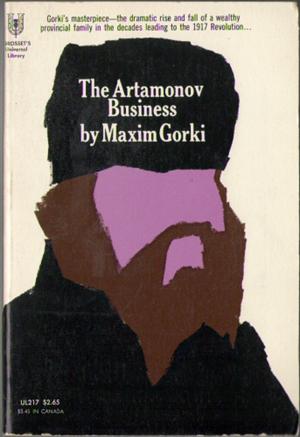
The Artamonov Business by Maxim Gorky

I have a real weak spot for Russian literature, for some reason. I have enjoyed almost all of it I have read, although I greatly preferred Anna Karenina to War and Peace. Last year, though, I made a run at The Brothers Karamazov, and although I had thoroughly enjoyed both Crime and Punishment and The Idiot, I found I got bogged down and never got through it. I mean, I was three or four hundred pages in, and very little had happened! Some day, I may try to go back, but for the moment, I'm content to let that one lie.

I had never read any Maxim Gorky, however, so when The Artamonov Business showed up on one of my lists, I was interested to see how it would compare to other works I'd read. At the beginning, it reminded me of The Brothers Karamazov in that it was about three brothers, one of whom wanted to become a monk, and the father was overbearing, if not as awful as the Father Karamazov. This, thankfully, was both much shorter, and a much breezier read. Not a light read, but any means, but not one that made me struggle.

The Artamonov Business takes place at a certain point in Russian history, when the muzhiks, the serfs, were liberated from the feudal system that had persisted to that point. In a town of roughly middle-class people, the senior Artamonov (I regret to say that the names have not stayed with me) comes with his three sons to set up a new business. He was liberated by that edict, and believes that by sheer force of will, he can prosper in this new economic system. And largely, he does, although the outcome may be more to the side of wealth than happiness.

Those in the town are put off by his manners and his insistence on doing things his own way, as he sets up a factory under their noses, marries his son to the daughter of the mayor (killing the mayor from grief/confusion in the process) and brings in workers to manufacture his goods. It is interesting to read (from Wikipedia, I'm not doing a deep dive here) that Gorky was hailed by the Communists (although he was also exiled from the Soviet Union) as a model writer, as the rise of the muzhiks is shown to be not without its difficulties. The coming revolution doesn't seem to be any more assured or confident in what it will bring. It does seem to be more and more inevitable as the book goes on, but the message is more complex that that it will just be a good thing.

The Father dies fairly early in the novel, and it is up to his sons (well, two sons and one nephew, who is treated as a son) to carry on his legacy, without ever being quite sure what that legacy is or if they want it. Peter does what his father wanted, but doesn't enjoy it, and finds himself prone to at least a few binges to let off the stress that has been building for years. The middle son joins a monastery, but appears to lose his deep faith, even as the monks want to use him as a model. The youngest, the nephew, seems more centered, I guess, but we spend the least time with him.

What laws there are and whether or not they can be transgressed, are all up in the air, and the Artamonovs are far from sure. This even extends to cold-blooded murder, which one of the brothers commits, and hides for decades, justifying it to himself in ugly terms.

I'm not sure I know enough about the time period Gorki is writing about, or in, to say anything deeper, but I really quite enjoyed this book, and can add it to the list of Russian literature that I have liked reading. Someday, maybe The Brothers Karamazov will join that list. Maybe.

Thursday, 6 September 2018

The Namesake by Jhumpa Lahiri

I feel like this is a story I've seen before, but told with more nuance and aplomb than I'm used to. The story of a young man of immigrant parents adjusting to life as an American, stuck between two worlds, it feels like a staple of a certain kind of movie, one that includes its very own tropes, including parents who never adjust or understand. The Namesake, though, neatly sidesteps the stereotypes to come up with a more complex picture that both is and is not, that story.

This is a story of pastiche, of pulling together outside and inside influences, and not about which one is right, or better, but rather about how they come to form a life as it is, not as it should be or shouldn't be. The main character, Gogol, carries some of this pastiche in his very name - the grandmother of one of his parents is supposed to send a letter with a Bengali name for him to the United States, where he was born. But the letter is never delivered, and the grandmother dies before anyone can find out what he's supposed to be called. So, in the meantime, his parents name him Gogol on official documents, after the book by Nikolai Gogol that kept Gogol's father up on a train, which saved his life when the train crashed and killed everyone in the sleeping compartments.

Carrying a strange Russian last name as his first name, Gogol fights against that name for most of his life, although it isn't as easy as being right or wrong. It marks him apart, but any other name might have marked him apart as well. His parents try to give him a Bengali name when he starts school, but a kindly teacher notes that Gogol doesn't want to respond to it, and so Gogol it is until he changes it legally as a young man, to the name his parents tried to give him as his school name. By then he will be known as nothing else to his parents and those of his parents generation, within their Bengali circle of friends, but will be known as Nikhil to his peers as he goes to college, and later, lives in New York while he pursues a career as an architect.

But, notably, the narration of the book, the omniscient third person, continues to call him Gogol. As an act of rebellion, Gogol never reads the book his father gave him from his namesake, at least not until the very end of the book. That may seem odd, but I have a similar feeling about the movie The Outlaw Josey Wales. My dad loved that movie, and while I mellowed on other things he liked, I never did watch it before he died. Still haven't seen it, and I may never - not because there's an ideological point to be made, but because the joking argument over it is part of what I still have of my father, much as I had the routine about who taught me how to swear with my mother, the call and response worn smooth by repetition.

What I think I'm trying to say is that while Gogol and his parents are never not at least partially defined by their status as immigrants to the United States, neither are they entirely confined by it. It's a story of individuals - parents who mostly socialize with other Bengali expats, but a mother who starts to work at the library and finds friends there, who is happy when Gogol has a Bengali girlfriend and wife, but is not inflexible or judgemental when things change. It's not about finding the right answer, like there is a right platonic answer that would solve everything, a way of life that would make everything turn out right. Everything proceeds from what came before, and shapes Gogol and his parents and his sister, but what comes after each moment is the product of the sum, not the life that happened before Gogol's parents even left India and conceived him.

The answer is not to date white women, but the major relationship with a white woman does change who he is. The answer is not to date Bengali women, although his marriage also shapes who he is. It's all about what life throws at a person next, and how you react in that moment, not in response to an ideal of what should be, but in response to what is. Sometimes irrational, but mostly quiet, mostly kindly, mostly muddling. There's something very enjoyable about this story, and it's the warm humanity of the characters and the avoidance of neat stereotypes for each decision as it looms on the horizon.


Tuesday, 4 September 2018

Crow Lake by Mary Lawson

There have been a couple of things that have bothered me about books I've read over the last couple of years, and I'm delighted to say that this book neatly sidesteps both of them. The first is the Canada 100 list I'm slowly making my way through - I have complained repeatedly that it's far too weighted towards the five years before the list came out, and that the books on it are frequently not very good. (Outright bad, in a couple of cases.)  And then came along Crow Lake, which is on that list, and relatively recent, but was, to my immense satisfaction, very, very good.

The other gripe I've had is thematic - I've read at least two books recently that dealt with death and grief in ways that felt off-handed and slightly flippant. They definitely felt like neither had been written by people who'd dealt with grief or known what it is to live with it, the complexities of that situation. So imagine how happy I was when this book, which started off with the death of both parents of the narrator, dealt sensitively and completely with the ways in which it both defines and doesn't define your life afterwards. They ways in which it never goes away, but that doesn't mean it's all you are, either.

There's one other thing that this book does well, before I launch into a description of the plot. I sometimes have trouble with books where you have main characters who will just not fucking say what they need to say, will avoid conversation for the sake of the plot. I wasn't sure if it was that I am too impatient with people who aren't good at communicating, or if the authors weren't doing enough to make me understand why these characters weren't communicating.

I've decided, after reading this book, that it is the fault of those authors. Sorry. I say that because this book similarly has a main character who has a hard time talking about her feelings, who has bottled up what she thinks she knows about her family and used it as a weapon, mostly against herself. And yet, it felt right this time, because Mary Lawson let me close enough to the character to understand why, the particular cracks and chips in her coping techniques that had led her to this spot. She didn't irritate me, because I understood her, and many authors aren't skilled enough, or don't care enough, to do so, and so their characters who withhold information don't feel true.

Okay, time to put these things I really liked about Crow Lake into context. It is the story of four children. First, two brothers, just done and about to be done high school, and their much younger sisters, one still in diapers. They live in Northern Ontario, and were a stable, happy family until both parents are killed in a car accident. From there, the town tries to help, but no one is sure what to do. An aunt comes from rural Quebec and proposes to take them back and split them up between families, but the narrator, the older of the sisters, is so traumatized by the prospect of losing what is left of her family that the oldest brother decides to forgo teacher's college to keep the family together.

This is interspersed with the reminiscences of the character (Kate?) as she is in her late twenties, a newly minted assistant professor of biology at a university in Toronto, and we see how this child who turned inwards and was unable to deal with any more change has calcified into a woman who has taken her need for stability and her inability to admit she needs things, and woven them into a story about the tragedy of her family. We don't get to see what the full tragedy is for a long time, and it's wrapped up with another family in the Northern Ontario town that has much more sorrow in their lives, in the midst of daily cruelties.

In particular, there is now a distance between the narrator and her brother Matthew, the second oldest boy, clever and good at school in a way that Luke, the one who stepped away from education to keep everyone together, was not. He loved the rock pools and sparked her love of biology as a girl. She resents something he's done, and we don't know why, but it has put a distance between her and her family, and so, she believes, has her education. She's invited back up for her nephew's birthday party, and reluctantly brings the man she's been dating.

The book goes back and forth between these two time periods, and you know early that a couple of things happened with her brother, but not what they were. When they were finally revealed, and revealed to be as much about her perception and even more, her expectations of him, it was deeply satisfying, particularly when she was called on her assumptions by several people.

This is not a book with a large story, but it does a stellar job at the story of one family, and how early trauma has shaped these four children, and how those children both do and do not allow more change into their lives, do and do not adapt to altered circumstances, do or do not deal with fears of losing more people they love.

Friday, 17 August 2018

Bright's Passage by Scott Ritter

This is part of one of my stranger lists, the "read-alikes" suggest by NoveList. I took my top ten lists from each of the last five years, and picked one book from the recommendations for each. In many cases, I haven't loved the read-alike, for reasons I'll go into, but once, just once, a read-alike for a book on one year's Top Ten list made it on to the following year's Top Ten list. So I persist.

I mostly persist because I loved Roger Ebert's style of reviewing movies, and I find this particular grouping of books a very strong object lesson in Ebert's Law - that a movie is not what it is about, but how it is about it. The same is true for books, and in nearly every case, I can see why NoveList picked a book as a "read-alike," but in every case, the end result is very different. The books tend to have plot elements in common, but oh, they couldn't be more dissimilar.

So imagine my puzzlement when I sat down with Bright's Passage and tried to figure out why in the world NoveList had thrown this up as a read-alike to Salman Rushdie's Luka and the Fire of Life, which is a book I absolutely loved. Eventually, I determined that it must be because, very loosely, both are about a main character going on a journey with a motley crew, including some talking animals. Which, yes. They have that in common.

Other than that, though? Virtually nothing. Rushdie's book is joyous and exuberant (but made me cry), untidy in its sheer energy bringing in so many references to so many things. There's a delight and expansiveness, even as Luka is working to save his father's life, which is very high stakes indeed, and taken seriously.  Where Rushdie's book opens its metaphorical arms to welcome the whole world in, Bright's Passage is narrower, darker, and dingier.

I do realize that Josh Ritter's book was at a disadvantage, starting out with Luka hanging over its shoulder, daring the book to be as good. It's not. It's not terrible either, but it ended up being very much not my cup of tea. There's a little too much withheld, and far too much of women just being there to enhance the main character's story - not as sex partners, which is a nice change of pace, but as potential mothers to Bright's infant son.

The book seems to be about the after effects of war, in this case, the First World War. Bright went away to war. When he came back, he stole/liberated his cousin from her father's house (where, it's insinuated but never said, she was abused by either her father or her brothers or both) and married her. She dies in childbirth just before the opening pages of the book.  We go back and forth between Bright's time in France and his first days with his son. Which are heavily influenced by his horse, talking to him.

Bright believes that an angel he saw on the ceiling of a church in France is in the horse, and the horse is the one who convinced him to free his wife. If the wife had a name, I don't remember it, which isn't great. The horse claims that the baby is the future King of Heaven, and for a while, Bright does what the horse tells him, even though burning down his house, as the horse demands, sets a devastating forest fire.

Ahead of the fire, Bright goes to a small town, and tries to find a new mother for his son, at the horse's command. He also takes a non-talking goat with him. It's unclear whether or not Bright is just hallucinating voices, but in many ways it seems likely, particularly since the horse/angel seems to be wrong about just about everything. Of course, so is Bright.  The horse wants Bright to make every woman he sees the baby's mother, but Bright is slightly more discerning. Which doesn't mean that's not what he's looking for too.

I think my biggest problem is that this just doesn't seem to come to much. Bright does eventually resolve things with his angel, but that leaves his war experience and the encroaching fire and his grief over his wife and his future life with his son open-ended questions, not to be resolved in this book. It feels like it's an artsy ending, but I didn't find it a satisfying one.

It's not surprising that a book about war and about poverty in rural areas and evil family members has no lightness about it. (Bright's uncle, who is never named such, just "The Colonel," is close to a cartoonish villain, aiming to take his grandson back from the man he thinks killed his child.) But if it comes to a comparison, the way Luka and the Fire of Life could encompass both joy and sorrow is a large part of what makes it, even now, loom large in my memory. This is just sorrow, and it's okay, but I wouldn't really recommend it.

Thursday, 16 August 2018

The Storied Life of A.J. Fikry by Gabrielle Zevin

*Major Spoilers Below*

This is a very nice book, and unfortunately, I'm not using that as a form of praise. It's a little too nice. If I laid out all the things that happen in this book, it would sound like it's rife with trauma and difficulty and life, but the truth is that the reader is allowed/encouraged to keep such a distance from the pain that it's all just very...nice.

As such, reading this book was vaguely pleasant, but leaves me with nothing much to grasp on to. And, while I don't need every book to be doom and gloom, having lived with grief myself, I do kind of resent this genteel handling of multiple bereavements that never come close enough to the reader to have any effect on them.

I need to take a step back to talk about the book as a whole, and why, although it's pleasant, I'm not sure it's particularly good.  It takes place in a small bookstore on an island, which does seem like the sort of book that would be up my alley. The book is framed with a recommendations of short stories at the start of each chapter, from the main character to someone we don't know as the book begins.

A.J. Fikry is a widow in his thirties. His wife died, and he is sunk in grief, but it's not the kind of grief that invites the reader in to share it. A priceless book he owns is stolen. A two-year-old is left on the floor of the shop and her mother is found drowned by her own volition. A.J. adopts Maya. The death of her mother is at a remove.

There is a representative from a publishing company who comes out to the island, and they flirt, and fall in love from a distance, and eventually get together, and this section is possibly my favourite, because it is sweet, and it's not sweetness at the cost of glossing over pain. (Let me say the book thinks the characters are in pain, and says so, but doesn't show so, and none of the pain seems to have much of a long-term effect on anyone.)

There are affairs of surrounding characters. Another death. But it's very sweet through all of that. And then, and here is the major spoiler, A.J. is diagnosed with terminal brain cancer. Now, let me make this perfectly clear. I lost my father to cancer seven years ago. I lost my mother to a stroke just over a year ago. I have grieved and am grieving, and will continue to grieve. It is a part of who I am, and just because I am functional in this world does not mean that I do not carry that with me, all the time.

Because I lost both my parents before I turned 40, I am particularly vulnerable to books in which parents die. Salman Rushdie's Luka and the Fire of Life has wrecked me both times I've read it. It's not hard to touch me emotionally with that particular plot point. So here's the thing - A.J.'s impending and actual death touched me not at all. At any moment. It felt, as the whole book had, rather sweet, but not real, or raw, or like it was happening to a real person or would affect real people.

Again, I don't need ugly, but this book feels like it thinks pain is best ignored and happiness foregrounded. I guess I'd rather read books where happiness is hard-won and pain is real, and both exist at the same time. If what you want is slight comforting fiction, you could do worse. But if you want anything that takes a risk, lets in an emotion, or explores something deeply, this isn't the book for you.

Friday, 10 August 2018

Narcopolis by Jeet Thayil

People recommend books to me a lot. It's hard to know when or how to fit them all in! And then there's the worry I won't like a book that is very dear to a dear friend's heart. For a long time, I just avoided reading books that had been recommended to me, unless someone pushed a physical copy into my hot little hands. (This is still the fastest way to get a book to the top of my list.) So I started a new list to read of books friends recommended. If you want to get in on this, you can recommend a book on this post.

This book was recommended to me by Chris

I wonder if it is that to get a book published when you're an Indian ex-pat author, it needs to be really, really good. I suspect that may be the case, but I have to say that by far and large, the books I've read by authors (mostly men) who come from India have been just so good. Dynamic, interesting, compelling, often very difficult. It'll be a mark of progress when you don't have to be this good to get published, when mediocrity is allowed you the same as it is allowed white authors, but at the moment, damn.


Narcopolis was recommended to me a long time ago (possibly a couple of years ago) by a colleague in grad school. I tucked it away on my list and forgot about it, more or less, but when it made it to the top of that particular list a few months ago, I was happy to get it out from the library. Then I got sidetracked by my first year of voting for the Hugos, and just kept renewing the book until I finally finished all my award reading. So this was also the first book in about four months that I was picking up not because it was science fiction or fantasy and had been nominated. It was a very enjoyable return to my more usual mix of mainstream and genre fiction.

I devoured this book. I was eager to get back to it, never wanted to put it down, and yet, despite that, I am having a hard time summing it up. This is not a book you read for plot. It is only partially a book you read for characters. But it is definitely one you read for atmosphere and prose, and on those counts, I was pulled along in a haze not entirely unlike the drugged lens the characters put between themselves and the world they live in, Old Bombay in the 1970s.

The first chapter quickly plunges you into the world in a way that is not stylistically mirrored by the rest of the book, but works to give the reader an entry - it is one very long paragraph, and I'm not even sure there are sentence breaks. It is not linear, it does not make sense, but it never feels like it needs to make sense. We are brought into an opium den with the first viewpoint character. From there, the prose gets a little less experimental, but was never anything less that intriguing to read.

I don't remember much about that first viewpoint character, because we get to know him relatively little - that he had been in the U.S. but had to return to India, that he quickly turned to opium, that he drifts between a mainstream world and this shadowy one. We see his misadventures shepherding a former enfant terrible of the expat Indian literary and artistic scene to the opium den, then leaving him there - long-term sense of responsibility not being a notable feature of his drug haze.

We get to know Dimple, the woman who works the pipe, coming from a former (and present? The timeline was never entirely clear to me) profession as a prostitute. We hear her history, including how she came to smoke opium and then to work for the Chinese man who ran the opium den in its first incarnation, after fleeing mainland China and the Cultural Revolution. We learn about Rashid, the next proprietor of the opium den, and his family, and relationship with Dimple.

This book is not a diatribe about drugs. It is not idyllic about them. It is just exactly what it is, and feels like an attempt to capture the whole experience, as closely as the author can. (Wikipedia says it's based on his own twenty lost years of addiction.)  There are dangers on the street, people become more and more desperate for the release of drugs, and newer, harsher drugs enter the scene. There are attempts at rehab, moments of cynicism concerning recovery, honest attempts and regretful changes, and reversions.

I don't think this is a book for everyone. This is another in a long line of books I've said are for people with high tolerances for ambiguity and meandering. Who are open to an experience rather than a straighforward narrative. Who want to spend time in a world where squalor is escaped from into smoke.

Monday, 28 May 2018

The Underground Railroad by Colson Whitehead

It has taken me quite a while to figure out what I wanted to say in a review of this book, and I'm not sure I'm entirely there yet. It's time to take a stab at it, though. I read almost the entire book in one sitting, which is very much out of my normal pattern, over the course of a day spent in unusual quiet and devoid of any electronic devices to distract me. I'm grateful for that. This was a book that deserved my full attention, and I'm glad it worked out in such a way that I could give it.

I had read only one Colson Whitehead book before, his take on zombies and societal trauma, Zone One. I liked that book quite a lot, without ever feeling really emotionally affected by it. In contrast, The Underground Railroad provoked strong emotion, as it should. Every time someone asked me what I was reading, I'd say it was very good, but very difficult to read.

Which, of course, it should be. This is a book about slavery, using the device of a literal railroad and a slightly (but only very slightly) fantastical journey to send the protagonist through different manifestations of racism in the United States, both during, concurrent with, and after, slavery. Much of it was gut-wrenching because it allowed no place to hide from the evils of slavery, and with a double whammy of seeing how much of the hatred, racism and pain has ripples that you can still so clearly see, although Whitehead does not make those connections overt. It was hard to escape the fact that they were there.

The novel starts on a plantation, in a location that disposes handily of the fiction that there were "good" slaveholders, and because they were not as brutal, life could be pretty okay there. No, no fucking way. Whitehead does not flinch from the violences slavery inflicts even when it's the "softer" side that some people like to imagine was the truth. This book isn't exploitative of the pain, but it is also not shy about showing it in ways that make it impossible to find bullshit excuses.

Cora lives on this plantation, relegated to a lower-status cabin, defending a small patch of land that she had planted, and her mother before her. Her mother escaped years ago, and Cora has never let go of the bitterness that she could go and leave her daughter to whatever horrors might come. Despite the owner of the plantation being the sort who'd like to avoid looking at or dealing with the violence upon which his wealth is predicated, it is still there. And when he dies and his harsher brother takes over, Cora takes a chance in escaping with another slave, Caesar, to the Underground Railroad, which, as has been said, is a real underground train system

Cora and Caesar end up first in South Carolina, then later Cora goes on to North Carolina (I think I have the order there right), and in each place, racism is not less prevalent, but takes different forms. We see the people surrounding them, vitriol and condescension, as well as those who work on the Railroad, risking lives willingly or reluctantly, to be conductors. Through all of this, there is a slave catcher on their trail, and he's known for being implacable - no matter how long a former slave has been gone, how safe they think themselves to be, they are not, and could come under his power at any time.

It was these parts in particular, that had the keenest resonance with today - different context, of course, but the way in which racism can lash out unexpectedly, the sense of danger and watchfulness, the ways in which a Black person can never count on being entirely free of it, were chilling.

I want to talk in more detail about the stops on Cora's journey, but I also don't want to spoil those bits for people who read this. The last section is heartbreaking, much as everything else, and the ending left me, at least, with questions and things to think about. This was a powerful book, encapsulating moments and kinds of racial prejudice in ways that are not precisely historical, but bring forward truths without needing them to be exactly realistic. That is, they feel real, but the settings are often a more impressionistic view of something in particular than they are a representation of a time and place. This holds an interesting ground between reality and larger themes, and the railroad holds that together in a way that works.