A Skinful of Shadows was another book I read because it was nominated for a Hugo. Well, a not-a-Hugo YA award that will be handed out at the Hugos, in this case. I get the reasoning for doing it that way, but it is confusing to write about. I picked this up during the last push to get books finished before the voting deadline, and managed to get it done with time to spare.
When it came time to do my rankings, I knew this wouldn't be top of my list. That's not to say it's a bad book - as I've been saying all the way through this process, these are very strong categories, and it's been hard to choose. But while I think this was good, it didn't vault into the realm of great in any one of a number of ways. I just never felt as engrossed as I wanted to, never really sank down into the story.
However, that aside, if you're looking for some good historical YA fiction with nary a focus on romance to be seen, let alone intense insta-love, I could definitely recommend this one. It's good, the main dilemma is strong, the characters and world interesting. It's not quite like anything I've read before, not that I'm well read in this particular genre.
This takes place during the reign of Charles I, just at the start of the English Civil War. Makepeace is raised among Puritans, but her mother never really fit in, and neither did she. There are hints in her early life that her mother is in hiding from something, but her mother is not one to share, nor one to coddle - when Makepeace starts to become aware she can see ghosts, and that ghosts attack her, her mother takes her to the cemetery, over and over, and leaves her there overnight so she can learn how to fend them off.
When she grows up, after a traumatic moment that leaves her motherless, followed by another that gives her an unintentional mind-mate, she finds out what her mother was hiding from, and to be more precise, what she was hiding - Makepeace herself from the family of Makepeace's father, rich lords, the Fellmottes, who want to hold on to power by making alliances with Charles, but are holding on to rather more than that.
Because, as it turns out, the sensitivity to ghosts is an inherited trait, and the Fellmottes have been using it in a manner strikingly similar to the plan of the old people in Being John Malkovich. And in so doing, destroy the hosts they take over - hosts who have to be their descendants, of one sort or another. Which...seems like it would suck? And give the descendants lots of reasons to rebel? Not just the illegitimate ones, the legitimate and totally screwed ones? And yet, only one does.
From here, it's about Makepeace trying to get and stay away from the Fellmottes, and coping with her newfound and growing power - and her hope to bring down her family of birth so that they can't hurt anyone else, most of all someone she cares for. (Not a romance.)
I can't put my finger on exactly what didn't grab me about this book - and that seems like it would be a feat, wouldn't it? To be able to say exactly why a particular book didn't grab me. There's nothing wrong with it that I can pinpoint, it just never took flight. Still, as it stayed firmly on the ground, at least the ground was unobtrusive and mostly interesting.
Monday, 6 August 2018
Thursday, 2 August 2018
Under the Pendulum Sun by Jeannette Ng
I haven't written all the reviews for Hugo-nominated works and authors yet, but I have now read them all and put my ballot together, which was very exciting. It's going to take me a few days to catch up on writing about the books I pushed to finish on time, and here was one of the late entries. It was also one I like a whole heck of a lot. Jeannette Ng was nominated for the Campbell Award this year, and I think this is a very strong contender in that category.
This is at least partly because this book appeals to a few very specific areas that I know about more than the average bear, and does interesting things with them. I have, of course, a well-documented weakness for fairy tales, and stories where fairies interact with the human world. Add to that a couple of well-meaning Christian missionaries, and an author who knows the theological tangles they'd get themselves into while trying to establish a mission in Fairyland? You have to know that I'm thoroughly in. Ng does a marvellous job of taking the Fae seriously and creating something unique and inhuman about them, and taking her human missionaries and their beliefs seriously and combining the two to create a marvellously twisty tale.
My one quibble, and it was by no means a dealbreaker, is that the reveals, of which there are two major ones, were telegraphed well in advance. In neither case did this spoil the twist, as having figured it out (quite easily) didn't detract from the enjoyment of seeing how we'd get there. But when the mysterious woman arose, it was quickly apparent who she was, if not why she was that way, and the final reveal about Cathy's origins wasn't hard to figure out, given what we know about the caprices of the Fairy Queen Mab. So those didn't land as surprises, but there was enough else going on that they didn't need to.
This is the story of Catherine Helstone, whose brother Laon has gone to Fairyland, under the titular pendulum sun, and moon fish, to minister to the inhabitants there, to bring the word of Christianity to truly foreign shores that can only be found by the lost. Once he gets there, communication cuts off, and Cathy goes in search of her brother. After Cathy finds her way to the shores, she finds an empty gothic castle where her brother resides. It is also the castle where the one former missionary had resided, although he died in mysterious circumstances.
Her brother is away, seeking audience with Queen Mab to extend his field of mission further than just the castle and the few inhabitants inside, who include Ariel, a changeling, Benjamin, the only Christian convert fairy so far, and The Salamander, a mostly unseen housekeeper. Catherine settles in impatiently and starts to amass the clues as to what happened to the previous minister, if not to understand them.
Laon returns, with the Queen close behind, and she is more than happy to play with the siblings like toys, wielding lies and truth with equal cruelty and caprice. How do you convert people who have no sense that they are fallen? What do you run away from, and what happens when that thing follows you? What happens when desires meet strictures and desires win? It's all woven together quite wonderfully, and I was glad I got to read this book.
This is at least partly because this book appeals to a few very specific areas that I know about more than the average bear, and does interesting things with them. I have, of course, a well-documented weakness for fairy tales, and stories where fairies interact with the human world. Add to that a couple of well-meaning Christian missionaries, and an author who knows the theological tangles they'd get themselves into while trying to establish a mission in Fairyland? You have to know that I'm thoroughly in. Ng does a marvellous job of taking the Fae seriously and creating something unique and inhuman about them, and taking her human missionaries and their beliefs seriously and combining the two to create a marvellously twisty tale.
My one quibble, and it was by no means a dealbreaker, is that the reveals, of which there are two major ones, were telegraphed well in advance. In neither case did this spoil the twist, as having figured it out (quite easily) didn't detract from the enjoyment of seeing how we'd get there. But when the mysterious woman arose, it was quickly apparent who she was, if not why she was that way, and the final reveal about Cathy's origins wasn't hard to figure out, given what we know about the caprices of the Fairy Queen Mab. So those didn't land as surprises, but there was enough else going on that they didn't need to.
This is the story of Catherine Helstone, whose brother Laon has gone to Fairyland, under the titular pendulum sun, and moon fish, to minister to the inhabitants there, to bring the word of Christianity to truly foreign shores that can only be found by the lost. Once he gets there, communication cuts off, and Cathy goes in search of her brother. After Cathy finds her way to the shores, she finds an empty gothic castle where her brother resides. It is also the castle where the one former missionary had resided, although he died in mysterious circumstances.
Her brother is away, seeking audience with Queen Mab to extend his field of mission further than just the castle and the few inhabitants inside, who include Ariel, a changeling, Benjamin, the only Christian convert fairy so far, and The Salamander, a mostly unseen housekeeper. Catherine settles in impatiently and starts to amass the clues as to what happened to the previous minister, if not to understand them.
Laon returns, with the Queen close behind, and she is more than happy to play with the siblings like toys, wielding lies and truth with equal cruelty and caprice. How do you convert people who have no sense that they are fallen? What do you run away from, and what happens when that thing follows you? What happens when desires meet strictures and desires win? It's all woven together quite wonderfully, and I was glad I got to read this book.
Monday, 30 July 2018
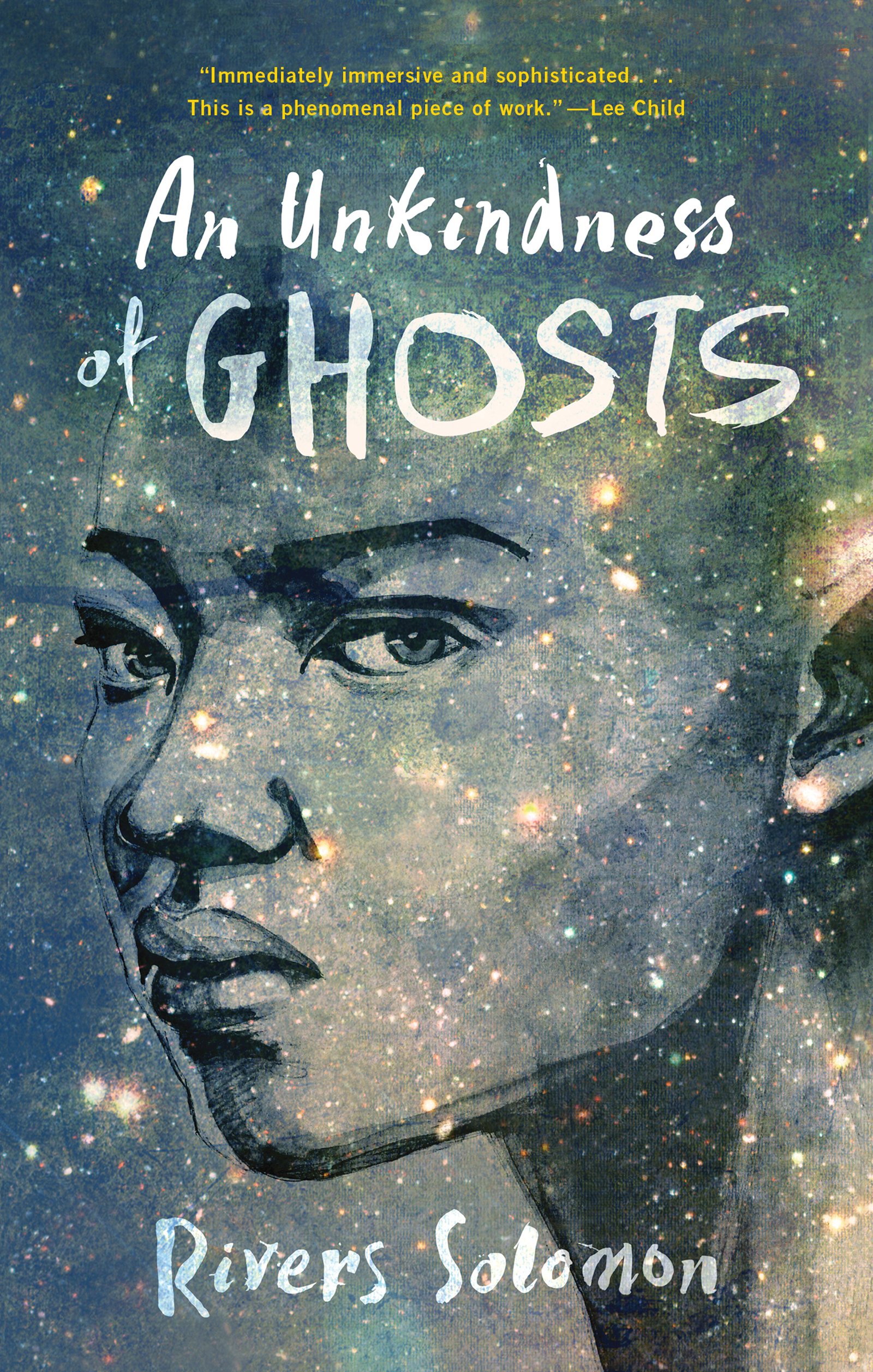
An Unkindness of Ghosts by Rivers Solomon
As of my writing this, it's less than a week to go before the Hugo voting cut-off, and I only have one book that I need to finish. And a couple of graphic novels, but I'm hoping those won't take too long. After that, I'll be able to get back to my regular reading for a while, and I'm looking forward to that. However, I have enjoyed the last few months and the frantic attempt to read all the Hugo nominees, and I'm looking forward to doing it again next year!
With that, I come to one of the last few Campbell Award nominees' works that I had to read. I had heard amazing praise of Rivers Solomon's An Unkindness of Ghosts and so I was both looking forward to it, and a little trepidatious, having paid attention to people saying it was a difficult and powerful read.
I think this might have been better had I not heard the hype. I did like it, I was moved and troubled by it, but there's a level at which I'm not sure anything short of a masterpiece could have lived up to the expectations. This didn't feel like that, but it's an amazing first novel, it is powerful, urgent, and deserves to be read, and I wish Rivers Solomon a long and successful career. I look forward to reading more of their work.
So, trying to put expectations so high it would be nearly impossible to meet them aside, what do we have in An Unkindess of Ghosts? We have a book that does not pull its punches - it is about plantation slavery on a generation ship, divided on racial lines. All of the horrors we know about plantation slavery in the Southern United States are enacted on these people who have never known any life but the ship, who have been on the ship for generations, while the white people on the upper decks live lives of wealth and leisure.
It is also the story of a neurodiverse narrator, who does not approach human interaction in the way that most people do, which seems to be both something she was born with, and altered in significant ways by the trauma she's experienced. On top of that, the narrator, and many of the characters, whether explicitly said, may be intersex, or at least the main character says at one point that on her deck, many people have...oh, shoot. It's a medical term (she's in training to be a doctor) that escapes me, but gender is not clear here, and at the beginning of the book, it's clear that different decks have different conventions for pronouns for gendering children and later, for adults.
Gender is there, a background and occasional forgrounded thing, and its woven well into the story of Aster as she lives as a slave, but with occasional moments of privilege because she is the, well, she's not sure what she is to Theo, the Surgeon General, and part of the book is the two of them negotiating desire, belief, privilege and distance in a world that is much more dangerous for Aster, although not toothless for Theo.
Add to that, there is the death of the man who is more or less a king (gender roles for the upper decks people seem to be as patriarchal as they are racist), which ties in in weird ways to the death of Aster's mother, who left behind coded journals Aster is just learning how to read.
There is, of course, much more to this story, a lot of cruelty, moments of respite, and the question of where the ship is going and if it will ever get there - and if the powerful care. The bad guys are irrevocably bad, for the most part, but I don't feel like there's any obligation to humanize slavers. I'm good with the story being firmly rooted with the enslaved, and what the ongoing institutional and very real violence does to people. It's a difficult book, it's a very good book, and I'm very glad I read it.
With that, I come to one of the last few Campbell Award nominees' works that I had to read. I had heard amazing praise of Rivers Solomon's An Unkindness of Ghosts and so I was both looking forward to it, and a little trepidatious, having paid attention to people saying it was a difficult and powerful read.
I think this might have been better had I not heard the hype. I did like it, I was moved and troubled by it, but there's a level at which I'm not sure anything short of a masterpiece could have lived up to the expectations. This didn't feel like that, but it's an amazing first novel, it is powerful, urgent, and deserves to be read, and I wish Rivers Solomon a long and successful career. I look forward to reading more of their work.
So, trying to put expectations so high it would be nearly impossible to meet them aside, what do we have in An Unkindess of Ghosts? We have a book that does not pull its punches - it is about plantation slavery on a generation ship, divided on racial lines. All of the horrors we know about plantation slavery in the Southern United States are enacted on these people who have never known any life but the ship, who have been on the ship for generations, while the white people on the upper decks live lives of wealth and leisure.
It is also the story of a neurodiverse narrator, who does not approach human interaction in the way that most people do, which seems to be both something she was born with, and altered in significant ways by the trauma she's experienced. On top of that, the narrator, and many of the characters, whether explicitly said, may be intersex, or at least the main character says at one point that on her deck, many people have...oh, shoot. It's a medical term (she's in training to be a doctor) that escapes me, but gender is not clear here, and at the beginning of the book, it's clear that different decks have different conventions for pronouns for gendering children and later, for adults.
Gender is there, a background and occasional forgrounded thing, and its woven well into the story of Aster as she lives as a slave, but with occasional moments of privilege because she is the, well, she's not sure what she is to Theo, the Surgeon General, and part of the book is the two of them negotiating desire, belief, privilege and distance in a world that is much more dangerous for Aster, although not toothless for Theo.
Add to that, there is the death of the man who is more or less a king (gender roles for the upper decks people seem to be as patriarchal as they are racist), which ties in in weird ways to the death of Aster's mother, who left behind coded journals Aster is just learning how to read.
There is, of course, much more to this story, a lot of cruelty, moments of respite, and the question of where the ship is going and if it will ever get there - and if the powerful care. The bad guys are irrevocably bad, for the most part, but I don't feel like there's any obligation to humanize slavers. I'm good with the story being firmly rooted with the enslaved, and what the ongoing institutional and very real violence does to people. It's a difficult book, it's a very good book, and I'm very glad I read it.
Wednesday, 25 July 2018
Heroine Complex by Sarah Kuhn
Heroine Complex was completely, fluffily, intensely, fun. I'm not sure it's deep, although it is pleasingly about female friendships and family in ways you don't often see, and incorporates fashion and style in perceptive ways, and is just, all around, thoroughly fun. Which is to say that I'm not sure it's going to change my life, but if I need a lift, or something enjoyable to distract me, these books will now definitely be on my radar for that.
On the other hand, I'm not entirely sure how to rank it on my ballot for the Campbell Award. Tons of fun, yes, but a few other books feel weightier. But then I feel uncomfortable with that - does everything have to be weightier? Isn't there room for acknowledging the artistry in enjoyable done extremely well? But, but, but...I don't know. This may not be at the top of my ballot, whenever I sort that out (and I have to do that soon!) but it is not because it wasn't a book I enjoyed reading. This was fluff or near-fluff of the highest order.
This book is about Evie, who is the personal assistant of San Francisco's greatest superhero, Aveda Jupiter (please tell me I'm remembering the name right.) Which is not an easy gig, because Aveda takes both the superheroing and the social media parts of her job extremely seriously, and as her actual super powers are somewhat minimal, tends to have hissyfit meltdowns over every stray trollish comment on her exploits.
Aveda is also Evie's best childhood friend, Annie, so there's that keeping Evie tied to a boss she has to manage like a small child. Evie herself is extraordinarily locked down, and we discover it's because she has much more impressive super powers of her own, that she's afraid of hurting people with. And also, her mom had died, and her dad flaked off, and she's trying to raise a bratty teenage sister who only wants to push boundaries.
Did I mention that all the characters mentioned so far are Asian-American? It's about damned time, and it's both part of the story and not part of the story at the same time - in that it informs who these young women are, but they're also themselves, and entirely different from each other. I shouldn't have to point that out as new and enjoyable, but here we are. Sarah Kuhn has written characters that feel real, and they're vivid and interesting.
I also very, very much liked how much this book referred to the movie The Heroic Trio, which is a Hong Kong action movie with three women main characters that I love very much. I don't know how those references would have landed for people who haven't seen the movie, but a) it's a great movie and you should see it, and b) I enjoyed every time it came up.
The characters in San Francisco with super powers got them the first day a demon portal opened up in town. Since then, they've been opening up with fair frequency, and Aveda Jupiter is always there to kick some demon ass, mostly by working her butt off to stay in shape so she can. But the things coming through start to change after an encounter at a cupcake shoppe, and Aveda sprains her ankle. With the help of the rest of Aveda's entourage (Lucy, her security guard, and Nate, her researcher) and Evie's childhood friend Sam, they come up with a plan to use a glamour to pass Evie off as Aveda for at least a little while.
Hijinks ensue, as of course, they do. Evie's little sister is pissed off. Evie starts to rediscover feelings, particularly around Nate, who she is supposed to find irritating so passionately it's obviously misplaced attraction. That relationship is a great deal of fun. And, of course, the demons keep on coming. And so does the snotty blogger who just loves to be catty about San Franciscan luminaries.
Nothing about this felt particularly unexpected, but all of it was done so well and so enjoyably that if you're looking for something that will make you happy and interested without feeling devastated, I recommend this book, and hopefully the rest of the series, which I will totally get to at some point.
On the other hand, I'm not entirely sure how to rank it on my ballot for the Campbell Award. Tons of fun, yes, but a few other books feel weightier. But then I feel uncomfortable with that - does everything have to be weightier? Isn't there room for acknowledging the artistry in enjoyable done extremely well? But, but, but...I don't know. This may not be at the top of my ballot, whenever I sort that out (and I have to do that soon!) but it is not because it wasn't a book I enjoyed reading. This was fluff or near-fluff of the highest order.
This book is about Evie, who is the personal assistant of San Francisco's greatest superhero, Aveda Jupiter (please tell me I'm remembering the name right.) Which is not an easy gig, because Aveda takes both the superheroing and the social media parts of her job extremely seriously, and as her actual super powers are somewhat minimal, tends to have hissyfit meltdowns over every stray trollish comment on her exploits.
Aveda is also Evie's best childhood friend, Annie, so there's that keeping Evie tied to a boss she has to manage like a small child. Evie herself is extraordinarily locked down, and we discover it's because she has much more impressive super powers of her own, that she's afraid of hurting people with. And also, her mom had died, and her dad flaked off, and she's trying to raise a bratty teenage sister who only wants to push boundaries.
Did I mention that all the characters mentioned so far are Asian-American? It's about damned time, and it's both part of the story and not part of the story at the same time - in that it informs who these young women are, but they're also themselves, and entirely different from each other. I shouldn't have to point that out as new and enjoyable, but here we are. Sarah Kuhn has written characters that feel real, and they're vivid and interesting.
I also very, very much liked how much this book referred to the movie The Heroic Trio, which is a Hong Kong action movie with three women main characters that I love very much. I don't know how those references would have landed for people who haven't seen the movie, but a) it's a great movie and you should see it, and b) I enjoyed every time it came up.
The characters in San Francisco with super powers got them the first day a demon portal opened up in town. Since then, they've been opening up with fair frequency, and Aveda Jupiter is always there to kick some demon ass, mostly by working her butt off to stay in shape so she can. But the things coming through start to change after an encounter at a cupcake shoppe, and Aveda sprains her ankle. With the help of the rest of Aveda's entourage (Lucy, her security guard, and Nate, her researcher) and Evie's childhood friend Sam, they come up with a plan to use a glamour to pass Evie off as Aveda for at least a little while.
Hijinks ensue, as of course, they do. Evie's little sister is pissed off. Evie starts to rediscover feelings, particularly around Nate, who she is supposed to find irritating so passionately it's obviously misplaced attraction. That relationship is a great deal of fun. And, of course, the demons keep on coming. And so does the snotty blogger who just loves to be catty about San Franciscan luminaries.
Nothing about this felt particularly unexpected, but all of it was done so well and so enjoyably that if you're looking for something that will make you happy and interested without feeling devastated, I recommend this book, and hopefully the rest of the series, which I will totally get to at some point.
Monday, 23 July 2018
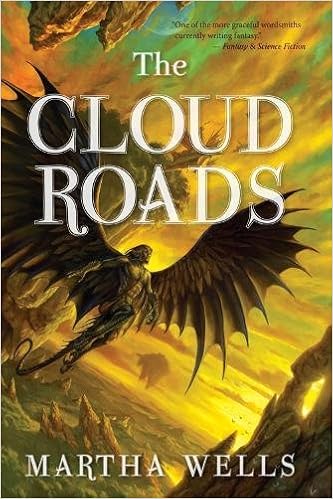
The Cloud Roads by Martha Wells
This is a hard book to write a review about, because it falls into the vast middle territory of books that I enjoyed perfectly well while I was reading them, while having absolutely no urge to seek out further books in the series. In other words, it was fine, even good, but it wasn't great. There wasn't anything I latched on to and loved, there wasn't anything that irritated me so much it became a negative reading experience. It was just...fine.
So what was it, and what wasn't it, and why does it sit in this strange middle territory that I find it very, very hard to write reviews about? It's fantasy, it's a fantasy world that is trying some new things, which I appreciate, but the ways in which it's trying them don't feel that innovative, I guess. Which is a weird thing to say, because it's easy to point to the background and the story and say that this is new. But if we're going with Roger Ebert and the "it's not what it's about, it's how it is about it," that's where this feels competent but not compelling.
That being said, we're in a fantasy land with many different races of people. The groundlings seem almost human, but not really - they frequently have very different physiological features, and that seems to not be a source of great friction, except in one case. The one case is a big one, though. There are a race of vaguely reptilian flyers known as the Fell, and you know they're evil because they carry a stench wherever they go, and kill almost indiscriminately, although they do tend to have intelligence.
Unfortunately for the main character, Moon, there are another race that are not widely known, but are physically similar to the Fell except for smell - reptilian, flyers, can shapeshift. He is one of these, having been stolen away or rescued, it's unclear, as a child. His family died early, and he's been masquerading as a "groundling," (his non-winged, non-reptilian form), repeatedly. And it sounds like, in multiple cases including the one we see, those experiments end up with people discovering he can shapechange and presuming he is a Fell, and try to kill him.
When he escapes, he is taken under the wing (literally, pretty much) of one of his actual people, who turn out to be the Raksura, an older consort travelling between Raksura kingdoms. Moon is incredibly suspicious of them, even more suspicious than it seems that he's been of the groups of groundlings he's been living with. Now, given one of those groups just tried to kill him, I get some additional wariness, but given that he's repeatedly sought out companionship despite the sudden but inevitable betrayal, the length of time it takes him to entertain the idea of staying with the Raksura never quite felt right. I get suspicion. I don't get total rejection, particularly when he's shown himself to be starved for connection.
At any rate, this is where this doesn't feel innovative. It's a well-constructed story of an outsider trying to find a place in a monarchical society, and even though thrown in is the idea that the monarch may have been compromised by outside forces, there's little that feels new. Which is not to say it's bad - it's actually quite good. It's just that there wasn't anything I was pleasantly surprised by. It pretty much went exactly the way I'd expect a fantasy book of this sort to go, just with reptilian flyers.
So, yes. It's very competent. It's not bad. I don't feel the need to pick up the next one, but if it crossed one of my book lists, I wouldn't turn away from it either.
So what was it, and what wasn't it, and why does it sit in this strange middle territory that I find it very, very hard to write reviews about? It's fantasy, it's a fantasy world that is trying some new things, which I appreciate, but the ways in which it's trying them don't feel that innovative, I guess. Which is a weird thing to say, because it's easy to point to the background and the story and say that this is new. But if we're going with Roger Ebert and the "it's not what it's about, it's how it is about it," that's where this feels competent but not compelling.
That being said, we're in a fantasy land with many different races of people. The groundlings seem almost human, but not really - they frequently have very different physiological features, and that seems to not be a source of great friction, except in one case. The one case is a big one, though. There are a race of vaguely reptilian flyers known as the Fell, and you know they're evil because they carry a stench wherever they go, and kill almost indiscriminately, although they do tend to have intelligence.
Unfortunately for the main character, Moon, there are another race that are not widely known, but are physically similar to the Fell except for smell - reptilian, flyers, can shapeshift. He is one of these, having been stolen away or rescued, it's unclear, as a child. His family died early, and he's been masquerading as a "groundling," (his non-winged, non-reptilian form), repeatedly. And it sounds like, in multiple cases including the one we see, those experiments end up with people discovering he can shapechange and presuming he is a Fell, and try to kill him.
When he escapes, he is taken under the wing (literally, pretty much) of one of his actual people, who turn out to be the Raksura, an older consort travelling between Raksura kingdoms. Moon is incredibly suspicious of them, even more suspicious than it seems that he's been of the groups of groundlings he's been living with. Now, given one of those groups just tried to kill him, I get some additional wariness, but given that he's repeatedly sought out companionship despite the sudden but inevitable betrayal, the length of time it takes him to entertain the idea of staying with the Raksura never quite felt right. I get suspicion. I don't get total rejection, particularly when he's shown himself to be starved for connection.
At any rate, this is where this doesn't feel innovative. It's a well-constructed story of an outsider trying to find a place in a monarchical society, and even though thrown in is the idea that the monarch may have been compromised by outside forces, there's little that feels new. Which is not to say it's bad - it's actually quite good. It's just that there wasn't anything I was pleasantly surprised by. It pretty much went exactly the way I'd expect a fantasy book of this sort to go, just with reptilian flyers.
So, yes. It's very competent. It's not bad. I don't feel the need to pick up the next one, but if it crossed one of my book lists, I wouldn't turn away from it either.
Friday, 20 July 2018
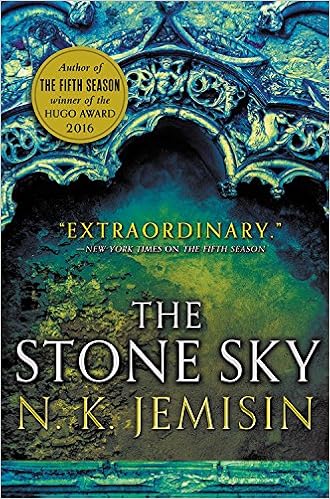
The Stone Sky by N.K. Jemisin
The Stone Sky was the last of the Hugo nominees for Best Novel that I read, and I had a sneaking suspicion that the last would be best. (Unlike one unfortunate book in this category, I had read the preceding novels and so was not jumping in blind.) N.K. Jemisin just utterly blew me away with The Fifth Season and The Obelisk Gate, and so I was prepared to be rocked.
What I wasn't prepared for was how hard The Stone Sky was to read. I wasn't expecting it to be easy, but there were sections that hurt so much, so intensely, so specifically, that there were days where I had to let it lie and wait until I felt emotionally stronger. This is not a complaint - I think this book is brilliant, I think this series is just so good, so strong, so powerful...and so painful. And at the end, completely earned, there is a spark of hope. The journey needed to be this painful to get there, but it gets there.
And it's not an easy ending, a pat answer, a way to wrap it all up neatly. It exists within and with the pain that came on this journey, and the pain does not end just because the ending has been reached. We pass traumas down, we perpetuate them, and although cycles can be broken, they cannot simply be waved away.
The book picks up with Essun and her daughter Nassun, still half a world away from each other. Essun wants to reach Nassun, desperately, but Nassun's feelings for her mother are so complicated and rooted in years of abuse done out of fear and love that the same cannot be said in return. Nassun has found someone she loves: horrifyingly, Schaffa. At least, it's horrifying if you've read the other books and know the other things he's done.
Essun, however, much she wants to make it to Nassun, is hampered both by her need to see the comm she joined, however half-heartedly, to relative safety, so that they can continue to try to build a world where orogenes and non-orogenes live side by side. Oh, and also by the fact that her arm has turned to stone during her last, monumental, burst of orogeny. With that new material as an appendage is the knowledge that any further orogeny use will continue her transformation. She is powerful, but cannot use it, unless she accepts a terrible cost.
She struggles with being part of a community when the world has taken so much from her, and caused her to deform herself in so many ways to live in it. But she is part of this one, like it or not, and finding that connection keeps her going on her way.
The story here, though, has a third part - that of Hwa, the stone eater who has accompanied Essun, and has, as it turned out, been around since the world was sundered into the condition it now has. We get flashbacks of what his life was like, as the first generation of what would become orogenes. We see the evil woven into their position from the very beginning, but I don't want to spoil who they were or what they were made for - but the repercussions of othering are there and bring the rest of the world, thousands of years later, into sickening relief.
We find out what the world is as its end draws closer and closer, and that is not metaphorical. Nassun wants to do one thing in reaction to the impending end, Essun another, and, it turns out, the planet has quite an opinion on this too. There are so many layers here, woven together so expertly, that it's mind-blowing. And it's difficult - this is about multi-generational trauma, about cycles of oppression and societies built on exploitation, and the ways in which that infests every aspect of them, whether you realize it or not.
I wasn't sure, all the way through, how bleakly this would end, and it would have earned a bleak ending, had Jemisin chosen that. But the one she did write is earned as well, in all its fragile hope for change, even in a world as hostile as the one Essun and Nassun have experienced.
This is brilliant. The whole series is just fucking brilliant. More than that, it's important, and urgent, and there's nothing else out there like it.
What I wasn't prepared for was how hard The Stone Sky was to read. I wasn't expecting it to be easy, but there were sections that hurt so much, so intensely, so specifically, that there were days where I had to let it lie and wait until I felt emotionally stronger. This is not a complaint - I think this book is brilliant, I think this series is just so good, so strong, so powerful...and so painful. And at the end, completely earned, there is a spark of hope. The journey needed to be this painful to get there, but it gets there.
And it's not an easy ending, a pat answer, a way to wrap it all up neatly. It exists within and with the pain that came on this journey, and the pain does not end just because the ending has been reached. We pass traumas down, we perpetuate them, and although cycles can be broken, they cannot simply be waved away.
The book picks up with Essun and her daughter Nassun, still half a world away from each other. Essun wants to reach Nassun, desperately, but Nassun's feelings for her mother are so complicated and rooted in years of abuse done out of fear and love that the same cannot be said in return. Nassun has found someone she loves: horrifyingly, Schaffa. At least, it's horrifying if you've read the other books and know the other things he's done.
Essun, however, much she wants to make it to Nassun, is hampered both by her need to see the comm she joined, however half-heartedly, to relative safety, so that they can continue to try to build a world where orogenes and non-orogenes live side by side. Oh, and also by the fact that her arm has turned to stone during her last, monumental, burst of orogeny. With that new material as an appendage is the knowledge that any further orogeny use will continue her transformation. She is powerful, but cannot use it, unless she accepts a terrible cost.
She struggles with being part of a community when the world has taken so much from her, and caused her to deform herself in so many ways to live in it. But she is part of this one, like it or not, and finding that connection keeps her going on her way.
The story here, though, has a third part - that of Hwa, the stone eater who has accompanied Essun, and has, as it turned out, been around since the world was sundered into the condition it now has. We get flashbacks of what his life was like, as the first generation of what would become orogenes. We see the evil woven into their position from the very beginning, but I don't want to spoil who they were or what they were made for - but the repercussions of othering are there and bring the rest of the world, thousands of years later, into sickening relief.
We find out what the world is as its end draws closer and closer, and that is not metaphorical. Nassun wants to do one thing in reaction to the impending end, Essun another, and, it turns out, the planet has quite an opinion on this too. There are so many layers here, woven together so expertly, that it's mind-blowing. And it's difficult - this is about multi-generational trauma, about cycles of oppression and societies built on exploitation, and the ways in which that infests every aspect of them, whether you realize it or not.
I wasn't sure, all the way through, how bleakly this would end, and it would have earned a bleak ending, had Jemisin chosen that. But the one she did write is earned as well, in all its fragile hope for change, even in a world as hostile as the one Essun and Nassun have experienced.
This is brilliant. The whole series is just fucking brilliant. More than that, it's important, and urgent, and there's nothing else out there like it.
Thursday, 19 July 2018
Six of Crows by Leigh Bardugo
Another heist book! The Heist theme for my SF/F themed cook club is going well - everyone seems to be enjoying the stories we've been reading, and having a lighter topic in the summer was probably the right decision. This was one of two on the list that I hadn't read, but I took a flyer on it and added it anyway, because it had gotten fairly good reviews from people whose judgement I trust.
And it was a lot of fun! It's an engaging heist story, in a really interesting fantasy world that has almost but not quite steampunky elements, with characters who are deep in the underworld for varying reasons, and want to or don't want to get out, also for varying reasons. It's Young Adult, which we agreed at the book club sometimes skewed the book in ways that we thought might have been better had Bardugo had the freedom to go all out in some areas that felt restrained. Overall, it was a book everyone liked.
One weird thing, though. My husband and I found that while we didn't always think of the characters as teenagers, it wasn't hard to think of them as young adults - early twenties at the latest. Whereas the other two people in our book club both listened to the book on audiobook, and it seems that because of the narrator, they couldn't help but think of Kaz as somewhere in his forties. It's interesting how that perspective can change based on voice versus print.
Kaz is the mastermind of this particular motley crew, a young man who has come up fast through the ranks, earning a name for ruthlessness, dispassion, and always wearing gloves, no matter what. And walking with a cane.
Wait. Before I introduce you to the crew, perhaps I should introduce you to the world? I was coming to it new, although there is a companion series to this also set in the same milieu, and, I think, published first. It feels vaguely Scandinavian or Eastern European with some aspects of industrialism, although not all. It starts in a port city, rife with crime. Somewhere else in the world, but not too far away, there were a group of people in one particular country called Grisha. (The Grisha have supernatural powers of several sorts, but I couldn't quite tell if this was a genetic heritage or a random one, and the one country just provided sanctuary for them.)
There are another group in another kingdom who hunt down the Grisha and kill or enslave them for the crime of existing. Someone has recently discovered a chemical concoction that greatly increases the powers of the Grisha while being fiendishly addicting.
Okay, world intro over. Back to the characters. Kaz. When he is brought in by the Merchant's Guild to travel to where the man who discovered the parem jurda (the chemical concoction) is being held by the Grisha-hunters, and offered a truly staggering amount of money to do so, he, of course, amasses a team. This could scarcely be a good heist book without one.
So, we have Inej, the young woman known as...on damn, what's she known as? The Shadow? The name has slipped away from me. But she's sneaky and incredibly good at climbing and thieving. There's Jesper, who is very good with guns and has worked with Kaz for a while. There's Wylan, the son of a Merchant, brought on to be good with explosives and as a guarantee his father will pay up when the job is done.
Then there are Matthias and Nina. Nina is a Grisha, one who can manipulate the body to cause emotions. Matthias is one of the Grisha-hunters. They arrived in this city together, and something Nina did right at the beginning got him thrown in prison. She's been trying to get him out since. He thinks he hates her, but we all know how the next part of that sentence goes, right? It feels a little pat, but it's well written and engaging, so I'll give it a pass.
And off they go to break the scientist out of an impenetrable fortress during the middle of the most important religious festival of the year! The heist is well done, even if I was always waiting for the sudden but inevitable betrayal. The characters are enjoyable, the action bomps along nicely, and if the YA means that all the people who obviously want to be smooching don't smooch, it's annoying but not unforgivable. There's a strongly telegraphed attraction between two male characters, but they get to be even less overt about it than the not-very-covert attractions between Matthias and Nina and Kaz and Inej.
While the heist is very satisfying, the book does end on an obvious "rush out and buy the next right away!" cliffhanger. Like, a particularly egregious one. Again, it's a pardonable literary sin, but not giving us a great resolution for one story before launching into the next is a little frustrating. So, in summary, this is a lot of fun, and the things it gets wrong are not so wrong the book becomes unenjoyable.
And it was a lot of fun! It's an engaging heist story, in a really interesting fantasy world that has almost but not quite steampunky elements, with characters who are deep in the underworld for varying reasons, and want to or don't want to get out, also for varying reasons. It's Young Adult, which we agreed at the book club sometimes skewed the book in ways that we thought might have been better had Bardugo had the freedom to go all out in some areas that felt restrained. Overall, it was a book everyone liked.
One weird thing, though. My husband and I found that while we didn't always think of the characters as teenagers, it wasn't hard to think of them as young adults - early twenties at the latest. Whereas the other two people in our book club both listened to the book on audiobook, and it seems that because of the narrator, they couldn't help but think of Kaz as somewhere in his forties. It's interesting how that perspective can change based on voice versus print.
Kaz is the mastermind of this particular motley crew, a young man who has come up fast through the ranks, earning a name for ruthlessness, dispassion, and always wearing gloves, no matter what. And walking with a cane.
Wait. Before I introduce you to the crew, perhaps I should introduce you to the world? I was coming to it new, although there is a companion series to this also set in the same milieu, and, I think, published first. It feels vaguely Scandinavian or Eastern European with some aspects of industrialism, although not all. It starts in a port city, rife with crime. Somewhere else in the world, but not too far away, there were a group of people in one particular country called Grisha. (The Grisha have supernatural powers of several sorts, but I couldn't quite tell if this was a genetic heritage or a random one, and the one country just provided sanctuary for them.)
There are another group in another kingdom who hunt down the Grisha and kill or enslave them for the crime of existing. Someone has recently discovered a chemical concoction that greatly increases the powers of the Grisha while being fiendishly addicting.
Okay, world intro over. Back to the characters. Kaz. When he is brought in by the Merchant's Guild to travel to where the man who discovered the parem jurda (the chemical concoction) is being held by the Grisha-hunters, and offered a truly staggering amount of money to do so, he, of course, amasses a team. This could scarcely be a good heist book without one.
So, we have Inej, the young woman known as...on damn, what's she known as? The Shadow? The name has slipped away from me. But she's sneaky and incredibly good at climbing and thieving. There's Jesper, who is very good with guns and has worked with Kaz for a while. There's Wylan, the son of a Merchant, brought on to be good with explosives and as a guarantee his father will pay up when the job is done.
Then there are Matthias and Nina. Nina is a Grisha, one who can manipulate the body to cause emotions. Matthias is one of the Grisha-hunters. They arrived in this city together, and something Nina did right at the beginning got him thrown in prison. She's been trying to get him out since. He thinks he hates her, but we all know how the next part of that sentence goes, right? It feels a little pat, but it's well written and engaging, so I'll give it a pass.
And off they go to break the scientist out of an impenetrable fortress during the middle of the most important religious festival of the year! The heist is well done, even if I was always waiting for the sudden but inevitable betrayal. The characters are enjoyable, the action bomps along nicely, and if the YA means that all the people who obviously want to be smooching don't smooch, it's annoying but not unforgivable. There's a strongly telegraphed attraction between two male characters, but they get to be even less overt about it than the not-very-covert attractions between Matthias and Nina and Kaz and Inej.
While the heist is very satisfying, the book does end on an obvious "rush out and buy the next right away!" cliffhanger. Like, a particularly egregious one. Again, it's a pardonable literary sin, but not giving us a great resolution for one story before launching into the next is a little frustrating. So, in summary, this is a lot of fun, and the things it gets wrong are not so wrong the book becomes unenjoyable.
Subscribe to:
Posts (Atom)