Pages

Showing posts with label humour. Show all posts

Monday, 20 November 2017

Envy of Angels by Matt Wallace

*Some Spoilers Below*

If I hand you a book and tell you it's about the adventures and misadventures of a supernatural catering company, that pitch would probably give you certain expectations. Like, this probably isn't a super serious book. That it's a little light and enjoyable, probably with some good action set pieces and plenty of banter.

And that's precisely what you get out of Envy of Angels.This book is so thoroughly what it says on the box, and that was a lot of fun. I was in the mood for something light and frothy, and this novel was never too serious, even though a lot of it is about how they try to get away with not serving up angel at a demon's peace summit.

I got this free from Tor.com during one of their giveaways of an older book to whet the appetite for a newer addition to the series, and like most of the books I've picked up that way, I enjoyed it quite a lot. In this case, I don't know if I enjoyed it enough to now go out and pick up everything else in the series, but this is very firmly in "if one of the other books comes to my attention, I would be more than happy to read it."

It's more than "liked but didn't love," verging into "thoroughly enjoyed but am not emotionally attached to" territory. If you're looking for something that's a bit caper, a bit funny, and not really heavy and you like food and weird shit going on, then this is probably a series for you. You know who you are.

To venture into this world, we're given a couple of characters to whom this is all new as well - two chefs who recently quit the restaurant they both worked at because the head chef was such an asshole. They get an offer they can't refuse, like you do, from Bronko, the head of the catering agency that secretly does most of their work catering for supernatural beings (oh, you thought I meant serving supernatural beings? Well, there's that too. These are a carnivorous group of customers.)   They come in just as the crack catering ingredient retrieval team comes back from a mission getting some delicacies that are grown in the bodies of creatures we'd rather think exist only in our nightmares.

Just then, the government shows up with a trussed angel. They'd like the catering company to serve delicacies of angel for a summit between two warring demon clans. If they don't...well, there'll be at least three powerful enemies trying to kill them all. So they decide they'll serve a fake, and discover that angel tastes a lot like...well, this world's version of Chicken McNuggets.

This sends that crack team out to infiltrate the corporate headquarters of the fast food chain, and what they find is behind the secret recipe of "Nuggies" has stranger origins than anyone has ever suspected.

Can they fool the demons? Get out alive? Escape the horrors that lie behind the corporate facade of Big Fast Food? Again, you'll know if this is up your alley. If it sounds like it might be, this is exactly what the box promises. Unlike those Nuggies.

Friday, 7 April 2017

Furiously Happy by Jenny Lawson

If you put Jenny Lawson in a cage match up against Dostoyevsky, Dostoyevsky is going down! I don't say that just because he's dead and isn't in any shape to fight, although that is undoubtedly the case. No, I speak from experience.

To wit: I had Furiously Happy and The Brothers Karamazov on the corner of my desk for most of the past month. Every lunch time, I'd get up and have to decide anew which one I would read that day. Would I be virtuous and continue slogging my way through a 900-page book in which I was on page 500 and the murder referenced on the back cover hadn't even happened yet? Or would I give in to the book that I wanted to read, that didn't tax my wrists with its sheer weight, that made me laugh out loud so hard every lunch I'm sure most of the people in the building complex where I work think I'm missing a few marbles?

I'll let you guess which one won.

I finished Furiously Happy quite happily and consigned The Brothers Karamazov back to the library, uncompleted. I don't know who did it. I only vaguely even know what "it" is. Move over, Russian classics! There's another book in town. And this one has a delighted taxidermied raccoon on the cover. I'd like to see you do that, Dostoyevsky!

(I should also state that while I was reading this, I'd loaned my copy of Let's Pretend This Never Happened to a coworker, and she came in every morning telling me which hilarious bit she'd read the evening before.)

Furiously Happy feels more personal, even, than Let's Pretend This Never Happened, probably because it's closer in time. Lawson is frequently letting people in on recent and ongoing issues with her mental health and body, and there's a vulnerability there that makes the humour sharper and more poignant.

But, of course, there are also stories about someone sending her a knitted vagina, and and a trip to see koalas in Australia while dressed like a koala, and more amazing discussions with Victor. It's so funny, and yet it's so jagged around the edges in a very good way, because the humour doesn't mean that the difficult bits aren't there.

It is exactly the sort of book where you read it voraciously, and know full well that it'll make you look slightly unhinged in public as you laugh while trying to eat soup and almost cause a catastrophe. (Just me?) Where you can't wait to get back to it every day. Where, when put up against The Brothers Karamazov, it's an easy choice.

Sorry, Dostoyevsky.

Wednesday, 19 October 2016

The Third Policeman by Flann O'Brien


This, uh, certainly was a book. A strange, confusing book, about people meshing with bicycles and one-legged men, and a house that seems to exist outside of time, but needs constant tending of the valves lest something drastic happen.

It all comes together at the end, kind of. In that the hallucinatory nature of the book is sort of explained, but even with that, I'm not sure why these were the thoughts that came into the narrator's mind, instead of others. If that's the explanation, the answer seems to be that dreams are just made up of random firings instead of any meaning.

Which is fine, but when you stretch that out to book-length, it does go bafflingly on.

The main character seems to come from a long British heritage of characters who somehow managed to grow up utterly clueless and inept about virtually anything or everything. He lives on his family farm, which seems to be getting winkled out from under him by his main help.

The man who is taking over his farm hatches a plot to kill and rob a rich old man in the district, and the two do, but then he seems to be alive again, and then...then the nameless narrator goes to the police with a false story to try to get their help in finding the lockbox he killed to steal. The policemen are more interested in bicycle thefts in the district, and turn out to be responsible for them, to prevent bicycles and humans from exchanging too many atoms.

No, I'm serious.

It's a strange surrealist romp, it's short, it's not hard to read. It's a bit baffling, but not in a bad way, I suppose. I didn't feel edified at the end, or even distinctly amused. It was amusing while I was reading it, but it seems like a studied attempt to reject meaning, or even to mock the search for any kind of meaning afterwards. Almost like it's the kind of book written to intentionally torment English majors.

At the start, I was frustrated by the gormlessness of the main character, who apparently went away to school without ever learning any of the rudiments of how to notice anything in the world. I tend to find that extraordinarily unlikely - there might be glaring gaps, but it's hard to grow to adulthood completely oblivious about every fucking thing. Even Neville in Harry Potter grew the fuck out of it. 

I've noticed it before in English literature. It makes me think of the narrator of The Wasp Factory, but that character was purposefully shielded from learning anything about the world in any substantial way. Or Adrian Mole, except Mole may be clueless, but he's not quite this this clueless. 

As it became more and more apparent that this was a comedy and not to be taken in any way literally, that irritation subsided. Still, I read the whole thing, and I can tell you what happened, but I'm fucked if I can tell you what it's about.

Wednesday, 18 November 2015

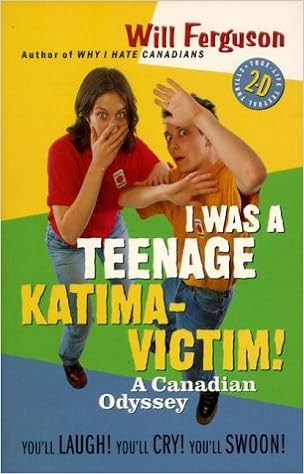
I Was A Teenage Katima-victim by Will Ferguson


I remember when this book was all over the place in the bookstore at which I used to work. (Possibly since it was shelved in the humour section, and that was the section that bred a certain kind of situational dread. Many humour books are big and floppy, and prone to falling on your head as you adjust other books on the shelf. I developed a strong flinching instinct in that section. It did not save my poor head. 

Now, however, it's a hard book to find, which is made more difficult when it's a book club pick. We're having to pass around one or two copies, as the library has none, and neither do any of the local used bookstores. That is kind of astounding to me, although perhaps a good sign - people are keeping their copies that used to be so ubiquitous?

At any rate, I was able to get my hands on a copy, a month early, thanks to the book club member who chose it. I had stubbed my toe hard on Ferguson's entry into the straightforward novel genre, 419, so I wasn't sure what I would make of something else by the same author.

Luckily, I discovered that his humour is much more palatable than the implausibilities of how Canadian authorities would react to someone being scammed. I ton't know if Katimavik was in operation when I was a teenager - if it was, it didn't really make an impact on my consciousness, but I saw a post on Facebook just yesterday, calling on new Prime Minister Trudeau to reinstitute it.

After reading this book, I'm not sure I would disagree, although given some of the stories of some of the conditions, I wonder how well it would fare when any amount of discomfort for people used to being comfortable is quickly seized upon.

On the other hand, I think a bit of discomfort for the regularly comfortable is instructive. Not verging into danger, but, you know, roughing it.

Will Ferguson relates his year in Katimavik, and while it sounds like maybe it wasn't the source of life-changing insights, there are certainly much poorer ways to spend a year, and while the value may be hard to pin down, that doesn't mean it's not there. At least, that's my feel. This is certainly not a picture of Katimavik as a source of deep spiritual or political significance. But still, not meaningless.

It's a story of seven young people, who frequently want to kill each other as they work cleaning up antiques for a museum in Kelowna, work with old people in St. Thomas, and build an "amusement park" in Quebec. They live together, fight, eat way more pasta than I could stomach, cook, argue, and do all the things you'd expect people in their late teens or early 20s to do.

I think the book was picked because a third of it takes place in St. Thomas, where the person who picked it lived. Will Ferguson apparently got there right before the Jumbo statue was unveiled, and gets a great deal of mileage out of the main tourist attraction being that it's the place an elephant got run over by a train.

But hey. When I was little, my grandmother took me to see the Jumbo statue. She bought me a coin with Jumbo on it. And nowadays, there's a microbrewery in St. Thomas that makes Dead Elephant beer. So it hasn't gone away as a claim to fame.

I enjoyed  I Was a Teenage Katima-victim far more than I did Ferguson's later, literary exploits. It's snarky, even though the youthful jackass does shine through. I'm glad I got to read it, now that it's in no danger of falling off a shelf and hitting my head. 

Wednesday, 22 July 2015

Seriously...I'm Kidding by Ellen Degeneres

I am seriously considering giving up on those painstakingly compiled (by me) Globe and Mail bestseller lists. I was doing it with the best of intentions, trying to make sure that I was still reading a certain number of books every year that other people were likely to have read. But over the last few months, I've been finding myself more cranky about it than happy. I also found a new way to come up with a year-end list of popular books, and it looks like it's yielding more interesting choices.

Because, quite frankly, a good number of bestsellers have very little content worth speaking of. Some of them are worth reading. A great book can absolutely make it on the list. The problem is, so can a lot of really mediocre books, and I'm just tired of it. (It may not help that I've got three other bestseller list books out from the library right now. I'll finish them, then ditch the lists.)

Which brings me to Ellen Degeneres' book. The problem here is not that it's bad. It's that there isn't anything to it. It's written in her voice, I could hear her in my head as I read it. And two days after being done, I don't remember a thing. This is fluff of the highest order, with absolutely no insight into herself or her life, just little funny sketches of a couple of pages. Sketches, however, of very little depth either, very little to remember.

I think there were a couple about not having children? A bunch about the show? Faux self-help stuff, which was amusing at the time, but has entirely fled my brain?

Ellen has made a career of being nice and accidentally talking too long then backtracking. That's her schtick. That's what's in this book. It's fine, it's just...I spent hours reading this, and feel like I was reading cotton candy, with about that level of permanence.

There's nothing wrong with that, if it's what you're looking for. If you like Ellen, this book captures her voice very well. But I am frustrated with it. I want more, some insight into the human condition. Even in a humour book, dammit. This was even more ephemeral than some of the other humour books that I've read and didn't tickle me in the past year or so. (And far more ephemeral than the couple I really liked, and which have stuck with me.)

I'm being overly critical of a book that is exactly what it's supposed to be and absolutely nothing more. The fact that it's making me this cranky is exactly why I'm giving up on those lists of the books that spent the longest time on the Globe and Mail bestseller lists in a given year. It's time to move on. I'm excited about the new method I have to compile a list of recent books, and time to let this one fall by the wayside.

Friday, 12 June 2015

A Dirty Job by Christopher Moore

This is maybe the third or fourth (or fifth?) Christopher Moore that I've read, and I've had varying reactions to them. A few I've really enjoyed, a few others have seemed to be straining too hard for a chuckle, without enough meat to them to make them a pleasant meal if the jokes don't whet your appetite. This one, fortunately, weighs the scale down more on the funny and substantial side.

Still, I am not finding them gut-bustingly hilarious. There are some good jokes, there are some amusing sequences, and the oddly matched taxidermied animals amused me greatly, but from far and large, this was more gentle smile territory than laughing-out-loud-alarming-my-husband fare. Which is okay. I have that reaction to a lot of humour writing. I respond much better to verbal humour, not so intensely to written.

The reason I think this one works better for me is the emotional core of it. Sure, the main character is a bit of a bumbler (or as Moore likes to repeatedly call it, a Beta Male), but he has suffered major loss and is trying to go on living as best he can.

So, the plot. Soon after his baby daughter is born, Charlie runs back into his wife's hospital room, only to find a strange man there, and a dead wife. The first part of the book deals with the genuine emotional impact of this, Charlie stunned by the medical fluke of the death of his wife, while trying to figure out how to keep this new small pink thing alive.

Then he discovers that the reason that he could see the man in his wife's room was that he, Charlie himself, is about to become like him, not quite Death, but someone who finds objects into which people put their souls and claims them around the time of death. Then, through his second-hand shop, he makes sure those souls find new homes.

Which is intriguing, the idea that most people are walking around quite happily and functionally without souls, but that there is a steady movement of souls around. We're never given a good explanation between souled and soulless. (What is is with authors refusing to actually define this? I'm looking at you, Gail Carriger.) I wish that was gone into in detail, because it's obviously not as simple as souled=good, soulless=bad.

At any rate, when Charlie messes up, strange voices start to hiss at him from the sewers, threatening all sorts of bodily mayhem. He eventually learns that what he does helps keep the world in order, and it would be bad if he didn't. Charlie becomes convinced that he himself is the big kahuna Death,  who has been absent from the world for a long time.

(The actual answer to this is a twist that is so obvious from the first few pages that I really hope it wasn't supposed to be a surprise. Because there's some pleasure in watching Charlie totally, consistently, and in a manner that owes a lot to Good Omens, miss the point, but I really hope the author wasn't expected his readers to miss it too.)

So it's a book about grief, wrapped up in a book about small taxidermied animals in fancy-dress, creepy Celtic goddesses in the sewers, and hellhounds that eat soap. It doesn't feel like there's another leap there about death more generally, and that would have been even better, but if we're merely talking about Charlie and his journey through a world made strange by his wife's absence, that's certainly enough emotional punch to carry this one through, to give some satisfaction when the jokes don't quite make it.

Wednesday, 27 May 2015

Let's Explore Diabetes With Owls by David Sedaris

This is the first David Sedaris book I've read, and I'm left with a mild grin. It was entertaining enough, there were a few lines that made me laugh, but overall, I certainly wasn't blown away. It's the sort of thing you can read in short gulps and not really end up remembering much at all. Remember when I've talked about not always enjoying written humour? This would be another good example of that.

Also, I have a strong feeling that any future writing about taxidermied animals should really be left to Jenny Lawson, as she has pretty much cornered the market in hilarity on that subject. This was brought home more by how hard I laughed at her blog post about Vincent Van Goat this past week, so in comparison, Sedaris' relatively mild strange encounter trying to buy a stuffed owl for his partner just doesn't quite add up.

I think a lot of it is that there there doesn't seem to be any strong emotion behind this humour, and I'm a big believer that neither comedy nor drama just happens. Both emerge out of someone wanting something very badly, and whether it's comedy or drama depends on how it is done and what happens on the way. Comedy based on just kind of drifting through life...I don't know. I don't get it.

Still, there's nothing off-putting about this collection. Sedaris' misadventures are amusing enough, but I finished this only a day or two ago, and it's already feeling like they're drifting away.

On the other hand, a couple of the stories did tickle me - the one about his father mistaking one child for another one who had bullied one of his children, and then making him eat terrible freezerburned ice cream to make up for it, that was amusing.

And most of the little vignettes that were fictional people writing essays, those were often more pointed and funny. Taking aim at some of the worst aspects of people, in this case Americans, was done well, and those often had a drive to them that Sedaris' own life seemingly did not.

And the essay about the French dismissing the possibility that Obama could actually get elected. There were some truly great moments in that one, including a bit about being resentful that American conservatives were acting like they were the ones who'd invented truly hating a President.

Overall, I wasn't sorry I read it, but it didn't leave me feeling eager for more. Another one of those authors that I don't think I'll avoid if one of his books pops up on my lists, but not one that I'll seek out. It's humour, but it's not quite my kind of humour.

Thursday, 23 January 2014

Handling Sin by Michael Malone

This is an exuberant, raucous, Drunkard's Walk of a book. It's the kind of book words like exuberant and raucous were coined to describe. And I loved it.

There is a huge, entertainingly flawed, and distinctly memorable cast of capital-C Characters. The story weaves all over a good portion of the southern United States. The plot veers crazily as well. This is a book you have to go into just wanting to be entertained, and willing to let the author take his own sweet time.

The main character is Raleigh Hayes, and as far as he's concerned, he's the only sane man in a family of careless, irresponsible flibbertigibbets. (I can't believe I finally got to use that word!) On the other hand, Raleigh regards himself as the paragon of normalcy. He runs his own insurance business, has a wife he loves and two daughters who are, disconcertingly, hitting adolescence, hard. He goes to the right church and belongs to the right civic clubs. He has well and carefully invested his money.

His life might have been thrown for a loop when one daughter started racing stock cars and the other aspired to be a Valley Girl, or when his wife became the very public spokeswoman for Mothers of Peace, and started to contemplate running for office.

Might have, that is, if his father, Earley, hadn't just the day before broken himself out of the hospital, withdrawn what Raleigh regards as his future inheritance from the bank, bought a new Cadillac and hit the roads with a young black woman no one had ever seen before. And left behind a laundry list of bizarre tasks (including stealing a plaster bust from the library) that needed to be done before Raleigh can bring everything to New Orleans in two weeks time and can retrieve his father and his inheritance.

On the way, he brings along the neighbour and best friend he always thought of as ineffectual, and ends up seemingly involved in finding his reprobate brother, a murder, a break-in, a jail break, drug running, conning wealthy Southern women out of fur coats and money, delivering a baby, taking down the Klan, a gunfight at an amusement park, a search for buried Confederate gold, and a duel. With swords.

Some of those things he actually did, others he was just near or accused of. I'll let you figure out which!

This book is hilarious. But what I haven't gotten across yet is how tender and heartfelt it is. About those sneaky messages about family and love and acceptance that sneak in behind the scenes. And by the end, Raleigh realizes that order doesn't necessarily bring you control, and maybe, just maybe, a little chaos is good for the soul.

I highly recommend this one. In fact, the only thing I didn't like about it was the title.

Friday, 3 January 2014

Areas of My Expertise by John Hodgman

I dunno, maybe I just shouldn't read humour. American humour anyway - British humour I am perfectly capable of sitting down and reading and laughing my ass off. But most American humour, in written form? Not so much. At most, there's a wry smile, a "that was kinda fun." I'm quite sure it would be different if I'd heard this read aloud, which people told me (too late) was the way to read Bossypants.

So there's a dear friend I'm about to disappoint greatly when I say that, yeah, I enjoyed Areas Of My Expertise, I guess. (He loaned his copy to me, and I did have fun, honest!)

But I didn't laugh. Well, maybe once or twice in the chapter on the States, which was, to me, by far the funniest section of the book. The rest was a fun read, but not a funny one. Something about humour just flies right over my head when it's written out, and that's okay, if there's a really good storyline to pull me along, but this is just a mishmash of funny, and so, here we are.

It was okay. The stuff on hoboes was fairly amusing, and some of the bits on history.

What's wrong with me? Why don't I read books written by American humourists and find them funny? I like John Hodgman, honest I do! What am I missing in the voice that's reading in my head that I don't seem to miss if it's Douglas Adams or Terry Pratchett? What is it that makes that humour different?

Something to think about, anyway.

At any rate, John Hodgman talks about the Areas of His Expertise, which range from hoboes to the States to the Mall of America. It's pretty off-the-wall, and topsy-turvy. Sometimes it felt like it didn't go far enough, though, that it was silliness but stayed close to the truth to sound like facts without being facts, when really what I wanted was for some of these funny ideas to be followed through to their truly ludicrous conclusions.

I really wouldn't trust my opinion on this, though. As I said, I seem to have issues with reading funny. If it's American. Also, apparently the audiobook is fabulous and quite different? Maybe I'll check that out and see if it's different when I'm listening and can hear intonation and delivery.

Sorry, dude. It's up there as one I sort of liked, but definitely didn't love.