I find writing reviews for books of short stories really hard. I read quickly, so I tend to burn through a story before it's had time to seep into my long-term memory. This means that I'm not doing the kind of memory reinforcement that happens when I read a novel over several days - each new day helps consolidate things about a book in my head. With short stories, that second crack at it never comes, and I'm not really interested in reading each story twice just to combat this.
In other words, short stories aren't really my favourite fiction conveyance. I do like some short stories, but they have to be really boffo to stick in my head. And when you read a whole bunch of them, and then sit down to write a review - particularly when you read another book of short stories just a few days before, and find they're blurring together in your mind...I'm just saying, it's not the easiest of tasks.
Of course, no one is making me write this review, or even making me read this book - both are things I freely and willingly chose. So let's get down to brass tacks and try to figure out what I thought of Howard Who?
Let's start this off by saying that I didn't have the same trouble with his female characters that I did with Mike Resnick's. Most of the stories are focused on men, but when the women appear, they are more interesting and varied, less caricatures. In fact, most of his characters have more to them than caricatures, given the space restraints inherent in short story writing.
Still, there were a couple of stories that I found troubling - not troubling as in "this makes me worried about the author and his viewpoints," but more "stories that made me uncomfortable and stuck with me." That's compounded a bit since both of those stories were about Jewishness - one is about a vampire attack in Germany that Hitler and his cronies use as an excuse to start the horrors of the Holocaust, and another about a Jewish elite time travel team that have a terrible, cruel plan they are carrying out in order to put their leaders in the present in the best possible position. I am not entirely sure what I think of either story, and I'm not entirely sure that what I got from them was worth the distress of reading them, but...I just don't know what I think yet, and will need quite a bit more time to mull it over.
But let's talk about the rest of the stories! They are mostly very fun! The first one in the book is about The Ugly Chicken, which is apparently his most famous story, and was a whole barrel of fun. It is about a...dammit, the word for scientist who studies birds is escaping me...bird scientist who runs into an older woman on a bus who identifies the dodo in the book he as looking at as one of those "ugly chickens" her neighbour used to have. This sends the scientist on a goose chase through Appalachia, trying to find out if the dodos really do still exist. The kicker to this story is delightful, if a little depressing. It does feel quite right.
There's also a lovely story about 19th century inventors who discover that one of the crackpot inventions that didn't work in our timeline does in theirs, with terrifying results. And one about a post-apocalyptic society where tractor pulls settle serious disputes, another with alt-history where Eisenhower was the musician and Elvis Presley the politician, and yet another where sumo wrestlers fight telekinetically, and the last, sad and yet hilarious story where Goofy, Donald, and Mickey go searching for a time capsule to tell them where all the humans went.
Most of these stories are humorous, but with an underlying elegiac, even mournful, undertone. Outside of the two stories that unsettled me, the rest were quite delightful.
Showing posts with label short stories. Show all posts
Wednesday, 20 September 2017
Friday, 15 September 2017
First Person Peculiar by Mike Resnick
I picked up this collection of Mike Resnick short stories in a Humble Bundle a while ago - I'm not sure which one, but I'm guessing the Nebula bundle, as I believe at least one and perhaps more of these stories were nominated for and/or won that award. Weirdly, I read this in close proximity to another book of short stories by another author that came in the same bundle, and the two started to blend together in my head.
So, not having read any Resnick before, what's the verdict? The first thing that strikes me is that a lot of these stories are genuinely funny. Resnick tends to have a humorous touch, even when the stories themselves get a little dark. They're often about incorporating elements of other genres - hardboiled detectives, heists, Casablanca, romantic comedies - into a science fiction (and less often, a fantasy) world. A lot of these I really enjoyed.
That's the good side, and we'll get back to it when I talk about a few of the stories I really enjoyed. The not so great side is that, well, his female characters are not great. I mean, most of the characters in these stories are kind of caricatures, so I'm not looking for deep understanding, but after we got through the second Jewish mother, the Jewish American princess and the fourth or fifth dead hooker...well, it felt like even for caricatures, the women were getting absurdly short shrift. Particularly the dead hooker aspect. (Three of those turn up in a story about Jack the Ripper, but it was only shortly after a spooky little story where violent criminals have their minds wiped and are supposed to be unable to regain memories, but one guy does, and starts his new killing spree with...you guessed it.)
It's unfortunate, because otherwise, I would have thoroughly enjoyed myself. A lot of these aren't deep (although a few are), and I can definitely be sucked into enjoyable little short stories. If, you know, the humour included fewer dead prostitutes and parodies of Jewish women.
If you can put that aside, (and I mostly can but not entirely,) I did enjoy the rest of the stories. They sometimes play with religious ideas, such as Resnick's take on the Wandering Jew of legend, and his actual enjoyment of an incredibly long life, or the later story where the Creator turns out to be a not-very-bright student in a galaxy creation class.
And many of his stories exist in interaction with popular culture, like the one where Rick Blaine is hoping to finally get the girl THIS TIME the movie comes around on the eternal reel. Or the one where a guy winning a lot of money gets mobbed by a host of gold-diggers (sigh), each with their own magician to help them turn the odds in their favour. Or the one where a hard-boiled detective is sent off with a beautiful dame in search of the sheet music for Leibowitz's Canticle, except the dame has plans of her own. And the last story, where John Carter shows up in an aging man's backyard, searching for the way back to Mars, and the narrator, having lost his own wife, beings to hope maybe she's out there with Dejah Thoris somewhere.
But I think my favourite story is a fairly short one where a travel agent robot is programmed with enthusiasm, and then gets up and walks away from his desk one day. It's short, and powerful, and the ending a bit depressing. It's one of the strongest stories in the book.
On the overall topic of recommending the book or not, though...I don't know. If you have a lot of time and love short stories, and can hold judgement on gender stereotypes in abeyance, maybe. Otherwise, there are a lot of great short stories out there. There are some really good ones here, but also some stuff that made it less thoroughly enjoyable than I'd have liked it to be. (AKA write about fewer tortured and murdered prostitutes in your funny stories, thank you!)
Wednesday, 24 May 2017
The Bread We Eat in Dreams by Catherynne Valente
When I started to read this book, just a few weeks ago, I had a mother. By the time I finished it, I didn’t have a mother anymore. I’d been orphaned at age 39 just as surely as any of the children in any of the fairy tales that Valente is riffing on, often brilliantly, in this book.
And yet this book will remain forever entangled with the last few weeks in my memory. I started reading it on the train to be there for my Mother’s surgery, surgery that didn’t have precisely the outcome we wanted, but which still was an answer that gave us a lot of hope and years.
I read about Coyote in a small-town America high school, about a detective who finds which story you belong in, and many other stories as I sat in the hospital room in between fetching warm blankets to keep my mother warm and take care of her, while my sister tucked her in and washed her face. I read about a demon expelled from Hell to New England and the struggle for the Bride of the World as we started to think about chemo and radiation, how we would be there for her and her new partner through difficult times.
And although this review is going to be largely about what I’ve gone through, let me say that these stories were the perfect damned accompaniment, entertaining and thought-provoking.
I returned home to my husband reading a brilliant Handmaid’s Talesque take on a Nuclear America with McCarthy as president, and a world above the clouds where words were not the words they meant. Another place where wolves stalked the streets of Brooklyn
Then I didn’t read it for about a week, sinking back into my life and getting used to the idea that things had changed and there were new things we had to deal with. And those themes resonated with these stories.
Then, a week and a half ago, my sister called with the news that my mother had just had a major stroke, and for a couple of reasons, the stroke unit could do none of the near-miraculous things they can do for strokes these days. To get there as soon as we could. I got there just as she was sliding into unconsciousness - I think she saw me, but I’ll never know for sure. We were told that in 48 hours, her brain would “declare itself” and we’d find out if she was going to ever regain any function, or if we were going down the path of palliative care. We were gently reminded the latter was more likely.
I read more of these stories while sitting in vigil with my husband in her room, trading off every five or six hours with my sister and my mother’s significant other. The world took on a strange unreality that comes from being detached from the passage of time or usual sleeping or eating patterns as I read about the Bronte siblings’ inner life made manifest. I read while we were waiting, after we’d started to make plans, if palliative care was the way we were going, to take her home for her last days. I was numb.
I had just started reading “Silently and Very Fast,” a story I’d always wanted to read, something that is a little bit Pinocchio and a whole lot unique, about an emerging AI, when her breathing changed and I called for a nurse, and the nurse asked if my sister was on her way yet, and when I asked if I should call her, she said yes, and I did, and at the end, we never made it to palliative care. The vigil didn’t last until my other sister had made her way back from New Zealand. In the space of the story when I put it down, while one sister was in the air, and the other sister was driving herself and my mother’s partner to the hospital as fast as she could, my mother died.
I’ve been witness to both my parents dying, now, and other than the part of me that wants to scream at the sky for the unfairness of it all, I am struck, again, by how nebulous that moment is. It’s not like in the movies or literature, where the moment of death is obvious. It's not that there’s a switch turning off. Both times, it’s been a little unclear and indistinct. You can put your finger on the minute or couple of minutes, but not on the second. I’d like to see that truth, someday, in something I read.
I finished this book after my mother’s life was suddenly, and so unfairly, over, still sleep deprived and in pain, with that melancholy story of the boundaries between self and other, between machine and human, easing my own passage into the land of grief, where I’ll be for a while. The answers in "Silently and Very Fast" were unexpected and so right, just as I was going through something so wrong. Weirdly, that fit.
There are not many books that would have been good companions for this voyage that I never ever wanted to take. Most would have sat wrongly, or hurt. But not this one. Between her language, and her stories, Catherynne Valente’s voice was with me in stress and in pain and in quiet moments of waiting and hurting, and it was the right voice for that moment.
Saturday, 10 December 2016
Blasphemy by Sherman Alexie
If I may borrow a metaphor from my favourite author, this is the sort of short story collection that should be served with a whisk brush, so you can dust yourself off after you pick yourself up off the floor. Blasphemy was my first introduction to Sherman Alexie, and it certainly won't be the last.These short stories are intense, often funny, often devastating. Some are a mere couple of pages long, others much longer, but they are universally really good. This is one of those books I can't wait for my husband to read so we can discuss it.
I am of two minds as to how to place this in my head. Do I compare it to other books by native authors? There's a value to that, for sure. But it also seems unnecessarily reductionist, relegating this to a division that should be acknowledged, but which this book both inhabits and encompasses.
Alexie is undoubtedly writing from a Native perspective, specifically a Spokane perspective, most of the time. But it also entirely his own, coloured as it is with all the experiences accumulated in a lifetime, and those are not experiences that are necessarily easily separated into neat piles of Having To Do With Race and Not Having To Do With Race.
I'm explaining this badly. I guess what it comes down to is that this is a fucking amazing book by a Native author, but if people try to put into a little pile of books that should only be read if you're interested in that specific genre, I would be prepared to fight them.
I think what this book most immediately puts me in mind of (maybe just because it's also comprised of devastating short stories and I read it this year) is Lucia Berlin's A Manual for Cleaning Women. The stories are vastly different, but there's a similar feeling of circling around moments, incidents, in multiple stories, trying them out with new characters and focus. And they are similarly difficult, although Alexie certainly has more humour.
What is the place of humour? That thread runs throughout many of the stories as well, with maybe a best guess coming at an answer in one of the later stories (I don't remember which one) when talking about humour from Native and Jewish people, that sometimes humour is the only possible reaction to genocide.
(One of my favourite stories was about the man who couldn't stop making jokes while he was dying of cancer, even at the cost of his marriage.)
It's the phrasing, though, whether witty, or funny, or simply a sentence shaped like a punch in the gut. Alexie's authorial voice is strong and merciless, even when it's also funny.
The stories circle around violence, around relationships to parents (particularly fathers), marriages, pining for a lesbian Native woman, basketball, and looking for that thing that defines you in a world that doesn't care whether or not you find it.
I highly recommend these. To everyone.
Saturday, 1 October 2016
Redeployment by Phil Klay

There are certain books that I find hard to review. It's not about the quality of the book, it's a deep-seated conviction that no matter how hard I try to put the book and its themes into words, I'll be doing the author a disservice. Those books where it feels that there's something to them that defies efforts to parse it out, that makes those efforts feel flat and misrepresentative. Like I'd be trying to muscle the book into being something else by describing it, instead of being able to write about it as it is.
Redeployment is one of those books.
I finished this book over a week ago, and every time I think about sitting down and writing this review, my mind stutters, because it feels like if I sat here and listed all the things I think this book is about, it'll sound flat and forced, where the book is not at all. It feels like if I try to get at the politics that are here about the Iraq War, I won't be able to capture it.
This is a powerful book, and it's hard to put your finger exactly what it's saying about war because it's said so directly that analysis feels like distancing myself not to understand more fully, but to put layers of meaning between us so it's further away.
Phil Klay fought in the Iraq War, and so did all the main characters in the short stories that comprise this book. Many fought in non-combat roles. Many killed people outright. Many deal with their tour convinced that there is nothing wrong in anything they're doing, including killing people. Others are uneasy in ways they can't put their fingers on, some few are driven to oppose the war, many others don't understand that as anything but betrayal.
The messages that come through aren't direct, but that doesn't mean that these don't all hang together and create something of a whole. Many of the stories hinge on the distance between the battleground and the civilian world and the impossibility of actually telling someone what you went through without looking like you're looking for sympathy, a drink, or to get laid. (Or in one story, not to get expelled.) Is it possible to tell a story without having an agenda? Some of these characters are too smart not to realize that, and yet their stories want to be told, even as they're aware that they are being molded even in the telling.
The focus on support characters - chaplain, morgue attendants, paper pushers, psyops, rebuilding project leaders - is, I think, one of the most interesting things about these books. These stories examine those who aren't actively fighting and killing and their relationship to the war and to the civilian world, the stories they tell and how they tell them.
There are a lot of good stories here, but the one that struck me the most was the one about the chaplain, as much for what it didn't say as what it said. In particular, it got me thinking about the role of a minister and wondering what has been lost in our increasingly secular society. Speaking from the pulpit can be an opportunity to challenge power and encourage a group of people to connect in ways beyond what they're taught about ours and theirs, and spoken in a place and time that maybe, just maybe, allows people to listen to things they'd otherwise shut down. Where can that happen otherwise?
This is a strong collection of stories, and at the end of it, I'm still not entirely sure about the author's politics, but I get the feeling they're complex. And I sort of feel like I didn't entirely warp the story in writing this review.
Friday, 24 June 2016
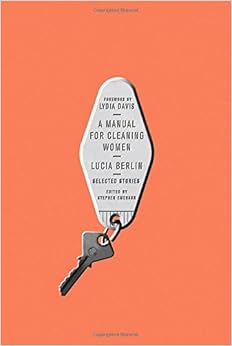
A Manual for Cleaning Women by Lucia Berlin

Reading this book feels like a strangely intimate act. The title is strangely apt in how it relates to this, where the reader is invited in to see someone's life on a material level, touch their things, see their surroundings, but with distance. You're not a friend, and these stories aren't for you. They exist, simply and sometimes harshly, resisting easy pulls of lessons or development.
It's that combination of intimacy and distance that makes reading this collection so striking. That, and that so many of the stories feel autobiographical - written in such a way that makes them fiction, but there feels like a core of her own story, motifs we see echoed over and over and over, parts of a personal saga that crop up again and again. (And when you read her biographical sketch at the end, the feeling of personal story is in no way abated.)
The stories that hit me hardest were the ones Berlin wrote about drinking. They're not sentimental, certainly not flowery or romantic. They're so practical about moving from drink to drink, the planning that goes into staying drunk enough to ward off the shakes, how her children feel about it, the deliberate calculations of the alcoholic.
Other recurring stories are of her sister dying slowly of cancer in Mexico City, of working in a doctor's office or emergency room, as a cleaning lady, failed marriages, her children. I can't say you get to know any of her children as individuals, and only barely more her husbands. The sister comes through clearly, though, the time spent there one of limbo, the kind of waiting that lets you get to know a person more intimately.
There isn't a real narrative sense to these stories. They're sketches of life at a certain time and certain place and while things change between stories, not a lot changes within them. Even when events occur, there is little sense that who the characters fundamentally are has changed, nor that they've decided to adjust how they approach their lives. As mentioned before, this is aided by the planned limbo of alcohol.
The combination of autobiography with really smashing prose lifts this into fiction. It's hard to put an exact finger on what makes this writing so powerful, but a good deal of it has to do with the matter-of-factness of what she writes. There aren't bids for sympathy, or pity, no promises of lessons learned or tables turned. There is just what there is, sometimes starkly, sometimes with moment of impossible connection.
The connection of these stories with working life, the kinds of jobs available for women,caretaking when she can barely take care of herself, are striking. Even when she is sober, there are still the caretaking jobs - cleaning, taking care of her children, her sister. Even when the stories take place in the extremity of alcoholism, even if she's not doing a great job of taking care of people, there is still that looming responsibility. These are the roles she's performing or not performing. They are almost inescapable.
It's not a theme in the sense that it's foregrounded, but the more I think about these stories, the more it is apparent how her drinking is gendered and ungendered, depending, but her work is always strongly connected to societal spaces that are created for women.
Monday, 10 August 2015
People of the Book edited by Rachel Swirsky
Another collection of short stories I picked up on sale at the local comic book store during that one sale every year where such things appear. I thought Jewish science fiction sounded really interesting, and the authors on the cover sold me.
Of course, having read it, this book is mostly Jewish fantasy, folklore brought to life. There are only, if I'm remembering correctly, two science fiction stories in it. That's a little disappointing, but in general, the quality of the stories in the collection was very high. Still, there isn't more Jewish science fiction out there?
Of what stories there are in this books, some are historical fantasy, like Rachel Pollack's take on Jacob. A fair amount is set during the Holocaust, including a really interesting story about cities dancing that I quite enjoyed. The Niels Bohr story was not as interesting, although not terrible.
Much of it is modern, relying on aspects of Jewish folklore coming into the contemporary world. There are a bunch of golems, at least two dybbuks, and one kibbutz. (Although that one is actually one of the two science fiction stories, written by Lavie Tiddhar. Also one I liked a lot.)
There is a sense of melancholy about many of the stories, of separation from the world. I've been trying to put my finger on it more precisely, but I wouldn't want to rely on stereotypes instead of puzzling it out, and so I will only say that as a collection, there is something in the writing that makes this hang together than some other anthologies I've read.
Perhaps my favourite story, though, deals with a classic of Christian children's literature. I love C.S. Lewis' Narnia book, but apparently Gaiman was bothered by the same aspect of it I am - that Susan gets exiled from Narnia because she becomes too obsessed with material things. For circumstances in which "material things" are synonymous with "girly things," bringing a troubling level of gender judgment into the mix. His short story deals with that, and I don't know if it would be appealing to someone who didn't know the Lewis books, but I was very taken by it.
I've read very little Michael Chabon, which is strange, given how much I loved The Amazing Adventures of Kavalier and Clay. It would perhaps surprise no one that his story circles around golems. It's presented as a non-fiction Golems I Have Known. And who am I to nitpick his stories of finding golems and having their power sources show up in his mail?
I realize I am pretty much just talking about the big name authors, and that's fine, because I'm not going to stop when I get to Peter S. Beagle's short story, which is an interesting mix of angels, art, and something else. I liked the twist, is all I'm saying, and I will not give it any more away than that. But if an angel shows up claiming to be sent by God to be a Jewish painter's muse, what are you going to do?
Overall, a strong collection. I just wanted a teensy bit more science fiction. (I'm not counting that sort of steampunk tale as science fiction. To me, that's still fantasy.)
Monday, 20 July 2015
Ruby Slippers, Golden Tears by Ellen Datlow and Terri Windling
It is hard to review an anthology of stories. The obvious temptation is to write a couple of lines about each story, but then you don't get into any depth about any of them, and when I read reviews like that, I tend to glaze over after a couple - it's not that I'm not interested, it's that it's a lot to take in about something I know little about, in a format that is not conducive to retaining knowledge.
So, let's maybe start by talking about the organizing theme? And then a couple of stories I particularly liked, and a few things I noticed. Retellings of fairy tales is an obvious win - so much so that this is the third anthology of stories with that theme by these editors. It's easier to put your finger on than Ellen Datlow's Supernatural Noir collection I read last year, in which there were many spooky stories, but few that actually seemed noir.
But tell people to rewrite a fairy tale, and I am betting eyes light up. Fairy Tale is stretched here to include the Wizard of Oz, but other than that, the collection also includes stories drawing from Russian and Japanese legends (although anything about Koschei the Deathless is going to be compared in my mind by Catherynne Valente's exquisite Deathless, which makes it difficult for a new writer to make an impact.)
Of the stories I liked the most, perhaps it isn't surprising that they came from authors I already knew I liked. Neil Gaiman's story in verse captured the rhythms of oral storytelling beautifully, where, yet again (this is a theme in this book), women turn the tables on less than fairy tale suitors.
Nancy Kress' take on Sleeping Beauty (and there were a lot of takes on Sleeping Beauty) stood out, with a princess who woke up only a few decades in to her hundred years, and spends the rest of the time tending the castle and watching the fates of the princes who impale themselves on the brambles, trying to save her. Not for her a traditional happily-ever-after, and I liked where she ended up.
Tanith Lee takes on Beauty and the Beast, and because it's Tanith Lee, it's beautifully written and frankly sexual, and under all of that, fairly disturbing. Her Beauty finds her power, and wields it in ways that are necessary, given her Beast.
I've never read any Joyce Carol Oates, so I was interested that she was the headliner, as it were, but her Sleeping Beauty story seemed less a fairy tale retelling, and more a ghost story about someone in a coma. The fairy tale wasn't embraced enough, although it was a fairly good, if not revelatory, story.
I would warn, though, that in this book, many of these stories include sexual and domestic violence, perhaps drawing on the undercurrents of fairy tales. It became a bit much, at times, to read story after story with beaten and raped women. (None of the ones I've mentioned were these.) It's commentary on the genre, yes. But all grouped together, it becomes...I don't know...less like people are saying something new about fairy tales. More like everyone's saying the same obvious thing and stopping.
As a whole, this is an excellent anthology, although yeah, a little heavy on the violence against women.
Friday, 3 July 2015
Shoggoths in Bloom by Elizabeth Bear
I snapped this up at a book sale our local comic book store has every year, where somehow books come out of the woodworks and I can pick up an armful for a song. In fact, this is one my husband got for me the day before I even made it to the sale, because he knows Elizabeth Bear is one of my favourite authors these days.
This is a book of short stories, and as long as people get that I mean this in a positive way, reading them is a lot like swallowing razors. They're sharp, dig in as they go down, lodge in your throat in unexpected and painful (deliciously painful) ways. I've loved her novels, but these short stories are really something else. Each one packs a punch.
Several stories in this collection take place in worlds she's already created - the Eternal Sky books give space to a princess finding out how to be a queen when she really doesn't want to, under the looming heel of an empire, with an attractive bandit causing problems. The Promethean Age takes a story, with Matthew dealing with a creature that preys on virgins, with tragic results.
Other stories feel like they all belong in the same fictional universe, although it's not one that I've read any of the books from, if there are books from it. There are three that struck me as similar, one (In the House of Aryaman, A Lonely Signal Burns) in India, a murder mystery with a parrot cat; one (Confessor) in the Pacific Northwest, tracking down genetic manipulators in the woods; and one (Gods of the Forge) in...oh goodness, I can't remember exactly where, with a scientist who must decide how much of a technology she believes in is too much. All share certain assumptions about future uses of energy, and massive changes in the way we can abuse the environment. They're all great, and the world that surrounds them is fascinating.
We also have little gut punches of stories about Weyland Smith, Sonny Liston, and a dying combat robot on a war-wracked world. And, of course, the eponymous story, Shoggoths in Bloom, which takes H.P. Lovecraft and adds race in a sensitive manner, that I found far creepier than the one Lovecraft book I've read.
There's also a lot here about what you must give up in order to move forward, to keep creating, to embrace humanity and pain in order to be whole - The Girl Who Sang Rose Madder, about an aging rock star who is given an agonizing choice, and Dagmar, about moving on after a difficult relationship.
There are several stories I haven't mentioned, but it's actually not because I liked them any less. I just don't have time to talk about them all without entirely losing any readers I might have! Trust me, these are stories that are pointed and painful and absolutely worth it. I may have snagged this at a sale, but you should have no compunction about going out and buying it right now.
Monday, 29 December 2014
"The Ice Owl" by Carolyn Gilman
Hugo and Nebula nominated? Really? Because this isn't a bad story, but it's got a very weak ending, and it's certainly not a great one. Great short science fiction stories can hit you like a punch in the gut, but this one changes themes at the end, and all these plot threads are left dangling. I'm not one to argue for everything needing to be neat and tidy, but some kind of pay-off, please.
The writing is fine. It wasn't intrusive, it wasn't clumsy. The main character, Thorn, is a well-drawn young woman who gets dragged from planet to planet by her mother. This is not well developed enough at the start of the story for where it ends up.
She is on a world that appears to be fairly Puritan in nature, although there's not really time to do more than sketch that in a short story. Somewhere else in the universe, there was a racially-based massacre. It's hard to know if it's really racial, or cultural - i.e., are there different alien races, or are we talking about disparate groups of humans here?
So, on the completely other planet Thorn lives on now, there are people who hunt for war criminals from that genocide. It's a very thinly veiled version of Nazi hunters. However, despite the thriving business hunting down ex-Gminta/Nazis, it doesn't seem like the actual world where the Gminta massacred the Vind has had a change in government. The main character has to go through a genetic test to get in, to make sure she isn't Vind. So where is the authority to hunt these people down coming from? Plus, if you were safe on your homeworld but subject to arrest and execution anywhere else, why would enough people have left to make
The problem is that this is obviously the core of the story, what takes up most of the time, and then...nothing is done with it. Nothing. It's thrown out the window in order to make this a story about mothers and daughters, which the previous part of the story does nothing, really, to support. You want to tell a story about Nazi hunters in space, do that. You want to tell a story about feckless mothers and fed-up daughters, do that. Just pick one. The fake-out doesn't work. It leaves me feeling like my time was wasted, when the author couldn't even be bothered to follow the plotlines she had laid out.
The Ice Owl of the title is sort of a misfire too. The fate of the owl signals where the story shifts gears, but it's sloppy. Again, we need more set-up about the mother to make that make sense, and instead, the story before this has been about guilt and hunting down the guilty. About collaboration and repentance. It could be good. But then it fizzles.
In part, it feels like this is supposed to be a longer story, possibly even a book. But if you're taking a chapter from a book in progress, make sure it's self-contained. Make sure the storylines you put in place are important and relevant and aren't just tossed aside because you have writerly distractions. If these things were followed up on in a larger work, that would be one thing. But for a short story? It's very strange. And it's frustrating, because the writing, while not stellar, is quite good.
Tuesday, 5 August 2014
Star Light, Star Bright by Alfred Bester
This is a solid, if not spectacular, collection of short stories. The
problem is, based on the two Bester novels I've read, I expect
spectacular. I expect him to bend language to his will and plunge
headlong into experimentation and emerge with gems. In this collection,
only one story explores those aspects of his writing that I've most
enjoyed in the past. For the rest, they were entertaining, but I don't
really expect them to stay with me in the same way The Stars My Destination and The Demolished Man have.
Story by story:
"Adam and No Eve"
This is an entertaining take on the "last man on earth" tale, with a twist, hinted at in the title - no one else to repopulate the earth with. In fact, it goes beyond that into being a "last living thing on earth." The ending is entertaining, the cataclysm that led to the destruction of all life on earth a frightening look at hubris.
"Time is the Traitor"
This is one of my favourite stories in the book, other than "The Pi Man." In the future, corporations and governments and everything, really, have grown so complex that almost no one can hold all the aspects of a large problem in their head and come up with a sensible answer. No one, that is, except for John Strapp. Naturally, his services are in great demand. There's only one problem. He keeps murdering men named Kruger. This one is entertaining and engrossing.
"Oddy and Id"
"Oddy and Id" is entertaining, but a bit too straightforward for Bester. A young man named Oddy has industrial-strength luck, and four college professors think they can use that to save the solar system. His luck has other plans....
"Hobson's Choice"
After a nuclear cataclysm, one statistician notes a statistical anomaly - the population keeps going up. And it really shouldn't. What he finds when he checks it out in person is a lot of fun. And I like the ambiguous ending.
"Star Light, Star Bright"
This story is way too similar to "Oddy and Id," as far as I'm concerned. It's perhaps the better of the two, but the two tread more or less the same ground with more or less the same results.
"They Don't Make Life Like They Used To"
A last-two-people-on-earth tale, except they're not sure they like each other very much, and at least one of them is probably lying. The vision of a deserted New York is interesting, but the story is a bit too cute sometimes.
"Of Time and Third Avenue"
A man accidentally buys a year almanac for forty years in the future, and a time traveller must convince him to give it up, unread. This one is twisty enough that it thoroughly satisfied me. I mostly but not quite guessed the ending, but the discussion over knowing the future was worth the price of admission.
"Isaac Asimov"
A magazine piece Bester wrote on Asimov, it's short and entertaining.
"The Pi Man"
This is the best story of the bunch, the one where Bester comes closest to the kind of writing that I've so enjoyed before. The Pi Man is buffeted by patterns, everywhere he goes, and the patterns demand righting, even if it leads him to do some pretty nasty things. Government certainly don't understand this. He doesn't even understand this. What does balance demand? And who's demanding it?
"Something Up There Likes Me"
I was literally in the middle of reading this story when I took a break, surfed the internet, and came upon a short speculative piece about how satellites could develop intelligence. The synchronicity astounded me, as that's what happens in the story. And the lead satellite, OBO, has quite the sense of humour.
While I'm talking about this one, I should say that his female characters are very well drawn, particularly compared to some other stories written in the same time period. They don't gurgle or burble, they aren't just out for sex or to mess the men up. They're about as well developed as the men in the stories, and if that's not always to an incredible degree, at least it's true for everyone.
"My Affair with Science Fiction"
An account of his science fiction writing career, and why he stopped. His discussion with John Campbell about Dianetics is a gem.
If you've read Bester's two great novels, and are looking for more, this is worthwhile. If you haven't, start with those. They're definitely his masterworks.
Thursday, 3 April 2014
Friend Of My Youth by Alice Munro
Alice Munro's short stories are always a delight to read, and Friend of
My Youth is no exception. In almost every collection of hers I have
read, there is a line or two of description that makes me start out of
my chair and realize, yes, that perfectly describes something I have
been feeling.
In Hateship, Friendship etc., it was a description of large family gatherings where no one ever says anything of consequence that described so many dinners at my grandmother's house. Not that those dinners were bad, necessarily, but everyone was so different that nothing of consequence was ever broached.
In this one, it was the framing device in the first story, a woman talking about her dead mother, and how she remembers her as she was when she was dying, and not as she was before. This is something I've been struggling with, on and off, with my father's death - remembering him before the end. It's easier, perhaps, because the end came so quickly, but for months pictures of him yellow and asleep in the hospital bed in the dining room or the look of fear on his face when he was having the worst of his strokes crowded out years of good memories. I feel like I'm just now recovering my sense of him as he was before.
So yes, back to Alice Munro. Themes of infidelity, love lost and deferred, memory and the way we invent pasts and lives for people we barely know populate these stories and weave together in such wonderful ways.
I am so glad Alice Munro writes short stories. She seems to know instinctively how long a story should be, and how to get there, even though these are not stories of urgency, and often seem to meander.
Subscribe to:
Posts (Atom)