Pages

Showing posts with label steampunk. Show all posts

Tuesday, 27 December 2016

Waistcoats & Weaponry by Gail Carriger

I am really not in a mood to be writing about this book, full as it is of fluff and adventure without real teeth. It's Boxing Day as I'm writing, and the fucking freezing rain outside means I don't get to have Christmas with my family. I'll get to see my Mom in a day or two, but the family occasion with one of my sisters and her spouse is scuppered. We'll try to see them soon, of course, but it's not the same.

Fuck the world.

In the middle of the funk caused by something as impossible to change as the bloody weather, as I impotently rage at it and try not to be depressed because these things happen, after all, I need to sit down and write a book review for tomorrow.

And maybe it's okay that it's fluff. Because honestly, this was fairly good fluff. I'd read two or three previous Gail Carriger books, and I really can't say I enjoyed them. There was a good deal of aggravation running through all of my previous reviews, and at least one or two moments of real anger. If this book had been one of those, this might be one of my more cranky reviews ever, on a book that wouldn't deserve that much ire.

But you know what? I was actually surprised that not only did I not mind Waistcoats and Weaponry, I pretty much enjoyed it. I can't say I fell in love with it, but as a fluffy diversion from the world, it was at least a good one. It had none of the plot twists and unexplained decisions and claims that made the other books get more than a little on my nerves.

Maybe Carriger's getting better as she goes along. Maybe her style of fluff is better suited to boarding schools teaching young ladies how to be spies than the more epic doings of the empire and vampires and werewolves. We're in the same universe, but not the same series, and somehow, that made all the difference.

This is a series about young ladies in steampunk Victorian England with vampires and werewolves and human supremacist inventors, although it's seen as more gauche than anything more serious. These days, that's a particular issue, and is a bit aggravating here. Carriger comes close to addressing inequities in British society, but it stays fairly firmly in the light category.

The girls attend a floating school for intelligence work, and the main character (this is several books into the series, I believe, but it didn't really affect how I read the book) leaves the school for her older brother's engagement ball. While there, she is found by her two love interests - a rich guy who is charming and part of the human supremacists and a young Black man who works firing the coal engines of whatever is nearby and has aspirations to become a werewolf.

One of her best friends, raised by a werewolves but not herself a werewolf, needs Sophronia's help to make it home to her pack. To do so, they end up stealing a vampire-piloted train, and further hijinks ensue with both the vampire drones and the Picklemen (human supremacist inventors) piloting a nearby dirigible.

It's all fairly light, and I wasn't ever really worried about any of the characters, and sometimes that's exactly what you need. I can't say I made me fall in love with Carriger's world, but I'm certainly feeling more kindly towards it than I was before.

Sunday, 11 September 2016

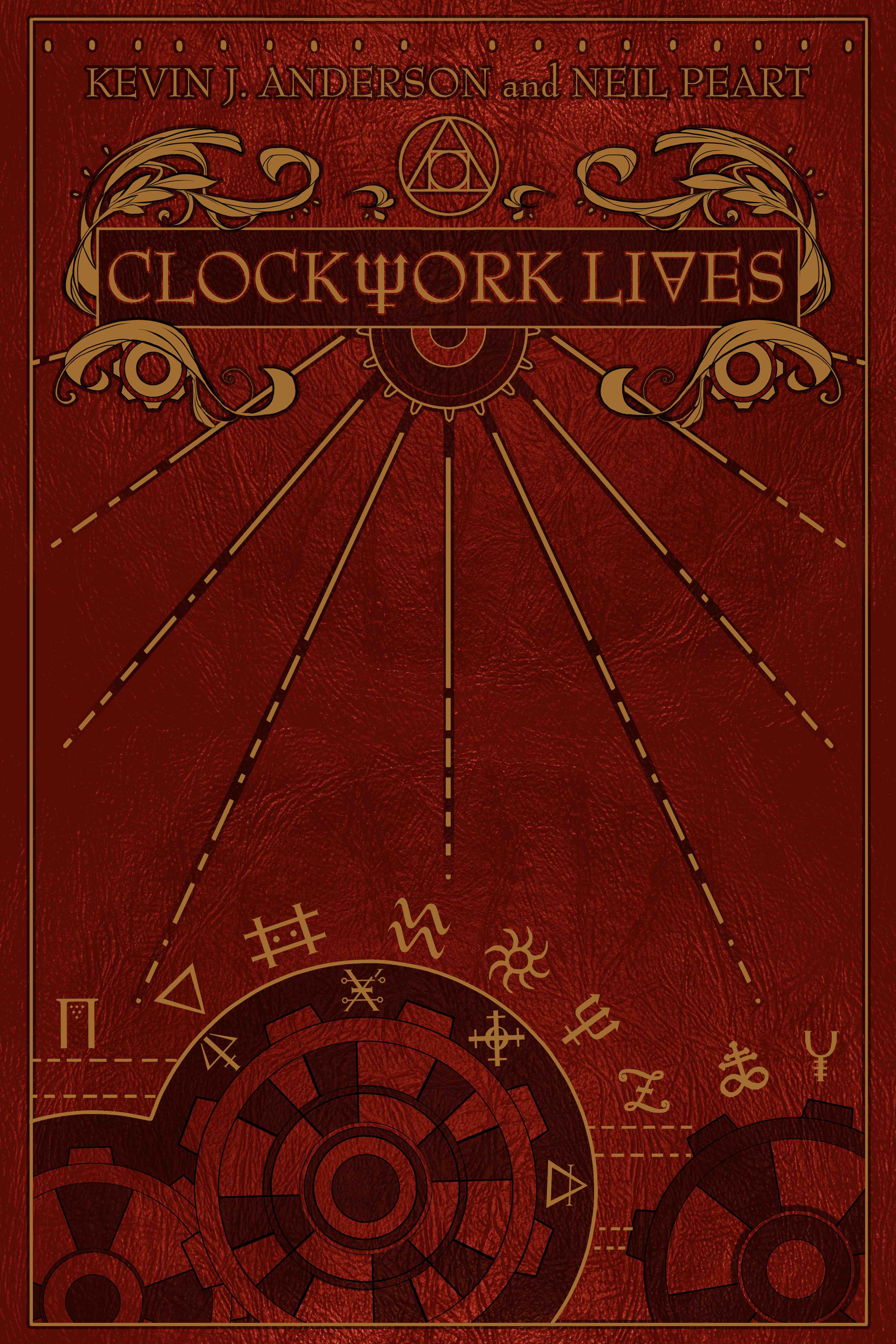
Clockwork Lives by Kevin Anderson

Image result for clockwork lives

Based on a Rush concept album, huh? Second book in the series? There's actually quite a lot to like here, and the central conceit is interesting enough, but it suffers by never quite bringing the disparate threads together to become a cohesive whole. Also from having a main character who is initially so single-mindedly conformist as to be cartoony.

In other words, this is just okay.

Part of my difficulty may be that this is the second book in the series - perhaps some of what felt like gaping holes were actually addressed in an earlier book. But even if books build on their predecessors, they should not feel like there is at least a third of the book missing.

Marinda Peake is the daughter of an inventor who was exiled to a small town by the Watchmaker, the man who conquered the land with regularity, and keeps it all ticking. When her father dies, she not only doesn't expect her life to change, she actively believes that change cannot possibly happen to her. This is not portrayed well. I can see someone not having thought their life would change being shocked, even a bit resistant. But it doesn't ring true the way it is portrayed here. It's a heavy hand of an author keeping her in place, not something that feels like it wells up from a completely realized character.

Her father leaves her a book that transforms a drop of blood into someone's life story on the page that Marinda must fill before she can move back into her house. Furious, she sets out, finding out that most people's stories are extremely boring. (That's sort of an unfortunate choice, but otherwise she wouldn't journey, I suppose.)

The problem comes when you start to expect all these disparate stories to eventually weave together to describe a greater whole. I might have had trouble keeping all the stories straight in Catherynne Valente's Orphan's Tales, but in the end, they all did weave together into a very satisfactory whole, allowing lovely moments of pleasure as stories started to click into place and the relationships between them became apparent.

You could also take the conscious tack of deciding that stories are just sometimes arbitrary and don't interact, but you'd have to be aware of it, and weave that theme into the story you're telling.

Neither happens here. At first, it seems like Marinda is on the track of her mother, who ran off from her father in search of adventure. The first person whose story she gets after she leaves was the man her mother ran off with, and I expected this thread of discovering different facets of her mother's life and personality to keep coming to light.

Nope. In his tale, you find out she was more or less addicted to danger and died. Even after that, I was hoping another story would come around to her, that her death wouldn't have been real, and Marinda would find more than that fairly flat portrait, but nope. Never comes up again.

Okay, fine. The next few stories each have a central or tangential aspect of what the Watchmaker most craves, and disturbing hints of how he's tried to obtain it. What he thinks life should be like. With that, and given that Marinda meets the Anarchist, wo is a terrorist opposing The Watchmaker, it feels like maybe this is the point of the book. Marinda will come to understand that the Watchmaker's plan is really not that great a one, and to be perfectly fitting, at the end, she'll get the Anarchist's story to pull it all together and launch her on the next adventure after the book is full. Maybe the Anarchist will even be her mother, or someone who knew her mother. Would make sense, right?

Nope. All these threads are just left there, not pulled together. The individual stories that make up the book are entertaining, and I can see how they could be woven together to make a more impressive whole, but it just never bloody happens.

At the end, after all that, Marinda is happy to have had her adventures, but now she's going to settle down and marry and return to her small town. And that is just...it. All the stories are just in a book on the shelf, the Watchmaker is still in charge, her mother is still a caricature, and that's just it.

Disappointing.


Wednesday, 27 July 2016

Karen Memory by Elizabeth Bear


There are a lot of books that I have had rough relationships with the past little while. Those I struggled with partially liking, and partially being upset by. Books that didn't live up to their promise, and didn't surprise and amuse or challenge me. And then there's Karen Memory, which was so utterly delightful that I think I was only fifty pages in or so before I started telling people how much fun I was having reading this book.

It was hard to explain why without it sounding just a little odd. "It's about steampunk prostitutes! With a really diverse cast of characters! And...it's just so much fun!" But that makes it sound like someone checking boxes, hoping for cookies, or like I liked this book because I feel somehow like I was supposed to like it. But on the contrary, the diversity that comes across in the book just feels as natural to the world Bear is creating as breathing. It's not the point of the plot, but it is a very enjoyable backdrop to it. 

Why shouldn't we have a lesbian main character? Why shouldn't there be a transgender prostitute in the house where Karen works, and why shouldn't that be perfectly fine by everyone who lives and works there? Why shouldn't the book take into consideration the prostitutes who live in terrible working conditions, and the ways in which those places might be more likely to prey on non-white women brought over for the purposes of trafficking? Why can't we deal with all these issues like adults, letting them be complex?

And then why can't we include airships, submarines, and steampunk sewing machine/mechs all at the same time? No reason, that's why. And it's because Bear has mashed all these disparate elements together so elegantly that I kept being happy that I was reading this book. Happy to be reading something that, although the prostitutes are in danger from the asshole who runs the worst cribs in town, didn't center around extreme descriptions or threats of sexual violence. (Interestingly, although the prostitutes are in grave danger from a serial killer stalking the streets, it's their lives that are being threatened. We don't get a rape threat in there to make sure we know that the psychopathic killer is really a bad guy.)

The storyline can be a little heavy, but it doesn't read that way. Even when Karen and Priya (the lead and her love interest) are in very deep danger, it's the kind of adventure story that is still entertaining. Karen's narrative voice (and she's very self-consciously the writer and shaper of this story) isn't doom and gloom. It's matter-of-fact, often funny and wry.

For a book about prostitutes with a very sweet love story at its core, there's remarkably little sex in here, and while I kind of wanted some, it was also perfectly in keeping with the tone of the book. 

I haven't connected strongly with steampunk before, often because a lot of it seems to want to have all the fun stylistic features of Victoriana with none of the unpleasant social context. I am delighted to find a book that is a lot of fun while not minimizing inequalities and oppressions. 

Plus, sewing machine mechs. I mean, come on. I don't know how you couldn't love that.

Friday, 26 June 2015

The Immorality Engine by George Mann

I think this series is growing on me. The first book I was solidly meh about, although the ending made me more intrigued and willing to go into the second book. The second book I still didn't love, but was more to my taste. Now, by the third book, I think Mann is getting better as he goes. This is now a solid series that I am more than willing to go further in. (Presuming there are more, I guess.)

Whereas the first book felt too forced, the characters are now more familiar, more relatable, and the story just...just better structured, I guess. Not that the first book was terrible, it just felt like it was too much "Look How Steampunk I Am," and not enough else.

In this third book, we start the first chapter with the funeral of Veronica's sister, and then flip back in time. Newbury is an opium eater by this point, but Veronica and one of the chief inspectors of Scotland Yard roist him out to investigate a murder/robbery. To be precise, the murder of a man, and then the commission of a burglary by the same exact modus operandi of the dead man. And then a second body, same as the first.

Newbury is intrigued, and this pulls him into an occult club that hates that Queen Victoria has prolonged her life by artificial means, and are willing to do fairly horrific things to reorder Victorian society in a manner more to their pleasing. In the meantime, Victoria is getting more ruthless and less human, and even the doctor keeping her alive isn't sure she should be.

Of course, he's also the doctor taking care of Amelia, Veronica's sister, so we can assume that there's some nefarious plot afoot. And of course there is. They all come to a boil at roughly the same time, and if there's very few of the twists and turns I didn't see coming, they at least felt well executed when they arrived.

It's mostly down to the characters now. I'm more invested in Veronica and Newbury than I was in the first book, knowing more about who they are, what they do, what they care about. The suggested romance that has been flowering very, very slowly over the last couple of books hits some nasty snags, but it was mostly background to the action.

And yet again, the end of the book has a veer that ups the stakes, makes things more ominous, and yes, yet again, makes me want to pick up the next one.

Interestingly, when I was reading this, there were aspects that almost made me group it with those books with the theme of a world devoid of a moral centre. It's less overt, but these books are more and more about the rot at the centre of Empire, so in that way, it felt like it belonged with the more illustrious company that preceded it in my reading list.

Friday, 10 April 2015

Dreadnought by Cherie Priest

Three books seems to be about the amount I need to decide whether or not I'm going to continue to read an author's books, unless they do something right away to piss me off. This is the third Cherie Priest book I've read. Unless something major happens, it's also likely to be the last. I'm just not getting enough out of them, and there are things that nag.

Also, I feel like the actual important events that happened in this book could have been condensed down into a couple of chapters in a different novel, rather than being stretched out over the length they were. I have not much patience for novels that are about a journey, that take pages and pages, but end up with the person merely having finished their physical journey, and not really taken an emotional one at all.

If, when you get off the train across the country that has taken hundreds of pages, and you're the same person you were when you got on, there's a problem. When all that has happened in the plot is that you've discovered that the evil drug-fueled menace we saw in the beginning is an evil drug-fueled menace that the army wants to exploit? Maybe that could happen in less space.

Not enough incident, I'm afraid, stretched out far too long.

So there's that. Really, though, what's making me put these down is the continued unease with Cherie Priest's insistence that her Civil War (which goes on much longer than the real one) has nothing to do with race. Every southerner we meet has no problem with Black people. Every northerner we meet is genteely racist. (It would be perfectly fair to make the point that people in the North were racist too, but you can't take something like the Civil War and try to make it okay to write about the South as your heroes by trying to erase race and slavery from the equation.) States rights, sure. But let's not forget that the specific states right they were fighting for was the right to own slaves.

It's disturbing, and it bugs me every time it comes up. Real people died. Real people were enslaved, suffered racism, war, deprivation, death. Trying to erase that from history, even if it's a fantasy version of history? It's not okay. Not even a little bit. You don't want to incorporate uncomfortable aspects of race in 19th century America into your book? Don't write about a fictional version of the Civil War.

In this one, Mercy, a nurse for the South, travels to the Pacific Northwest, to the territory of Boneshaker, to find her dying father. On the way, she must travel with Northerners and get attacked a whole bunch because these naughty Northerners are transporting something the South doesn't want them to have. Because the whole book is pretty much spent with the North, it means that, again, we get a heaping dose of how the North is just as bad, while at the same time, continually making excuses for the South.

It's frustrating, and I'm done. I might have stuck it out a bit longer if the story had been good, or the characters, but they weren't either, and I'm calling it quits.

Wednesday, 11 February 2015

Heart of Iron by Ekaterina Sedia

I don't know what it is about Sedia's books. I like them enough to keep reading them when they cross my plate, but not enough to seek them out. She's never irritated me enough to want to say that I'm done, but there just always seem to be a little bit missing. It's like they're *this* close to being great, but end up settling in merely satisfactory. (With the exception of at least one of the stories in Moscow But Dreaming, which was finally, finally, a perfect little gem.)

So here we are in Heart of Iron, set in a Russia where the Decembrists were successful. Russia is thoroughly Anglophile, although England might not share that particular emotion. (But no Crimean War means Florence Nightingale is somewhat at loose ends. Malevolent ends, one might say.) Constantine is in power, although his brother is in charge of much of the security of the Russian state.

The main character, a young woman named Sacha, is sent off to be part of the first class of women in university in Russia, where she is met with the nastiness and misogyny that you might expect. It's too bad that this is so much what you would expect. While it would be ridiculous to show them being welcomed with open arms, you might want to twist the trope just a tiny bit, do something new with it?

The Chinese students there to study likewise run into a brick wall of intolerance and secret police. Nevertheless, Sacha gets herself involved, believing that they cannot be too mistreated if a white Russian woman stands up for them. That goes badly, and she needs to be saved by an Englishman, who is, of course, Spring-Heeled Jack, there as another university student/spy.

This is where I think the book is weak - coincidence piled on coincidence, and so many tropes just used without a new twist. It's not bad, it's just not exciting. At any rate, Sacha ends up on a trip to China to broker a deal between Russia and China, with absolutely not imperial support or reason for success. She goes with Jack, of course, and disguises herself as a man. Her period is never brought up, and yet this trip goes probably over a month.

In the end, I just don't know. There's not objectionable. The writing isn't bad. But there's nothing that sets my heart on fire, there's not really anything that feels surprising or new, and maybe it's just me, but there's no real sense of danger to Sacha. Or real sense of repercussion if she fails. I'm not necessarily asking for her to be put into personal physical danger, but there needs to be something hanging overhead if she messes up. Yes, maybe the English will invade, but it's all very wishy-washy and doesn't seem at all urgent.

Tension. That's what's not here. There's not enough tension. There is an interesting story, and characters, but there's not enough reason that it matters. The one time there is tension, when her closest Chinese friend is whisked away by the secret police, that's almost immediately undercut by Sacha finding out he left Russia safely. There needs to be a bit more on the line, and then it will matter more. Until then, it's merely fine. Not great. Just fine.

Friday, 8 August 2014

Behemoth by Scott Westerfeld

The continuing adventures of naval crew and girl-in-disguise Deryn and secret-heir-to-the-Austro-Hungarian-Empire Alex. This time, in Istanbul! With a continued mix of steampunky ships and genetically engineered beasties, including giant airships. And bats who poop razors. Plucky kids in their early teens, battling to take down empires!

It's, you know, fun. Not much more, and it still feels like there's something lacking I haven't quite put my finger on, but fun.

Well, there's that review done!

*dusts off hands*

No? That's not nearly long enough to suit my inner reviewer? Dammit. So, what else do I want to say about this book?

Well, you all know how I like fictional dogs? And cats? Well, there's neither of those here, but there's a new beastie, a Perspicacious Loris, who is pretty endearing. He parrots people, but not unthinkingly. They may not be listening, but he's saying important things. He's cute.

The mechs that the Turkish rebels have are actually very interesting - they're mostly shaped like mythological beings, and the descriptions (and drawings) of them are beautiful. The rebels themselves are moderately interesting.

Oh, we're just coming down to the fact that nothing in this book really grabbed me. I'm struggling to remember what I thought of it, and I finished it less than a week ago. I enjoyed it perfectly well while I was reading it, but there wasn't a moment that made me excited or eager to read more, right away.

Which, given that it's a book about the start of a steampunk World War I, shouldn't really be the case. It shouldn't be this hard to engage with the characters, or care about their fates. I found myself not really caring whether or not Alex found out that Deryn was female, although the minor subplot where another female character had a crush on Deryn was moderately fun.

I think that's the best way to sum up this book. Moderately fun. There's nothing bothersome about it, there's just not enough right. It's fine. And if that isn't damning with faint praise, I don't know what is. I don't know if I'll go on to the others in the series. Given how hard it was to write this review, I suspect not.

Monday, 21 July 2014

Camera Obscura by Lavie Tidhar

I feel like this series is developing nicely. The second book feels slightly more accomplished than the first. But two books in, isn't it about time to state clearly what's going on here? It's not a deal-breaker, because I enjoy very much this literary steampunky world, but I've stuck it out for two books. What are Les Lezards? (Yes, it's been broadly hinted at. But I'm ready for answers, not just hints. If something major had been revealed each book, but reserved part of the secrets, that would have been fine. It's substituting the hints for any real reveals that makes me a bit impatient.)

Still, this series is getting better as it goes. This one is set in Paris, and therefore brings in a whole whack of French literary figures, from Mme. de Winter from The Three Musketeers to Victor Frankenstein to the Phantom of the Opera. Along with Tom Thumb and the Marquis de Sade. I truly do have fun with spot-the-literary-reference. I'm not sure that it adds anything to the stories themselves except to make me pleased with myself for being well-read, but it is a main feature of the stories.

And, in a massive bit of improvement, none of the literary characters struck me as wrong as Irene Adler being on the side of order in The Bookman did. Although, to tell true, I've only seen movie adaptations of The Three Musketeers, but I liked what Tidhar did with that character.

Milady is the operative of a secret Parisian council, probably dedicated to preventing the lizards from gaining the same toehold on France that they have on England. But their motives may also be more suspect. She is called to investigate a corpse of a man who seems to have been given a c-section, and something removed. Her investigation takes her through the sewers of London, and into robosexual subcultures, and darned if she doesn't keep coming across bodies that just won't stay dead.

She also keeps running across Chinese operatives who are in Paris trying to retrieve whatever that guy was carrying in his stomach, but the Council wants it too. It's broadly hinted at as to what they think they could do with it if they got it, but this is one place just a smidge more clarity might have helped. I'd even have accepted monologuing.

The Phantom of the Opera is an operative too, but he seems to have been infected by the grey plague that is making corpses still walk, and he was never that stable anyway. So he's killing people left right and centre, and Milady is bound and determined to stop him, but the Council tells her to let him alone. Little people don't concern them.

She can't let it alone though, and this leads to a chase across the Atlantic to Vespuccia (apparently Amerigo gave his other name to the continent in this world) and the Chicago World's Fair. Before this happens, though, she gets a piece of the statue everyone is chasing lodged in her eye, and it starts whispering curiously scientific sentences to her, about finding its way home. Turns out the Phantom has one of his own, as does a Chinese man, and hey, les Lezards may want to use the statue to open a portal to...their own world? Seems likely, but more hinted at than said.

So all in all, I love the world-building. I enjoy the characters from literature. But after two books, I don't think I'm being overly demanding when I say that I'd like some answers. Not all the answers, but some. Seriously. I've stuck it out this far. It's getting to where withholding answers has gone past the point of creating tension, and into the part where it bugs me.

Sunday, 15 June 2014

Leviathan by Scott Westerfeld

This is a very solid young adult book, with not too much romance shoehorned in. (That is to say, there is some romance, and it feels very shoehorny, but is on the brief side. This book in particular feels like it could have skipped the burgeoning of the feelings without in anyway detracting from the book.) I am waffling on the three or four stars right now - because I liked it enough to be interested in further books in the series without in any way falling in love with it.

But it is interesting, and there are real flashes of something exciting here. I am still undecided, and I retain the right to come back and tinker with the star rating later. Or after I'm finished writing the review and have figured out what I think.

So, it appears that the looming Great War in the this book is not just between the imperial alliances of Austria and Germany vs Britain/France/Russia. It is also between biology and engineering. The Germans, of course, have efficient machines - huge mechanical landcraft that strike my imagination something like a Star Wars walker. And in Britain, Darwin not only wrote about evolution, but pioneered genetic engineering, so the English battlecraft are giant living beings, sort of like flying jellyfish. And bats that poop razors.

Two young people are in the middle of this - Alex, the son of Archduke Ferdinand, suddenly in the crosshairs of dynastic politics. And Deryn, who passes herself off as a boy to join up as part of a flying crew. As the world lurches towards war, both have to fight in battles, and in the end, join forces.

It's not a deep book, and some things made me raise my eyebrows a bit, and oh, the flowering of new romance felt so unnecessary. But the ideas are interesting, and the characters may be a little flat, but they push the story along nicely. The world, though, that's what holds the most attraction. This is an interesting place.

Tuesday, 10 June 2014

The Osiris Ritual by George Mann

This series is growing on me. The first book I thought was merely serviceable, with a bit of a revelation at the end that made one of the characters much more interesting. Either the author has gotten better at plotting, or the tension has been amped up, or I was just in a better mood to enjoy Victoriana. I think perhaps all three, and the end result was that this was quite enjoyable. Not revelatory, but fun.

Our lead detective, Sir Newbury, is exploring his growing opium addiction, moving from laudanum onto the hard stuff. This concerns both his lovely assistant Veronica Hobbes, but also the Queen herself, and his friends at Scotland Yard, who have far too vivid memories of the last time one of Her Majesty's investigators went to the bad. It led to human experimentation and atrocity. No wonder they're keeping an eye on him!

In the meantime, two, no, three, mysteries have reared their heads. One involves the fad for mummy unwrapping parties among the fashionable - the mummy proves most unique, and the next day, appears to have led to murder. Newbury must investigate this while also tracking down a former agent who had been killed by his murderous predecessor, yet brought back to a grotesque half-life by a doctor whose work seems dodgy. Even if he is keeping the Queen alive.

At the same time, Veronica is increasingly obsessed with the disappearances of young women, and has traced those disappearances to the stage performances of a magician. All this, while worrying about her younger sister, whose trances seeing the future are becoming more frequent, and the asylum where she's confined less than hospitable.

The surrounding characters are entertaining, if not particularly deep, and the fraught relationship between Newbury and Hobbes, complicated by opium and personal loyalties, interesting.

These mysteries are each satisfyingly dealt with, and Mann is better in this book about having things have tension and real consequence. At least one character dies who I had not expected to! The chase scenes are satisfying, the answers to the mysteries interesting, and the examination of a vaguely steampunk world, where Queen Victoria is being kept alive by strange machinery, better drawn. And I'm just a sucker for a good mummy party reference.

Mann also has a knack for a good closer - it was the end of The Affinity Bridge that convinced me to continue with the series, and the end of this book was similarly tantalizing. Even more so because he seems to be getting better at putting the lives and emotions of the main characters on the line, and if this continues, the third book should be very interesting indeed. I wonder if it's out yet.

Sunday, 13 April 2014

Changeless by Gail Carriger

*Caution: Spoilers Near the End*

Changeless relies less heavily on standard romance tropes, and so was a more entertaining book than the first in the series. I was a little let down by the ending, though. It felt abrupt, and pointless - the theories advanced to explain it seemed immediately logical, so the reaction of some characters seemed overblown. And more, unforgivable. We'll wait to see what the next book does, but if the main character is desperately trying to get her husband to forgive her, my feminist outrage may outweigh the amount of frothy fun these books have been.

Let's see. The main character from the first book is now married to her Scottish werewolf paramour, and lives with him and the rest of his pack. But he takes off in the middle of the night to investigate a plague of humanity that is afflicting the supernatural elements in London. Not humans. Werewolves and vampires are reverting to their former vulnerable human selves. Ghosts have disappeared.

As the resident preternatural, Alexia is summoned to investigate what's going on. While in London, she is diverted to a hat shop, where an attractive hat designer dressed in men's clothing gives her a parasol and some innuendo. I sort of hope that's going somewhere, and not just teased. That would be kind of a rip-off.

The locus of the anti-supernatural whatever moves to Scotland, and so Alexia's husband follows. (Is it a bad sign that I can't remember any of the character names, after two books? I've had to look them up.) Alexia goes after him by airship, accompanied by the hatmaker/inventor, her best friend, and her sister. There is a fairly tiresome subplot about the two latter characters, mostly about them being silly women and cattily fighting over a man.

They emerge in Scotland only to meet what's-his-name's former pack, recently returned from the wars in India, and seemingly carrying this anti-supernatural plague with them. The pack is led by a non-werewolf, the granddaughter of Alexia's husband. (All right, let me take the time to look it up. This is getting tiresome.) Conall Maccon. Fine. The granddaughter wants Conall to change her, even though women rarely survive the process (why? This is said for both vampires and werewolves, but no real explanation why.)

We still have no real explanation of what not having a soul means. Any time, Carriger.

This is a fairly fun romp, and I enjoyed more than the first, which I thought was very slight. As a romance, it was fine. As anything more, meh.

But right at the end, when it is revealed that Alexia is pregnant, the shit hits the fan in a very weird fashion. Her husband gets violent and breaks things. Werewolves can't impregnate anyone! It's known! Yeah, but Alexis points out, he's human when they have sex, since she's touching him, and can age during that time and stuff, so why couldn't he get her pregnant?

This, to me, seems perfectly logical. But no. More violence and threats. And seriously, if any part of the next book is HER trying to get HIS forgiveness, I will probably have issues. My husband is Scottish, if not a werewolf (that I know of), and would never pull that shit on me.

But more than the gender politics, I hate false drama. And this just reeks of false drama.

So this is a fun adventure, spoiled by a melodramatic ending.


Sunday, 23 March 2014

Boneshaker by Cherie Priest

My husband gave up on this one when he got a hundred pages in, and felt nothing was happening. So I wasn't too sure what I would make of it, but in the end, I liked it a lot more than he did. I certainly never felt like nothing was happening, and the core mother-son dynamic of the book I found particularly engaging.

Briar Blue (or Wilkes, her maiden name, which she goes by now) was married to a dashing and arrogant inventor, accused of creating a machine that he used to rob several banks in Seattle, destroy a good deal of the downtown, and unleash a gas that is inimical to human life. Seattle itself was eventually walled off, and people live on the outskirts in abject poverty. Briar tries to make a life for herself and her son, but has to deal with the hatred people still bear her husband. And her son has become convinced that maybe his father was falsely accused, and goes into the walled-up city to prove it.

Which leaves Briar with nothing to do but go after him.

I enjoyed the grunge of this book, the feeling of desperation, and again, how Briar and her son related. Maybe I'm just in a good position to read this right now - we just finished a roleplaying game in which my character was desperately searching for her daughter throughout the entire campaign, so I was in the right place to appreciate that as a sense of urgency. I also enjoyed the part where, when the chips were down, they really did love and trust each other.

On the not-so-great part of the spectrum, I'm not convinced zombies were necessary. I think the gas and its effects are interesting enough, and I'm not sure what zombies add to the mix, except to create a lot of chase-and-battle sequences, which are by far the least interesting part of the book. I enjoyed the setting, the tension between the past that happened and the past people want to have happened, and the characters much more. (This is not to say that the characters are incredibly deep, but I still found them interesting and fun.)

So the tendency of the book to stop for a zombie chase/fight for quite a bit of the second half made it a bit draggy. There were too many, and it didn't seem like it really added something. I think there are enough dangers in the city, with the different factions, the mad scientist, the gangs, and the earthquakes that somehow, zombies seem superfluous. But maybe that's just me. I rarely find zombies that interesting, and they need to really add something to a story, instead of just be there as all-purpose obstacle.

But I still enjoyed Boneshaker. The vision of a collapsed city next to a new one where people are trying to rebuild something was interesting. Ideas about who would still try to live in a place that was trying to kill them were neat. And I liked Briar.

Booklinks:

I read this book as part of an attempt to read all the Hugo Nominees

Thursday, 27 February 2014

Soulless by Gail Carriger

What strikes me most about this book is how much, despite the vampires and werewolves and vague steampunkery, this feels like a very straightforward romance novel. Not a bad specimen of a romance novel, but so exactly falling into those tropes. If you took one of the few romances I've ever read, one where the main female character was a spunky female detective who ran afoul of the handsome, rough-around-the-edges-but-still-well-off male character and they gradually discovered they feel strongly about each other, and he rescues her from her spinster state even though she's spunky and self-sufficient and could survive without a husband...and replaced the conspiracy they're looking into with werewolves and vampires, you'd have almost exactly the same book.

So, this is a romance. With historical urban fantasy flourishes. And for that, it's not bad, although I do wonder why almost all of these ruggedly handsome rogues who never intended to settle down are Scottish. That's my husband's ancestry, so I'm not arguing, per se, but it seems that "Scottish" has become code for a certain type of romance male, an alpha male who is really dying to have a woman stand up to him. To this, we're just adding "werewolf."

The object of his eventual affections in this is Alexia, who is (gasp!) half-Italian! Doesn't have porcelain skin! Likes to read! Oh, wait, and she also doesn't have a soul. Which seems to limit her not a bit - if I read further in the series, I hope the actual implications of that are made clear. It certainly doesn't mean she doesn't have feelings, or morals, or ethics. But in this world vampires and werewolves suffer from an excess of soul, and she is their opposite. And temporary antidote.

Her feather-brained mother and sisters, naturally, don't understand Alexia's distaste for late Victorian society, and have consigned her to spinsterhood. She wants to work for BUR, and I don't remember what that stands for, and I don't care enough to go check. It's the BPRD, all right? She keeps running across Lord Maccon, the alpha werewolf in town, and they bicker in a way that totally in no way disguises sexual attraction.

But there are evil forces abroad, kidnapping the recently integrated vampires and werewolves and performing experiments on them. And boy, they would just love to get their hands on soulless Alexia. And along the way, she starts to experience feelings. You know, down there. And there are almost sexy times, repeatedly.

So yeah, romance. Fun, very slight, romance. With werewolves. And vampires.

Tuesday, 18 February 2014

The Affinity Bridge by George Mann

The epilogue to this book almost caused me to bump this up to a four-star review. Almost. But given that the vast majority of it had me quite comfortably rating it as a 3, I'm going to stay with that. But the ending is just interesting enough to convince to to pick up another.

This is perfectly competent Victorian London steampunk, if not anything that set my personal world on fire. It is also a mystery, with male and female detectives, and if there is the hint of future romance, at least that wasn't the focus of the whole novel.

Men are turning up strangled in Whitechapel, killed, so go the reports, by a man glowing blue. Newbury, curator at the British Museum and Special Investigator for the Empire is called to investigate, along with his plucky young assistant, Veronica Hobbes.

But they are diverted by a blimp crash, in which the passengers appear to have been tied to their seats, and the pilot missing. This leads them to a prominent industrialist who has recently diversified into automatons, which they claim couldn't possibly be acting erratically.

Oh, and there is a zombie (Mann uses "revenant") plague in the poorer areas of London, so you don't want to be out after dark.

If you like steampunk, this seems like a perfectly good journeyman entry into the genre. It was fun, and entertaining, and the mystery sufficiently diverting. And the epilogue adds a new layer to one of the main characters that made them much more interesting to me.

Thursday, 13 February 2014

Clementine by Cherie Priest

Clementine is a slim book, a fun romp, but in some ways unsatisfying, and in others, a little...troublesome. Which is perhaps too much thought to put into a book that seems to be intended as brain candy and little more. But still, doubts remain. Can you really keep slavery as an aspect of life in the Southern states during the Civil War, and yet then try to make the pre-eminent Confederate spy's motives all about states rights, and give her absolutely no prejudices against an escaped black slave?

There is a rather large difference between saying slavery was not the only factor in the Civil War (even your fictional steampunk Civil War), and ignoring it as a factor. But still, to have one of your protagonists be a fugitive slave having to go back into dangerous territory, and then, not ever really having it be an issue, other than that he doesn't get served at one bar? You can't have your cake and eat it too, and that's never been a metaphor that's made much sense, but I guess what I'm trying to say is that you can't have it both ways. And you can't ignore it. You introduce slavery, you can't just then handwave away having that mean anything.

This is too weighty a thought for a book this slight. But that's part of the problem. I get not wanting to delve entirely into slavery as the main topic of your steampunk fantasy - but you can't bring it up, and then ignore it.

But if I put that aside, what's left? Mostly fun, but not a whole lot more.  Captain Croggan Hainey, former slave, former captain of the ship (I can't remember if it was formerly Confederate or Union) The Free Crow, had it stolen out from underneath him, and is now pursuing it across the Rockies into dangerous territory in Kentucky and environs. All he wants is his ship back.

Meanwhile, "Belle" Boyd, former famous Confederate spy, now put out to pasture, is working for the Pinkerton detective agency. As her very first mission, she's sent after the Free Crow, now named Clementine, to make sure it does get where it's going to go. But she discovers that what it's carrying might have some very real fallout for the side she spent her life serving, and her new loyalties are torn. (Might it have been more interesting if she'd been with the Pinkertons for a while, and it was a struggle between two loyalties?)

With nary an eye batted between them, Hainey and Boyd team up to fight crime find the Clementine and stop her from carrying out her mission. They get along very well, and the attraction between them is interestingly both present and downplayed, but honestly, the former slave and former Confederate spy able to put aside all personal prejudices and see through to the other person as an ally happened a little too easily. But I liked them together.

And really, I did enjoy this book. There was just this niggling "shouldn't the historical context that Priest is drawing on have some actual impact?" thought that kept running through my brain. If it hadn't been there, I would have been thoroughly amused by this romp. As it was, it was still quite fun. But not a lot more. Which is part of the problem. To truly be that light, you can't draw on something that heavy and then ignore it.