Pages

Showing posts with label mystery. Show all posts

Tuesday, 29 January 2019

The Death of Mrs. Westaway by Ruth Ware

A friend loaned me this book because it has a tarot reader as a main character, and I'd just recently started reading tarot cards professionally, after having spent 25 years learning them quite thoroughly. The tarot reading is not a huge part of this book, which is mostly a thriller, and not a bad one at that. As it pertained to tarot, I thought it was perhaps unfortunate the exact take Ware decided to take, but it's not an unreasonable one. It's all about expectations from tarot reading, really.

The main character, Hal, lost her mother recently, and in order to make ends meet, has taken up her mother's role as a tarot reader on the pier of an English seaside town. She's in debt with usurious interest, and it's coming due, and her legs and life have been threatened. So, when a letter arrives about a grandmother that can't possibly be hers leaving her a bequest, she decides to see if she can con her way into a small amount of money.

Of course, when she shows up at the funeral and reading of the will, it's not a small bequest at all. It's the entire house, quite a large country estate. So Hal is caught by her lies as family secrets swirl around her, and she has to keep her own secrets while others are definitely keeping theirs - and worse, she starts to like some of the people she's conning.

Hal's a good character, by far and large. It's just too bad that she views her job, and tarot as a whole, as a con. She doesn't believe she can tell the future, so she relies on cold reading. And sure, absolutely, you can read that way. I don't think it's ethical at all, and so yeah, if that's what she's doing, there are issues. (I am terrible at knowing exactly what people are feeling while I'm reading tarot cards. I realized long ago, as a tour guide, that I often mistake deep concentration for disbelief. But then, I also tell people that I'm not psychic before I start their reading, and that I'm not there to wow them with what I know, or to tell them what their futures hold. I'm there to help them reflect on their present)

It gets strange because what Hal seems to think about tarot cards is not that far off what I think. There's no reason for her to run this like a scam. Be up front, tell people you're providing a mirror for their lives, a way to recognize patterns and understand personal stories, but that they'll be doing most of the work fitting what they know to what you're saying. But she thinks she can't say that, and so she runs it like a scam, which is frustrating, upset with herself when she pretends she can tell the future. (Also, the author tries to have it go both ways by having tarot cards whenever they come up, be uncannily accurate about situations.)

But really, that's not the focus of the book. The focus is the family Hal finds herself sort-of part of, the interactions between the three brothers who are her theoretical uncles. Hal discovers a picture fairly quickly of them as young people, with her mother there - a cousin of the family with a similar name to a daughter who disappeared many years ago. So, she's related, but not necessarily the way the lawyer's letter and the will describe. There are concerns about the money, but also about justice, and all three brothers are understandably very interested in whatever happened to their long-lost sister.

And some people don't want the truth to come to light, about the sister, about Hal, about the cousin. Some of the twists seemed a little telegraphed, but all in all, this holds together as a competent thriller set in a spooky old house in England. I'll say mystery too, because it does have some good central mysteries to be uncovered.

Friday, 7 September 2018

The Silkworm by Robert Galbraith

I don't read a lot of mysteries. I mean, I have, at certain points in my life - my mother was a huge fan of mysteries, so there were always lots around to pick up and read, so I'm reasonably familiar with the conventions. They aren't, though, a genre I go looking for. There are a couple of authors for whom I make an exception - Dorothy Gilman's Mrs. Pollifax, which are as much spy as mystery, and Donald Westlake's books, which span genres, but both of these authors are most often shelved with the mysteries. I've read a fair amount of Agatha Christie and P.D. James and Ngaio Marsh.

But where I am now in my life, it's not something I seek out. There's only one major exception - Louise Penny, who writes mysteries unlike anything I've ever read, using the conventions of the genre to tell deep stories about broken people, with such empathy and compassion and truth that I need to read each and every one.

When it was revealed that J.K. Rowling was writing mysteries under a pseudonym, honestly, it felt like a perfect fit - she's very good at laying down clues so deftly that you don't realize until a reread that they were always there. She's good at shaping a whole story knowing how it's going to end. I read the first Cormoran Strike book, and was pleasantly impressed. I just got around to reading the second and, now I'm in a bit of a weird spot.

They're fine. It's not that they're not fine. It's just that with The Silkworm, fine meant "very much like most other mysteries I've read and no depth that makes me want to plow further," unlike Louise Penny, who can make me cry buckets with a scene in a car with a duck. That's right, a duck.

Would I be reading or keep reading these books if it wasn't J.K. Rowling writing them? Probably not. Her writing style is good. Her mystery construction is good. It's just that mysteries, in general, are not my genre, and I don't get much exciting out of them. Every once in a while, for a comfort read, sure, but they're not leaping onto my To-Read Pile, nor do I have several lists of just mysteries to read, unlike SF/F where the number of those lists I'm pulling from just keeps getting bigger and bigger.

So, where does that leave me with The Silkworm. Back at "it's fine," and in that vast middle territory where I wouldn't avoid another one of the Galbraith Cormoran Strike books, but neither would I seek them out.

In this one, Cormoran is asked by a writer's wife to find him after he's stalked off again, in his favourite role as aging enfant terrible of the literary scene. Cormoran finds instead Owen's body, and while the police are more than happy to pin this particular (and very gruesome) killing on the wife, he's sure that she's innocent, but that her usual demeanour works against her when gaining sympathy. It's a nice recognition that not being all that likeable is not the same as being a murderer.

Taking on this case nets Cormoran little money, but does plunge him deeper into London's literary world, including the huge blow-up that happened about Owen's last work, a manuscript called libelous by everyone who reads it, and was quickly dropped by his publishing company because he's horrifically mean to everyone who works there. Everyone hated him, so who killed him? (This is where we're lacking a bit of emotional connection - like Cormoran, I didn't think the wife was guilty, but we don't get that much time with her, and there's no one I connected with strongly to make the murder being solved more pressing.)

Robin, in the meantime, is hoping to become more Cormoran's detective partner than his secretary, and there are, for a while, a lot of misunderstandings between the two as her wedding day approaches as well. This is all done a little obviously - either this is going to end up with Cormoran and Robin getting together in some future book, or with her unhappily married, but either way, it feels fairly pat, like they relate to each other as they do because that's how characters of these sorts are supposed to interact. I do appreciate Robin becoming a bigger part of the books, though.

This is a sufficiently satisfying mystery that I don't mind having read it, but there's no depth that is making me anxious for more. If you're a mystery reader, this might be up your alley. If you're not, it's probably not.

Wednesday, 7 June 2017

The Girl on the Train by Paula Hawkins

This was touted as the "new Gone Girl" when it came out a couple of years ago. It seemed to have the same kind of popularity as a thriller that hit the mainstream hard, twisty and yet able to appeal to many readers, not just the hardcore mystery lovers. I read Gone Girl a couple of years ago, and liked it well enough, without ever falling in love with it. So then I sat down to read A Girl on the Train, and the verdict is...yeah. It's very, very much like Gone Girl.

It's a mystery/thriller with unreliable narrators and enough twists and turns to satisfy most readers. That is to say, I didn't like it more than Gone Girl, but neither did I like it any less. It's a very competent thriller. The unstable narrative voices add a nice bit of complexity, and the characters are written well enough to hang this plot on.


It's not a complaint to say that there isn't really anything more to it than that - this is written to be a mainstream best seller, and a mainstream best seller it is. It does not transcend the genre, but it is a good example of it, and I can't imagine anyone who wants to read something like this being disappointed by what they find. (I heard that the movie wasn't that good, but that's neither here nor there.)

If you read this book while it was at its peak, unlike me, a plot synopsis is probably unnecessary, but here goes anyway: Rachel is an alcoholic, despondent after the breakdown of her marriage, fired from her job, who hides this from her roommate by riding the train into London and back every day. As she passes by the house she used to live, where her former husband and his new wife still live, she concocts a fairy tale for another couple a few houses down, giving them the imaginary life she always wanted.

She also at least once gets off at her old stop, in a drunken array of intentions, and gets back on a few hours later with a wound across her forehead and a large blank spot where her memory should be, but it's not the first time she's drunk to blackout and next-day loss of memory. That also ends up being the evening when the woman she's been creating a fantasy good life for disappears.  Rachel is sure there are things she saw that are relevant, but she can't remember them all.

Then a good portion of the book is her trying to do the right thing, but cocking it all up, partially through drink, partially through trying to hide her issues from the police and suspects alike. We get to follow along as she makes assumptions about what has happened and who has done what, and I, for one, winced at a number of them, even as they made perfect sense for that character in that moment.

Of course, it turns out she does know more than she realizes, even if it's not the things she thinks she knows. Did that sentence make any sense? We whirl around this small street, through sordid affairs and bleak pasts and worrisome futures, and at the end, there are twists upon twists and the tale rockets to a conclusion.

The Girl on the Train does what it says on the back of the box. It's a very competent thriller, an easy read, a book that would be excellent for summer reading when you're looking for something you can breeze through quickly. That it does not have any great insights deeper than that is not necessarily a problem, although it will likely not last as a book of great merit.

Sunday, 25 December 2016

The Last Policeman by Ben Winters

So, the world is going to more or less end in the next year - an asteroid is going to crash into the Earth, and anyone anywhere remotely nearby will be killed instantly, and the rest may die in the ensuing long winter of ash and dark. But in the lead-up to that, how much does society collapse, and how much does it cling to some rough semblance of normalcy? These are the questions Ben Winters is considering in this murder mystery set in exactly the above, and despite a couple of things, it was mostly pretty good. Good enough to keep me reading the series, if not quite good enough to send me out onto the streets telling others to get off their butts and read it too.

First of the quibbles is that I've seen Last Night. This small Canadian movie came out, god, quite a while ago now. (Let me look it up. Hey, 1998, the year my husband and I started dating!) You never know what is going to end the world at 6pm that night (or whatever the time is), but it's certain, and the sun never seems to set anymore. In it, we follow a bunch of people around as they try to wrap up affairs, in a world that has changed but not fallen apart in the long shadow of the knowledge of the end. I am reminded of the character who sits at his desk, assuring customers by phone that they'll continue to have electricity until the end and thanking them for their business.

The main character in this book is a little like that, except with the police. Always wanting to have been a policeman, he's vaulted into being a detective rather quickly. When he finds what looks like one more suicide in a world that is awash in them, he thinks it looks hinky enough to do some further investigating, despite the general feel of the police that they're just keeping the peace and what's one death more or less at this point?

The other thing that wasn't quite up to snuff is that I figured out who the murderer was within probably seconds of meeting that character - they just screamed perpetrator to me. And I say this as someone who NEVER guesses whodunnit in advance. Some people have that gift, I rarely do. (I do sometimes know because I read the last few pages early on, but I am bad at guessing.) So it's too bad that it was telegraphed as clearly as it was (to me, anyway).

However, there were enough pleasures in just reading this book that that was fine. Most of it is, of course, about how people deal with impending mass death, if not extinction, from religion to suicide to drugs, which the U.S. government is cracking down on with disproportionate harshness (although apparently pot has been legalized.)

There are conspiracy theories and risk analyses, as the world waits to find out where the asteroid will land in six months, and that's a good moment to set the book. And it's interesting, even if much of it kept reminding me of Last Night, although without the emotional punch of that last scene with Don McKellar and Sandra Oh. But hey, Winters has two more books to go in the series that are already out, and I'm looking forward to reading them.

I just wish that the mystery part was a little better crafted. I like the idea of a murder mystery in the buildup to the apocalypse. What we get from that part is serviceable but not quite enough to take it to the next level. Which pretty much sums up how I feel about the book. There's nothing wrong with it, and I enjoyed it. It just didn't reach further.

Monday, 11 April 2016

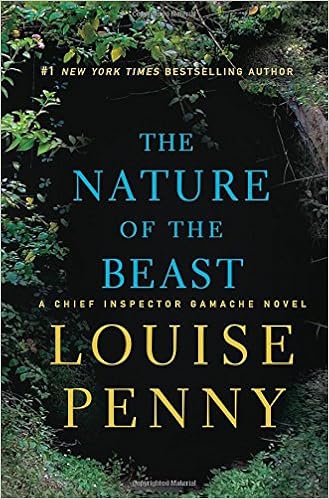
The Nature of the Beast by Louise Penny


The Nature of the Beast feels like a return to form for Louise Penny. It's not that the last book was bad - it was still pretty good. I'm just so used to superlatively good that merely good is a bit of a letdown. Last year was the first year in a while that one of her books hasn't made my year-end Top Ten. We'll see how next year shakes out, but this has all of the things I love about Penny's mystery series.

Gamache and his wife are still in Three Pines, although the job offers for Gamache have been pouring in, and it seems likely he'll be back in some kind of active service in the next book or so. (I've seen pictures of the cover of the ARC on Twitter a couple of times this last week, so I know it's coming on schedule.) A young boy who always tells tall tales comes running into Olivier and Gabri's bistro, talking about a gun as big as a house.

The next day, he's found thrown from his bike, dead in a ditch. It's written off as an accident, but Gamache realizes that some things don't add up. His old team shows up, LaCoste and Beauvoir, to investigate, and they find that the gun as big as a house is far from a story - it's hidden out in the woods, a weapon of legend. A missile launcher without electronics, made by a weapons designer who was murdered in Brussels decades previously.

Two CSIS agents show up, file clerks who know about the designer, as a does a university professor. Unsettlingly, the case seems to bring up casual references to the worst serial killer in Quebec history, at whose trial Gamache found out more about depravity than anyone would ever want to. 

It's a race to find the boy's killer before the news of the giant gun gets out, and to negotiate a murder investigation against CSIS agents who think their investigation is more important. 

So why do I say that it's a return to form? It's tighter, I think, than the last book. Gamache is mostly recuperated and almost back in action, although careful not to undermine Isabelle in her new role. The mystery is compelling. We also get some new insight into Ruth Zardo and her history, and as Ruth is one of my favourite characters, that's very welcome. 

There's an undercurrent here, about art, and intention, and of the ways that art can be an expiation, or, more unsettling, a way to avoid dealing with the past while thinking that you are. Getting stuck on what you think you should be doing instead of moving forward to find the next moment in your life. It's very much a side story centered around Clara, but those last moments were very powerful.

The thread about the gun and the threat it poses to the world is also strong. While they're trying to find the murderer of a child, others are trying to get control of the gun, or find its plans or missing firing mechanism. There are those in the world who would be more than glad to get their hands on it, and that has to be a consideration. But smaller stories must not get lost just because there are big ones, and Penny does a good job of juggling both.

I don't know what else to say. It was a thoroughly satisfying mystery, with an ending I didn't see coming, but which made a macabre sort of sense. There's also some set up for, I presume, later books, with the serial killer. I'm not fond of fiction with serial killers, as a rule, but I'd made an exception for Penny, because I believe she'd have a reason for it. 

Monday, 7 September 2015

The Woman Who Married A Bear - John Straley

Yet another review where I keep opening the file, sit staring at it for a while, then close it down, because I am just not sure what to write. It's another dreaded "well, it was fine" type of thing. As a mystery, it's...perfectly acceptable. It was an easy read. But I won't be rushing out to get the next in the series.

Is that enough? Okay, fine, I can at very least muster up a summary. The detective, who is suitably hard-boiled and drunk, but whose name I can't remember...let me look it up...Cecil Younger!...is hired by an old woman in a nursing home to look into the death of her son. He was a hunter and guide, killed. His assistant was convicted and is in jail for the crime. But the murdered man's mother doesn't think it adds up.

The detective starts to look into in a more or less desultory, drunken fashion, but then his roommate is shot with a high-powered rifle, and this turns into a classic noir trope of someone hurting your partner and you having to do something about it.

Turns out, the dead man's wife doesn't want Cecil looking into it, and his children don't want Cecil looking into it. The dead man's business partner, whose daughter's death was ruled a suicide, even after she was the only witness to the night of the murder, does want him looking into it.

People ply him with a lot of alcohol. His ex tries to convert him to Christ. He keeps drinking. The ending isn't particularly surprising, but it's not bad, either. Like I said, this is a fairly good mystery, but not a revolutionary one.

The inside cover compares him to Tony Hillerman, and I have not read any Tony Hillerman, but I have to wonder if that's lazy marketing based on the fact that Hillerman's books and this series takes place around and in Native cultures. (Cecil is quite white.) I mean, one's Navajo (I think?) and the other Tlingit, in Alaska, so they're probably not all that much alike, but it feels like something a publisher would slap on there to try to sell more books.

The Alaskan setting is interesting, with the frequent small puddle-jumper planes to get to remote areas, but it does feel like a bit more could have been done with it. Most of the action still takes place in cities, or trailer parks, or small towns. There is one trip out to a hunting camp, where the man was murdered.

So, was the man a bear? And if so, who killed him? There are answers, and they're okay. I wouldn't avoid another book by the same author, but there was nothing here that grabbed me and made me eager for another slug.

Wednesday, 29 July 2015

Flash and Bones by Kathy Reichs

Temperance Brennan goes NASCAR! Well, not really, but this one centres in and around Charlotte, North Carolina, just before and during Race Week. It's supposed to be near Brennan's home base, and that worked for me better than the only previous Reichs I'd read, set in Quebec and Hawaii. At any rate, having read two, I'd say this is a competent mystery, but oh man, have I ever been spoiled by Louise Penny. In comparison, this is just so surface.

In other words, if you're looking for a quick, not-particularly-challenging-or-deep mystery, go right ahead. The solution is fairly satisfying. It moves right along. It just doesn't do anything more than be a procedural mystery. Not even capture the lives of the rich and murderous a la Agatha Christie. Or the small town stylings with Miss Marple. It's just so...straightforward.

As far as NASCAR goes, I have to confess that I watch NASCAR with my husband. We've fallen off in recent years, but I'd say we still tune in for a good third to half of the season, whenever it's on TV or convenient. My husband's driver is retiring at the end of the year, so it's anyone's guess if that'll be it for NASCAR for us. I read, and look up every once in a while, check where Jeff Gordon is, go back to the book.

In other words, without being a fervent fan, I know NASCAR. So I have this to say - Reichs has clearly done her research. And her main character doesn't know much about the racing world, so that's fine. What ends up happening is that you get well-researched facts, that still don't quite jump the gap to feeling like NASCAR. That is perhaps inevitable.

However, the end of the book, which I will not spoil, draws on an interesting and disturbing part of NASCAR culture, and when it was revealed that was where we were going, I approved.

There are also the FBI, ricin, white supremacist groups, a missing CDC guy, and a body in an oil drum to contend with. And a sexy head of security at Charlotte? Brennan has a lot of love interests, it appears. The book lists them off at one point, with what I read as an exhausted air. While it's cool that there's no particular premium placed here on settling down into monogamous bliss, one has to wonder if four or five sometimes sex partners in the picture at the same time (most of them to be very far away and have troubles that mean there is no actual sex) is a bit much?

I'm glad it's not the centre of the series. But it's so diffuse, it feels like it could use some pruning. Sorry, guys.

The thing that did bother me about the book was the way Reichs does descriptions. It's more like product placement than anything else. We're always told what brand Brennan's eating, and that's all the descriptive prose we get. It's just lists, not actual description. I started to roll my eyes just a little bit.

In the end, this is fine. It doesn't change my decision to ditch bestseller lists in any way. The mystery is competent. It's not anything more.

Tuesday, 30 June 2015

The Long Way Home by Louise Penny

*Minor Spoilers for Previous Books*

Huh. Clever. I noticed that the cover image was upside down before I started reading it, but it never occurred to me while I was reading the book. It's only now that I'm grabbing an image to use for this  review that I realize why it's upside down. Very appropriate.

So, Gamache has retired! He lives in Three Pines now, with Reine-Marie, and Henri the dog, and heals from a gunshot wound and from everything that led him to the end of the last book. The big question is not, will Gamache take up a case again. It's whether or not the book after Louise Penny tied together all of the loose strings of the overarching mystery in virtuous and heartbreaking form could possibly live up to the masterpiece that was How the Light Gets In.

The answer appears to be, yes and no. Yes, this is a wonderful book, as always. It's a wonderful mystery. It's a wonderful character study. She understands pain as few authors do, period, let alone manage to bring that effortlessly into a mystery novel. On the other hand, it's possible nothing could have topped a book like the last one, and I'm not sure Penny is trying. That's probably wise. Still, I missed that slow burn of the long plot.

Penny has wisely focused this down to a more domestic story. Several books ago, Peter left. The arrangement was that he'd come back in a year, and then he and Clara would see if there was anything left of their marriage. The day came, and went, and not only was there no Peter, there was no word. At all. Clara becomes worried about it, although sure he's out there somewhere. Gamache fears that perhaps Peter became despondent out there, away from the cocoon of Three Pines. He and Beauvoir help Clara and Myrna try to track Peter's journey once he left.

It goes strange places, and seems to show a man in search of a different artistic soul than the one he had honed into technically amazing but safe paintings, to be outstripped by a wife who dared more and eventually reaped greater success.

More than that I will not say, about the main plot, except that it was a physical challenge not to flip to the end and find out if Peter was all right. I managed to hold out until about the 2/3rd mark, which may be some kind of record for me. (I'm not recommending this, mind, I'm just saying.)

What struck me the most, in addition to the things that always strike me about Louise Penny books, was one particular theme. When Clara comes to Gamache for help, he is reminded that he could say no. He's retired. He'd been shot. Emotionally, he is still fragile as well. And he says something that hit me with a ton of bricks. Paraphrasing greatly, and possibly changed by my days of thinking about it, he says that if it's a recovery that depends on becoming entirely focused on himself, on rejecting all sense of community and obligation to each other, then it's not much of recovery at all.

That was very powerful for me. I know that recovering from difficult times often needs a time of self-absorption, but sometimes it feels like people get stuck there, that they decide that now they're taking care of themselves, they only need to take care of themselves, and stay in that place. Gamache is wise and strong enough to recognize that, even fragile, we are part of the world we inhabit. And while saying no to some things is a part of healing, so is saying yes, I will help you.

So, while this wasn't the tearfest that How the Light Gets In reduced me to, particularly Beauvoir and Rosa the duck in his car, I am not disappointed. I miss the overarching story, but this was a smaller story, delicately told, and I come out of it again feeling like she has been able to put words to fragile human experiences that I haven't seen depicted on the page again.

Monday, 26 January 2015

Death Comes To Pemberley by P.D. James


P.D. James tries to combine her mysteries with Jane Austen. There has been a great division of opinions on this book. The blurbs try to make it sound like the most amazing book ever. Most of the people I know who've read it dislike it intensely. I don't feel that strongly one way or another - at most, it awakens in me a sense of slight disappointment. This isn't that good, and it isn't that good on both the mystery and the Jane Austen novel levels. On the other hand, it isn't abhorrently bad. It's just bland enough that I don't have a strong reaction to it.

Let's take those two elements in turn. It feels like here, P.D. James is trying to show us how policing and the justice system has changed. But it's not really a mystery. It's missing a detective, or really, anyone who is looking at the evidence, trying to ferret out the truth. I realize that being a detective as such is anachronistic, but even without having that formal position or informal undertaking, the mystery part falls flat.

The story just sort of happens, and that would be okay, if it were a little more lively. This is sedate without being interesting. Austen may have been sedate at times, but she was also always interesting.

The answer to the mystery arrives by carriage at the end of the mystery, and so, without lifting any fingers, it is solved. This is less than satisfying. Other authors, writing before the advent of detectives, have still found ways to give us that central character who is trying to get to the truth. It might be an experiment to see if you can do without them, but it's not that successful of one.

As for it being an Austen book, ten years after Pride and Prejudice, it's not terribly successful at that. The faux-Austen prose is clunky, and that's almost an unforgivable sin. It calls attention to itself, and there is too much of a data dump about what they're eating, or what the rooms look like, and it seems to be there to prove that James has done her research, rather than for good effect. If she's trying to ape Austen, it's done without grace. Also, you're P.D. fucking James. You should know you don't have to show all your research.

The biggest problem, though, is that the characters are boring. Elizabeth Darcy should not be boring. She may have changed, but you can't make her boring. That's ridiculous. Also, you know how Austen always has that one character who chatters on and on and you kind of want to kill her, but she's also so vibrantly alive that somehow she needs to be there? There is nothing like that. At all.

Lydia ends up being more interesting than Elizabeth, and a) really? And b), if that's the case, give us more of her than just having her go into hysterics once. We keep hearing about her being overbearing, annoying, hysterical, and quite frankly, that makes her the most interesting character in this book, but we barely get to see her. There is scarcely a scene that I didn't think would be improved by her presence. If you've made a vibrant character, why would you banish her to the spaces between the pages?

As far as I can tell, the book is missing feeling. With it, I could have forgiven the rather lackadaisical mystery. In Austen, there is a distinct difference between what the characters are doing and what they are feeling. They may be acting proper, but man, is there stuff roiling beneath the surface. And there is really none of that. They all seem to be pretty much as sedate as they act, although mildly perturbed at what has gone down in the woods near Pemberley. That is not enough to make a book out of, and it certainly doesn't do justice to Jane Austen.

Oh, P.D. James. I do like your mysteries. But this one, while it wasn't atrociously terrible, missed on virtually every aspect I would have wanted out of this book.

Friday, 5 September 2014

The Cuckoo's Calling by Robert Galbraith

I wish I knew what I thought of this book before I knew it was written by J.K. Rowling. It was obviously important to her to fly under the radar, at least for a while. And my reaction is undoubtedly coloured by that knowledge. The first fifty pages felt a little forced, compared to the rest of the book, which flowed on smoothly from about that point. If I hadn't known, would I have found those first 50 pages less to my taste? Would I have given the book less of a chance?

We'll never know, I guess. But in the end, whether or not it was influenced by my knowledge of who the author was, I thought this was a very solid mystery. I am looking forward to the second one, and have recommended this first one to my mother and mother-in-law, both heavy mystery readers.

So while I did find the first fifty pages or so a bit jarring to read, it settled down into nicely readable prose, which is something Rowling tends to excel at. It's not overly literary, it's not cloying, it's relatively straightforward and enjoyable and does not call attention to itself.

More to the point, Rowling also weaves in quite a bit about class in English society into the narrative, although not, obviously, to the degree that she did in The Casual Vacancy, and her commentary on the topic is always fascinating. It's this presence behind everything, and she is thoughtful in how she pulls it out, how people react to others based on perceived class, how it continues to operate in society.

Right, the mystery. And the detective. Those two vital elements in any mystery series. A supermodel falls to her death from her balcony. The police rule it suicide. Her grieving brother believes it was murder, probably by her junkie on-again/off-again boyfriend. He hires detective Cormoran Strike to investigate.

So, the detective? Other than the fact that my brain wanted to supply a concluding "t" to his first name every single time? He's a war veteran, missing part of a leg. He's the illegitimate son of a famous 70s rocker who wants nothing to do with him. His beautiful upper-class fiancee has just broken up with him. Again. He has few private detecting jobs.

Luckily for him, the temp agency sends Robin to be his new office assistant, and she is thrilled at the idea of working for a detective, although her fiance is not. Rowling strikes a good note here between having Robin be smart and capable, but not having her immediately become a brilliant detective. She helps out in important ways, but she's not a Watson, nor is she an unbelievable natural mind at the detective trade. Much of it seems to be learned.

Strike takes the case because he badly needs the money, although he believes that the model probably did commit suicide. Slowly, he changes his mind. I won't, of course, even hint at who the killer is. It's not a bad solution to the whole matter, though.

But it's the minutiae that shine here, the slogging through the days, the recalcitrance of witnesses, and cushioning of money. Most of the people involved have the power to decline to participate, and many do. It's no mistake Strike gets to talk to the police, the model's driver and the building security guard before he does the lawyers, the film producers, or the fashion designers. Those people all have people meant to bar access.

I can't say this was a revelation. It's certainly nowhere near on a par with Louise Penny, who I think is the best mystery writer writing today. And perhaps for a long time. But it's fun, it's solid, and it's satisfying. That's enough.

Wednesday, 27 August 2014

No Questions Asked by Ross Thomas

No Questions Asked is a solid mystery/suspense. It's probably not going to stick with me over the long term, but I enjoyed reading it, and will look for more by the same author.

There seems to be a whole minigenre of non-detective detectives - Bernie Rhodenbarr from Lawrence Block's Burglar Who...series springs readily to mind. Or Dortmunder from Westlake books. This book is firmly in that tradition, with the main character being on neither side of the law. He works as a go-between.

As the book starts, Philip St. Ives, (I had to look up the name, even though I just finished the book two days ago,) is hired by an insurance company to handle the hand-off between the company and the thieves who stole the rare book they had insured. Double-crossing naturally ensues, and St. Ives wants to track down what the hell just happened to him.

Along the way, he hires an aspiring young political operative as his driver in an unfamiliar city, gets cozy with the owner of the rare book, as well as with a psychiatrist/poker player, loses a friend, and sorts out a tangle.

I figured out the culprit fairly early, but there was enough in this book to keep me interested. I don't think this author is going to become one of my favourites, but it was fast and fun to read, and just the sort of break I needed from heavier tomes.

Tuesday, 22 July 2014

Butcher's Hill by Laura Lippman

*Some Spoilers Below*

This was a pretty good mystery, marred by a hasty ending. But after reading that dreadful Patricia Cornwell book a week or so ago, this was just the palate cleanser I needed for that genre.

I wasn't expecting too much when I opened it, and I've never read any Laura Lippman before, but from the beginning, the characters were interesting, the mysteries engaging, and the book moved quickly from scene to scene.

The theme of the book centers around children who go into the system - the detective, Tess Monaghan, is hired by one client to find the daughter she gave up for adoption, while the other client went to jail for shooting and killing a boy who was in foster care. This character, Luther Beale, claims he wants to try to make some kind of peace with the other children who were present the night Donnie Moore was shot. Tess believes him. And then those children start to turn up dead.

The problem I did have with the book is that the epilogue is far too rushed. I have this theory, that I just came up with, that an epilogue can add one major piece of information per character. More, and you needed another chapter earlier to relay one of those pieces of information or to foreshadow it, or something. But in the epilogue, too much comes out, it's all too fast, and I wasn't given time to process any of it.


For example: *Major Spoilers*

Okay, Jackie did decide to be in contact with her daughter, fine.

But wait, the entire Monaghan family had welcomed her into the fold after they found out she had had a child at sixteen by the patriarch of the family? (It's not that this couldn't happen, it just can't happen off the page and be convincing.)

And she is in the process of adopting the infant and orphaned sister of Donnie Moore?

And is something going on between her and the cop?

Some of this needed foreshadowing.

And so we find out Donnie Moore's foster parents were gaming the system for money. Fine.

But they were also gun running?

And acting as Fagin, sending out their foster children to steal for them?


It's too much of an infodump, and some of it really needed to be in the main narrative, or hinted at in the main narrative. As it stands, the book downloads all that and more, in the last 5 pages. These are important enough developments to be part of the denouement, not the epilogue.

While this wasn't the greatest mystery in the world, it was solid. Lippman doesn't have the style of the truly great mystery writers, but I enjoyed Butchers Hill, and will probably read more of her books.

Sunday, 20 July 2014

Trunk Music by Michael Connolly

This is my first Michael Connelly, and thus, obviously, my first Harry Bosch mystery. And, as always, I throw continuity to the wind and start somewhere in the middle! Who needs beginnings?

I don't know why I was suspicious of this author. Maybe just how often he's appeared on best seller lists, which, given my recent run-ins with bestsellers (I'm looking at you, Sarah's Key!) starts me off from a position of skepticism.

Maybe it's because, like James Patterson, Connelly has appeared in one of the poker games on Castle. I like Castle, but I'm not hugely fond of Patterson, so I was unfairly lumping them together.

This is not in any way like a James Patterson book. What it is is a very solid police mystery, with some sidebars on evidence tampering, suspicion of police misdeeds and actual police misdeeds, and how one can often look like the other.

Harry Bosch is just back on the job (I don't know why) after an enforced absence, and the first case that comes his way involves a corpse in a trunk, shot at close range. Is this a mob hit? Organized Crime says no, but they say it suspiciously quickly. Victim went to Vegas often, and may have been into something shady there.

The mystery itself is very competently executed, and sufficient twisty for my satisfaction. I enjoyed Bosch's character, and in particular, the relationship he knows he shouldn't pursue but does anyway. The police politics rang true, although I dream of the day when those who try to make sure that police officers aren't abusing their authority aren't automatically villains with massive sticks up their collective asses. Because, dude, it's not like police don't sometimes abuse their authority, and it's not like we don't need some oversight of that stuff.

Friday, 18 July 2014

Fer-de-Lance/League of Frightened Men by Rex Stout

To be precise, 3 stars for Fer-de-Lance and 4 for The League of Frightened Men.

Nero Wolfe books are always a great pleasure to read, and the wonder is that it's taken me so long to get back to them. There were always a bunch around when I was growing up, but they aren't something I've returned to as an adult as much as I have to, say, John D. MacDonald. As mysteries, they're entertaining, but much of the pleasure lies in the world Rex Stout creates for his main character, the insular haven to which people must bring him problems, and which he rarely ever leaves.

Of course, for that he has Archie Goodwin, womanizing leg-man, who is sent out on what seem to him nonsensical errands that somehow always lead Nero Wolfe to the bad guy. Not that Wolfe is interested in catching the bad guy for the sake of justice. Oh, no. For that, son, he's got to get paid. In fact, in both these books, Wolfe makes deals that, if they panned out the way they were offered, would shield a murderer from justice, as long as Wolfe gets his money.

Of course, it never works out that way, and he and Archie Goodwin teach the cops how to do their business, in between daily orchid-tending and eating world-class food.

Of the two, Fer-de-Lance, the first ever published, is decidedly the weaker, as the murderer is revealed fairly early on, and the snake doesn't make an appearance till near the end. When the blurb on the back promises me that in the midst of an investigation that some unknown adversary will send Nero Wolfe a deadly snake, I wanted that snake earlier, dammit! And to come with some mystery about who had sent it.

The second, The League of Frightened Men, was far better. The mystery started to click, and the twists were less obvious. Threatening (and terrible) poems are sent to a group of men, claiming responsibility for unsolvable deaths, and threatening vengeance. The men are certain they know who's behind it. But can Wolfe find the proof?

Well, of course he can. What were you expecting? The real mystery is, what could possibly entice Nero Wolfe to leave his home voluntarily?

Monday, 14 July 2014

Mrs. Pollifax and the Golden Triangle by Dorothy Gilman

I love the Mrs. Pollifax book. They are, as I've said before, some of my favourite comfort reads. When I need an old friend, this senior citizen CIA spy is one of my favourite companions.

This particular Mrs. Pollifax book, however, is not one of the best. The characters she meets don't jump out at me the way they do in other books, and Mrs. Pollifax herself feels a little flat.

Was Dorothy Gilman trying to figure out how to deal with Mrs. Pollifax now that she's married? If she was, I thankfully know it gets better from here. And I love Cyrus, her new husband.

In this book, on their holiday to Thailand, after Emily Pollifax is recovering from her most difficult mission yet, she is asked to do a simple exchange and then enjoy herself. Of course, nothing goes right, her contact is dead, and Cyrus is kidnapped. The rest of the novel is the search for Cyrus through the wilds.

Mrs. Pollifax has two very endearing qualities. She is genuine and makes friends everywhere she goes, and she is persistent and comes up with inventive solutions. Where this book falls apart is that we still get the former, but lack the latter.

She is just as good as ever at collecting friends along the way, although those friends do not stand out the way they have in other books. But, despite the fact that she's trying to find her husband, Emily is pretty much along for the ride. She herself isn't figuring out ways to help Cyrus. Other people are doing that for her. When she meets a mysterious man out in the jungle who ends up poisoned, she gets to wait with him while others go for help.

In short, she isn't the resourceful, dogged Mrs. Pollifax I know and love. She's still friendly, but she's not thinking.

And so, while this is still entertaining, it's one of my least favourite Mrs. Pollifax books.

Monday, 30 June 2014

61 Hours by Lee Child

Let's get this straight - this isn't deep. It's not literary. But when I wanted a light read at my in-laws over Christmas, this was just about perfect. It's not taxing, but neither is it the incredibly short chapters and no-mystery-at-all of a James Patterson book. In fact, Child pulled off the difficult trick of making me think that my first instinct about the bad guy was wrong, and then having it be true after all. That's a good move - the staple of J.K. Rowling, when it came to Snape.

And the misleading was subtly done. I was quite appreciative when things became more clear.

So yeah, solid thriller/mystery. Jack Reacher gets marooned in a small Midwestern town in the midst of a terrible winter, just a new prison has been built, and a local witness is under threat from a faraway drug lord. Also, there's a mystery military bunker outside of town that the bikers have set up shop outside of. Reacher ends up pulled into the world of the local police to protect retired librarian Janet Salter, whilst trying to figure out what the military built that has been so utterly forgotten, and what possible importance it could have to those occupying it now.

And again, I didn't see either of those two answers coming, but they were satisfactory when they came.

Reacher is an interesting character, and the people who populated the small town were well-written and distinct. The notion of a travelling hero is an intriguing one, and I think it worked very well in this book, although I have no idea if it's getting a bit repetitive.

I've now read the first Jack Reacher book and this one. I'll probably delve into reading more - not with any haste, but if they come my way, I'm more than happy to pick them up and devour them. Unlike James Patterson books, which have been relegated to the "thanks but no thanks" pile, which is reserved for authors I don't hate, but couldn't care less about.

And of course, the book ends on a cliffhanger, which intrigues me, but doesn't fill me with any sense of urgency to pick up the next book. It's one where the outcome is totally dependent on how the author feels about the series, and I'll probably find out eventually, but in good time. Lee Child sits solidly in the interesting, but not addictive category.

Thursday, 19 June 2014

Worth Dying For by Lee Child

I enjoy the Jack Reacher books. I've dipped into the stream here and there, and I'm pretty sure I read the book right before this one, as the events he has just come from sound very familiar. And this is another fine entry. Child writes very enjoyable mystery thrillers. They aren't deep, but they are twisty, and Reacher is an entertaining hero. He gets less character time here than in some of the others, though.

It feels like his personality in this one can be summed up in one word - implacable. He's always been dogged, but it almost gets taken to a new level here - or maybe because there's so little else. Maybe it's always been that way, but it felt more obvious.

In this one, he's rather beat up. More than usual? I'm not sure. But he's hitchhiking his way across the northern Midwest, when he gets let off in a small town entirely under the thumb of one family, who does all the trucking for the farmers in the area, and enforces their will with a matched set of former football players.

Just trying to get a room, he ends up getting involved. (Naturally.) There's a domestic abuse call for the doctor, who has been told not to see to her. Reacher persuades him, and drives him, and then goes and breaks the abusive husband's nose. The abusive husband is one of the powerful family.

He can't leave town now, as the powerful family has put out the word. And everyone obeys. They have since a little girl went missing decades earlier, was never found, and the family was cleared of all suspicion.

So of course this is the kind of situation Reacher can't leave alone. He picks at it, and picks at it, leaving an impressive pile of crippled football players in his wake. He looks at the police work for the cold case. He befriends the locals. And he evades the three sets of errand boys for various mobs who have been dispatched to make sure the next shipment of whatever shady thing it is the powerful family are also shipping, along with the wheat, makes it through.

When what the shady business is is revealed, right at the end, it's difficult. While Reacher books are generally a bit hard-boiled, this one was almost too much. It makes sense with everything that's gone before, but still.

There isn't a damn thing that's new here, but it does what it does well. If you like the series, you'll like this one. If you're looking for something innovative, look elsewhere. But for a straightforward thriller, this is a competent and enjoyable one. Even if it did get a little too serious for me there at the end.

Friday, 13 June 2014

How The Light Gets In by Louise Penny

This is a very special series, and Louise Penny a truly remarkable mystery writer. I read mysteries, on occasion, but they're not books to which I get greatly attached. Generally, they are light fluff. I'm not sure you could have convinced me that reading a mystery would reduce me to big soppy tears for most of the last two chapters.

But that's what happened here.

First off, the warning. Do not read this series out of order. There are few mystery series where I think that would matter, but it does matter here. Start at the beginning (you won't regret it) and work your way forward. Because there is an overarching story that is only hinted at in the first couple of books, but becomes more and more apparent as the series goes on.

How The Light Gets In is the culmination of the long arc, and it is worth the trip. Of course, it doesn't hurt that the trip has uniformly been so excellent, so perceptive about people, with mysteries so intriguing and characters so rich. But this is where it's all been headed, and that hit me like a ton of bricks.

Where do we go from here? There are strong hints that this is not the end of the series, but it is the end of the overarching plot about a creeping corruption in the Surete de Quebec. It's rare that I've seen a mystery series with that kind of long-term goal in mind, and one that is parcelled out so perfectly over so many books that the emotional impact when we got to this point nearly broke me.

We're back in Three Pines for this one, which is welcome. I've missed this cast of characters, in their roles as witnesses, suspects, and killers. The crime took place in Montreal , but the victim was on her way to Three Pines for Christmas, and perhaps was killed to keep her from getting there. When Gamache, Chief of Homicide, gets the case, he soon finds out that the woman was one of the famous Ouellet Quints. (Think Dionne quintuplets, with large amounts of artistic license.)

Who would have wanted her dead? The answer is satisfying, but really, the story in this book is the culmination of the Surete storyline. It centres around Gamache's decimated homicide department, dispersed and filled with jackasses, as those above him try to discredit him. It's about who he can trust. And it's about the heartbreaking relationship between him and his former second-in-command, Jean-Guy Beauvoir.

There's a point in this book with a duck that started the tears running down my face, and they didn't stop until I'd finished. I'm not going to say any more than that. Those who have read the previous books can guess who the duck is, but I'm guessing they didn't see this moment of grace coming.

Gamache has long believed that kindness and love are stronger, in the end. He investigates those moments when they've turned into their opposite, but he is a fundamentally optimistic and compassionate man. Are those qualities rewarded? I'm not telling, but you owe it to yourself to find out.

I don't care if you're a mystery reader or not. If you are, you'll love these. If you're not, you still ought to check them out. These are something truly special. And as we reach the end of that storyline, if not the series, I am so glad I've been on board for most of the run. The emotional impact was staggering.

Scarpetta by Patricia Cornwell

Spoilers Below. Also, trigger warning for discussions of sexual assault.

 This is my first Patricia Cornwell, starting 16 books into the series, which is probably not optimal. Earlier books may be better. I may try them some day. I may not.

I did, however, come in with a bad attitude towards the author and her knowledge of how detective work might work, given her ludicrous TV special on Jack the Ripper, in which she based her conclusions on two pieces of "evidence" (both DNA evidence and handwriting analysis failed to turn up anything):

1) That the artist she thought was the serial killer had used the same kind of commercially available stationery as the person who sent the Jack the Ripper letters to the newspapers (which the police never thought were written by Jack the Ripper anyway)

and

2) She didn't like his paintings.

I'm not kidding. So my views of what she thought was good evidence were extremely dim. However, the biggest issue with this book is that it's far too obvious. Pretty much the first time she introduced one character, I knew they were the killer. To be more obvious, Cornwell would pretty much have to have had "perpetrator" tattooed on their forehead. I also guessed by the halfway point who was behind the gossip column.

I never guess whodunit, so trust me, this was very painfully obvious.

Being able to guess who the killer is is not necessarily the death knell for a book, as long as there is still enough there to keep the reader engaged. In this case? There were a few interesting things, but no, not really. So a mystery, it was a bust.

This next section is about sexual assault, which was very troubling.  I take it an assault occurred in the previous book, when Scarpetta's partner attacked her. In the whole book, much more of the concern was for him than for her, and every time she took the blame on herself for the attack, in the present, or in flashbacks, no one contradicted her. Everyone insisted it hadn't been an actual crime, since it wasn't an actual rape.

Wrong. And just once I wanted someone to grab Scarpetta, who as a character is a bit of a opaque cloud devoid of quirks or personality traits, and tell her "You know what? Doesn't matter if you weren't assertive enough in every situation. The punishment for that should not be attempted rape!"

And her boyfriend's reaction being to protect the assailant's career and avoid the issue? Blech.


Also frustrating was the book's confusing conflation of consequences and vengeance. If you weren't the serial killer and thus irredeemably evil, having any consequences happen was seen as being vindictive. I'm sorry, Scarpetta. Reporting the psychiatrist who leaked confidential information about your attempted rape to the medical college is not vindictive, it's actually an obligation. It is a requirement, if regulations in the U.S. are anything like they are here, for a doctor to to report such huge lapses in professionalism in a fellow doctor.

If someone tells me the earlier ones are better, I may try them. If not, this is where I get off the Patricia Cornwell train, for good, after only one book.

Monday, 9 June 2014

Spider Bones by Kathy Reichs

This is the first Kathy Reichs I've read, and, well, I didn't hate it. (Unlike the Patricia Cornwell I read last year.) But neither am I really grabbed by it. Will I read more? Only time will tell, and whether or not one of my lists coughs up one for me to read. I certainly won't avoid it, but I know there's at least one mystery writer writing forensic anthropology mysteries that my mother likes more. Maybe I'll search him out.

Also, I watched the first two episodes of Bones and hated, hated, hated them, so that might explain why I avoided these for so long. I knew the books were probably better than the show, but the association lingered. I've also been told the show got better, but I've never gotten back to it.

Temperance Brennan is doing her thing with a drowned body in Quebec when the fingerprints throw up an American, long dead in Vietnam. So she is requested to go and disinter the recovered remains of that vet from his family cemetery. And then she is requested to go to Hawaii. This requesting go on a lot? While interesting, it did leave the story feeling a little fractured - oh yeah, there was this story back HERE we haven't talked about in a while.

So she goes to Hawaii where the task force for finding American military remains and repatriating them resides. And where she used to work. And there, she finds more relevant bodies than you can shake a stick at, and some surprising DNA matches and lack of matches.

I'm all for unlikely medical twists, but there were two in this book, which feels like one too many. When you have two conditions or events, for each of which there are only one or two recorded precedents, including both does strain credulity.

It also puts this book into the category of pulling out left-field information to solve the murder, something the reader could not possibly have guessed. I don't have a huge problem with that, but I do tend to classify such books mentally as thrillers, rather than mysteries. (I'm looking at you, James Patterson!) But this book has enough actual mystery, and a few bits where I could speculate on what had happened, to keep it in the mystery camp.

The family drama was fine, but didn't add a ton to the story - it felt like it would be largely the same story without it as with it. But as a mystery, this was fine, if not great. I doubt it will linger in my memory for long, but I never got angry with it.