Pages

Showing posts with label nonfiction. Show all posts

Wednesday, 12 October 2016

Living With A Wild God by Barbara Ehrenreich


This is definitely not for what I usually sit down to read Barbara Ehrenreich. That's not necessarily a bad thing, but it did take me a little while to adapt to what was not a story both personal and researched, relating her experiences to wider domains of thought and study. There's certainly work out there on mystical experiences and the like, but she is not drawing it in and weaving it with her story. This is as close to a straight-up memoir as I've ever seen from her.

I miss that, the strength that she so often has in relating the personal to the theoretical, to drawing on buttloads of research to make engaging and compelling arguments.

However, now that I've said what the book is not, perhaps I should take a look at what it is. It is Barbara Ehrenreich looking back at both her spiritual and ethical development, coming from a family that was staunchly, even fervently, atheist. She's an atheist too, or has been, or sort of.

The sort of enters the picture because, as a teenager, and less frequently since, she's been having experiences that most closely fall under the umbrella of mystical. Without recourse to any material on the topic, as a teenager, it felt close to losing her mind, although Ehrenreich firmly refuses to be medicalized in that manner.

That's the vaguely spiritual part - these were terrifying experiences, inexplicable by what she knew of the world, and persist as unexplained to this day. But that is paired with what might be better termed her philosophical struggles, complete with a remarkably intense bout of solipsism.

This was one of those moments where I stare at the page, amazed. I remember running into solipsism in my last year of high school, playing with the idea for few minutes, then more or less dismissing it. I never had any doubt that people around me were autonomous human beings with their own thoughts and desires. I would attribute a lot of that to my parents, who, early in my life, encouraged me to understand why people did what they did, by constantly asking me why I thought someone had acted in a way that upset me. It drove me crazy then, when I just wanted to be angry, but now it is one of the parenting techniques for which I am most grateful.

It was difficult and interesting to come into someone else's journey towards falling in love with humanity that was so dramatically different from my own. Ehrenreich's story has the solipsism persisting, in one way or another, until her graduate work, when she was suddenly struck by one of her labmates concerns about being sent to Vietnam, causing a breakthrough in seeing people as different, and also as worth fighting for.

In that way, it's about how she comes to identify herself as an activist, to embrace learning and writing about things less easily quantifiable, and in the end, to try to come to grips with those parts of her life that still defy easy explanation. Her conclusions draw on all of these strains in her life, her atheism, science background, social science research, and the experiences which shaped her. It's an interesting read, although at times I did want it to be leavened with research.

But that is not this book.

Wednesday, 17 August 2016

Being a Dog by Alexandra Horowitz


I was a little uncertain about reading this book, even when it was sent to me by the publisher as an ARC. I mean, I read Horowitz's last book, Inside of a Dog, which I enjoyed even though I am not particularly a dog person. Particularly, it was helpful in letting me understand what is going on behind doggy eyes and noses a bit more. But from just the title, my question was whether or not this book was going to be very different. Are we just rehashing what I've already read? 

As it turns out, this book was varied enough that I avoided my worst worry of a retread. It's still not the sort of book I'd probably seek out on my own, but for nonfiction of the type, it's well-written and entertaining, with at least a few anecdotes I felt the need to tell my husband. Horowitz's voice is inobtrusive, and when I did notice it, it was to appreciate a bit of well-placed irreverence or cussing.

The book starts with how dogs smell, and comes back to the topic frequently, but is really about smelling more generally, and how dogs utilize smell differs from how humans do, and the strengths and weaknesses of human smell. At the end, she concludes that we still can't quite conceptualize how dogs smell, as so much of our own taste of smell is tied, she argues, to language. This is a convincing argument, made subtly over the length of the book. And so, with our ways of organizing and smelling conceptually, we're still not a lot closer to knowing how dogs experience smell. That they can, and that they excel, there's no question. But what it's like, that's quite different.

I think it's too harsh to call this book inoffensive. It's really quite a pleasant read, and made me pay more attention to what I was smelling, at least until I got struck down by a dreaded summer cold that has laid me up for the last several days. But it's not a ton more than that. It's very much in the genre that Mary Roach has staked out, although Horowitz' own science background contributes in interesting ways.

Like Roach, Horowitz has picked a subject and moved around it, examining from many different angles all passed on to the reader through as much personal experience as she can garner. It works as a way of writing science non-fiction, giving laypeople an entry into a world they might otherwise not see. Or smell, I suppose, in this case.

Smell, it is often said, most elegantly by Proust, is the key to memory. We can be brought back to childhood by smells that unlock memories. While I don't dispute this, I think the most interesting thing Horowitz does here is to make it clear how hard it is to smell smells detached from context. Memory itself seems to be tied intrinsically to locating a smell, or a smell a memory. But when you're just put in front of a box with a 1000 smells, as she was, without context, you're at sea. Memories don't always pop up, and the smell remains frustrating without language or a past. 

I'm not really sure what more to say. Being A Dog has a slightly misleading title, being only about half about dogs, and half about smelling in general. The two halves are mated thematically, if not compellingly. If this is a genre you like, this will serve you well on the subject of scent. I enjoyed reading it, although I'm not that sure how long the book will linger in my memory - there's nothing that grabbed me intensely, although much I had pleasure reading.

(An ARC of this book was provided in exchange for an honest review from Simon & Schuster Canada)

Monday, 13 June 2016

Daring Greatly by Brene Brown


This is rather far afield from the books I usually read. I have a healthy skepticism about self-help books born of years working in a bookstore, seeing the vast mass of them and how few looked like they offered anything at all but platitudes. However, this was a pick for my real-life book club this month, and so I sat down and read it. It didn't hurt that a youtube video of Brene Brown (not her ubiquitous TED talk) had helped me figure out a few things during a stressful time.

So, when I sat down and read this, what did I find? I liked a lot of her message, and felt that the book was strongest when she was drawing directly on her research. However, there were a few sections in the middle where it got a little mushy, and one particularly irritating moment when I had a moment of recognition, and then very little help. 

Her main thesis (looks liked explored more thoroughly in a previous book) is that when she studied people who lived wholeheartedly, she found that they were the very people who accepted and even embraced vulnerability despite how much it gets you hurt.  And that shame was the greatest barrier to embracing vulnerability, because we think other people will see our openness as weakness.

In general, I'm on board. Her main ideas feel right, and she has a few practical ideas for staying mindful and opening yourself up. (On the other hand, most of the kinds of vulnerability she's talking about I already feel like I'm fairly good at embracing, so I would wonder how this would read to someone who is entirely vulnerability-averse.)

I am particularly wary of self-help books when they advise being more vigilant every second to make sure that you're doing this right. It's a twisted way of creating more stress - when your happiness is all your own responsibility, are you doing enough? Being enough? If you're not happy, is it really your own fault?

At least this book is striving to help people achieve a sense of innate worthiness no matter what happens in their lives, of knowing that bad things happen and you can fuck up and that does not mean you are a horrible fucked-up person. I feel like in the the last ten years, I arrived at a place of believing that I was an alright person, no matter what happened, and deserved my spot here as much as anyone does. (And furthermore, that it's not a matter of deserving, so just let that the fuck go and be here.)

(Thanks, Mom and Dad, for well equipping me to arrive at that place.)

So, in other words, I'm already on board with her general ideas. But there was this one section that annoyed me and got a little mushy. In the section on armour, she goes through what she says are the three distancing/coping techniques for vulnerability that everyone uses at some time or another, and ways to combat them. Then she goes through some less frequent ones. And one of those made me stop and go "yes. That's what I do. That's the one I use." Then I was eager to see what she'd say was a good coping technique with that particular armour.

But she really didn't. It felt like her research hadn't covered that one yet, so she could identify it, and all she said for addressing it was "when I'm doing this, I think of this one movie that contains the line I'm referencing in naming this armour, and it makes me stop."

That is...not that helpful if you've never seen the movie and are unclear on how knowing the movie would help you stop. I get that it's a deeply personal reminder that works for her but this is one place I really wanted some simultaneously broader and more specific advice like she was dispensing earlier in the book.

I don't think this book changed my life. I mean, really, it was more or less validating for several strongly held beliefs I had, so it was a welcome reminder, and gave some good advice on how I can keep working on something I'm already working on. Ways to think about it.

Friday, 22 January 2016

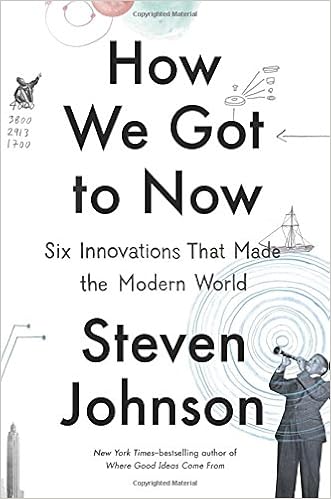
How We Got To Now by Steven Johnson


Tonight (by the time this gets posted, it will be yesterday), I go to my book club, where this was our choice this month. I don't mind reading non-fiction, although I am not entirely sure what we will be talking about. This book was entertaining, not as deep as The Ghost Map, and...neat?

In his favour, Johnson's writing style is as accomplished as ever. He's an engaging writer of popular history, and the way he writes is unobtrusive. In this book, he looks at "six innovations that made the Modern World," although truthfully, what he's looking at is a theory of innovation that depends not on the lone genius, but on the necessary preconditions for certain discoveries, and the ways in which their impacts are broader and unexpected, in ways both good and bad. 

I'm trying to remember what the six are, and it may not be the greatest sign for how well this book will wear that I'm not sure I remember all six, even though I finished it less than a week ago. Let's see. There's...Glass. Sound. Light. Cold. And...hmmm.  And...nope. Gone. I'll have to look them up.

Clean and Time! There we go. 

It's sort of a strange way of dividing it, one obviously done to tie in with discrete episodes of television, as it's less a single innovation than a constellation of innovations around a general topic. That's harder to put in a blurb, though. 

The thing is, this book is just chock full of interesting little facts and insights. When he looks at cold and ends up by tying the growth of cities in hot areas to air conditioning, I am fascinated. There are tons of interesting linkages here, ways of looking at the effects of technologies that I had not thought of.

And yet, it remains a bit scattered. Unlike The Ghost Map, where he was bringing a really great sense of making nuance accessible, in this book it seems a little more surface. It would be interesting to compare this to the TV show, because writing is able to go into ideas in depth that an hour long show just is not going to be able to. And while he is able to bring some depth to the writing, it doesn't amount to a lot more than a ton of admittedly fascinating anecdotes.

But if that's all we get, fascinating anecdotes are perhaps enough. As is the idea that great inventions are far more than a moment of inspiration by one lone inventor. The problem is just sort of this...I'm about two thirds of the way through the normal length of a review, and I've run out of things to say. I think everything from this point would be a reiteration of "boy, there sure are some good tales in this book!" 

So maybe I'll leave it there, a slightly shorter review, but not really a negative one. Just not a hugely enthusiastic one either.

Friday, 20 November 2015

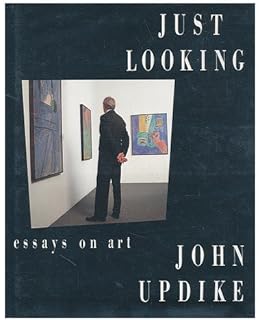
Just Looking by John Updike


This is quite unlike most of the books I read. It's not fiction, which is the vast majority, or a focused non-fiction. It's a collection of essays about art and artists, written by a man best known for his literature. (I have only read Rabbit, Run, and I can't say I loved it.) I know very little about art. At all. 

So it's interesting to get a perspective from a layman, although Updike is careful to make sure he comes across as an educated and erudite layman. He wants his readers to know he knows what he's talking about. Still, this is primarily essays from the perspective of someone who enjoys art, but has not put a lifetime into studying it. Very few people can do that, and they would be unlikely to reach that stature of Updike has in popular consciousness. This is not a book someone who wasn't already famous could get published.

These were bite-sized chunks about various artists, some of whom I'd heard of before, and some of whom I hadn't. For the most part, they were informative, even if they occasionally shaded into needing to make sure I knew how smart Updike is. There are a good number of pictures, but many of the works taht Updike references aren't in the book, leaving me feeling like I might not have entirely understood his point, without the full set of examples to look at. 

He's a little snooty about Renoir and Wyeth both, although I quite enjoyed the photos of their artwork in the book. I know nothing about whether or not that's a good opinion, but I have far less knowledge than Updike, having to rely solely on whether or not I respond to what I'm seeing.

Maybe that's it. This book in enjoyable, but he's not "Just Looking." That's the pose, but there is enough needing to show that he has the right to write these pieces that he is constantly pushing to get away from the very title he's given the book. He is analyzing, and the analysis is frequently very enjoyable to read. It's just that the pose is uneasy. 

Several of the artists he writes on, particularly the sculptors, are incredibly intriguing, and I would like to know and see more. Particularly to see them in person - all art should be seen that way, if possible, but with sculpture that feels even more necessary to be able to walk around it , see the proportions and how it occupies the space.

I don't know if I have much more to say about the book. The essays are certainly accessible to a total amateur in art appreciation, like me. They are for the most part enjoyable, and if there aren't as many reproductions as I might want, I got a great deal of pleasure from staring at the ones that are there. In the long run, I may remember the pictures more than the prose that accompanied them. 

Wednesday, 12 August 2015

The Ghost Map by Steven Johnson

In a way, it's amazing it took me this long to get to this book. My husband and one of my best friends had both read and really enjoyed it. It's about cholera in England, and I have that weird sort of interest that comes from having played a roleplaying game in which my teenage vampire slayer and her cohorts in the Royal Magisterial Corps were tracking a vampire who had been possessed by a cholera spirit. Plus, it's history.

Still, I felt a bit reticent to start it. The Devil and the White City was okay, but didn't really hang together. (I know it's by a different author. I'm not saying this was a logical reaction.) Mary Roach's books are popular science, not popular history, but I've gotten tired of how surface her books are, refusing to engage with complexity. And I'm a historian by training. Could I possibly enjoy this one?

Well, the answer ended up being yes, I could enjoy it quite a lot. Johnson is a much better writer, and manages to grapple with difficult issues accessibly. And, endearing him to me forever, he doesn't stop at "weren't people in the past silly?" that so much popular history falls prey to.

He actually does a very good job of looking at miasma theory, and instead of using that as a whip to lash the doctors of the past for being stupid, takes a look at why it was so widespread, why it was so powerful, and what was strange about the mavericks that let them look beyond it. That takes nuance, and I appreciated it a lot.

This book centres around a cholera outbreak in London, spread through a pump that had waste from the first victim seep into its source water. Poverty and cleanliness had no connection to who died and who lived, confounding the theory that the poor were just dirtier, if people had been able to see it.  One doctor, who had already had the theory that cholera might be waterborne, was able to track virtually every case to one pump that was known for having particularly pure water, and hence, used by some people outside the geographic district, who also came down with cholera.

He was challenged by many, including the medical establishment, but also by a minister who had been on the ground during the outbreak. The minister set out to prove him wrong, and ended up believing he was right. The two of them worked on the map that would, over time, come to prove the theory of how cholera was spread.

Johnson argues that it took both the ability to think outside the box and the individual knowledge of the streets, using the strengths of both men, to accomplish the task. He looks at who they were, their backgrounds, and their actions. It's all readable.

The epilogue is a bit long-winded. Johnson is passionately pro-urban, which is nice to see, in a world that still has a remarkable bit of 19th c. idealization of the pastoral hanging around it. He goes through what he sees as all the potential dangers to urban space and ways that where we are now might counteract them. It's interesting, but it's very long.

Overall, good popular history that embraces complexity instead of trying to make us laugh at those silly people in the past.

Wednesday, 8 July 2015

Spook by Mary Roach

I am feeling a little tired of Mary Roach's books. I think this is the fourth I've read, and I'm starting to get the same feel from many of them, and it is this: she finds interesting stories, but she doesn't do enough with them, just plops them down in front of the reader like her job is done with the anecdote, and without delving more deeply into the issues that really interest me.

For a while, I was just thinking that this was what popular writing was like, and then I started The Ghost Map, and realized that, no, this is what Mary Roach is like, because The Ghost Map is immediately a more thoughtful popular history book than this is a thoughtful popular science book. She's a messy writer, and doesn't follow through on provocative questions. That's fine for a while, but eventually, I just want an editor to tell her to sit down and come up with a stronger throughline for her books. Nonfiction does not mean no direction.

At any rate, as usual, she digs up some interesting stories in this collection of what science has made of the various claims of life after death, including seances, the weight of the soul, reincarnation, and near death experiences. As usual, they tend to be entertaining, although in this case, they verge on the sneering at some points. Some of them are definitely sneer-worthy, but sometimes, it comes off as snide and uncomfortable with uncertainty.

That was one of my major "wait, what?" moments, near the beginning, when she was saying that science can get rid of uncertainty and figure things out, and I was sitting there thinking, doesn't all science at least start with uncertainty? And a desire to figure things out in laboratory conditions that may, and this is the big point, may not give you anything conclusive? Scientists don't go around knowing all the stuff, all the time. In theory, if they're acting honestly, they're trying to figure out uncertainties that they may have been the first to perceive.

And so, despite this being all about science, Roach falls preys to at least one logical fallacy that drove me nuts. She'd look into one aspect of her topic (which has certainly attracted its share of nutbars), and find someone whose results she can't adequately evaluate, for whatever reason. At that point, instead of saying that and leaving it, she'd say something like "I can't tell whether this data is good or not, but here's someone who is definitely off their rocker who believes something similar!" As though the fact guilt by association of ideas is a logical thing to do.

It isn't. It's a basic logical fallacy. So if we're setting out to do the science, let's not fall into those, okay?

Those are the complaints. Many of the stories she finds are interesting. But after reading three other of her books, they just feel so surface. It feels like there are more interesting connections to be drawn, more interesting thoughts to be thought, deeper depths to be delved. I get this is popular science. But I'm not convinced that means that this is all we can ask for.

Saturday, 30 May 2015

Barrow's Boys by Fergus Fleming

I have been putting off reviewing this book for so long! There's nothing wrong with it. (that would have made it easy to review.) I just kept passing it by and passing it by, and now we're at the point where I usually write blog posts a week before I post them, and we're now several days past when I was planning on publishing this.

In my defense, my sister got married a couple of days ago and I've been a little busy. And I'm about to head off to an academic conference, so more busy. Still, Megan, sit down and write a bloody review!

Maybe I should talk about the book. That would be a good start, right?

Barrow's Boys. It's nonfiction. It's about explorers funded by the Royal Navy (mostly under the urging of Barrow), including the most famously ill-fated Franklin Expedition. Fleming does a really excellent job of writing about these often disastrous trips engagingly, with some snark and well-deserved English sarcasm directly from some of the correspondents involved.

I knew little about this era of exploration, and it was entertaining to read about it. It was also a happy coincidence that I read this while I was going through my long slog of Thomas Pynchon's Mason & Dixon, and jaunt through Lovecraft's At the Mountains of Madness, and both make references to people who popped up in this book, and that helped a lot with context.

What's most striking is how much class status was valued over experience in early exploring efforts, with the assumption being that experience was no match for being born to the right family. With predictable results, often resulting in death. You just want to shake your head at many of these people, although they perhaps had to be a little mad to want to strike off in uncertain conditions with inadequate preparation and supplies.

I knew little about the Franklin expeditions that merely ended in malnutrition, madness, possible cannibalism and shoe-eating, but gave up some survivors. Nor did I know about the ill-fated and wrong-headed expeditions to find the source of the Niger in entirely the wrong spot.

Nor about the better-fated Antarctic expeditions, or the infighting between the various Rosses and the Rosses and everyone else.

Really, it's a fairly entertaining book. It's not going to rock my world, but it did give some great context to some other things I was reading. The lessons here shouldn't be "silly people not knowing where the Niger was," although I do think "idiots for thinking a whaler with decades of experience knew less about Arctic ice than a gentleman who'd never been there" is justifiable.

Wednesday, 27 May 2015

Let's Explore Diabetes With Owls by David Sedaris

This is the first David Sedaris book I've read, and I'm left with a mild grin. It was entertaining enough, there were a few lines that made me laugh, but overall, I certainly wasn't blown away. It's the sort of thing you can read in short gulps and not really end up remembering much at all. Remember when I've talked about not always enjoying written humour? This would be another good example of that.

Also, I have a strong feeling that any future writing about taxidermied animals should really be left to Jenny Lawson, as she has pretty much cornered the market in hilarity on that subject. This was brought home more by how hard I laughed at her blog post about Vincent Van Goat this past week, so in comparison, Sedaris' relatively mild strange encounter trying to buy a stuffed owl for his partner just doesn't quite add up.

I think a lot of it is that there there doesn't seem to be any strong emotion behind this humour, and I'm a big believer that neither comedy nor drama just happens. Both emerge out of someone wanting something very badly, and whether it's comedy or drama depends on how it is done and what happens on the way. Comedy based on just kind of drifting through life...I don't know. I don't get it.

Still, there's nothing off-putting about this collection. Sedaris' misadventures are amusing enough, but I finished this only a day or two ago, and it's already feeling like they're drifting away.

On the other hand, a couple of the stories did tickle me - the one about his father mistaking one child for another one who had bullied one of his children, and then making him eat terrible freezerburned ice cream to make up for it, that was amusing.

And most of the little vignettes that were fictional people writing essays, those were often more pointed and funny. Taking aim at some of the worst aspects of people, in this case Americans, was done well, and those often had a drive to them that Sedaris' own life seemingly did not.

And the essay about the French dismissing the possibility that Obama could actually get elected. There were some truly great moments in that one, including a bit about being resentful that American conservatives were acting like they were the ones who'd invented truly hating a President.

Overall, I wasn't sorry I read it, but it didn't leave me feeling eager for more. Another one of those authors that I don't think I'll avoid if one of his books pops up on my lists, but not one that I'll seek out. It's humour, but it's not quite my kind of humour.

Friday, 20 March 2015

The Spark by Kristine Barnett

I really expected to hate this book. Or at least, to be fairly unmoved by it. The first few chapters did nothing to disabuse me of that notion, as they felt like too rounded a tale. All the edges seemed to have been filed off, making a story that was palatable for what people wanted to hear about autism, or about life with a child with a disability, or just, quite frankly, feel-good, glad-it's-not-me pablum.

It is to the book's credit that I ended up liking it more than I was expecting. It didn't set my world on fire, I'm not telling everyone to run out and read it, but honestly, it slowly won me over to being at least bearable, with a couple of sections that rang very true to me, even though my own interactions with people with autism have been limited to knowing the men my father worked with.

On the other hand, this is one of those books where you look in disbelief at the author, wondering where she gets the energy. I for one, do not have it. Would not have it. And like a certain amount of time for contemplation and relaxation. Maybe it would be different if I was under the immense kinds of pressure you find in this book, but having been under my own versions of those, I think I'd be more likely to head for a nervous breakdown.

So yeah, it's one of those books that makes you feel inadequate in your own life. But I've come to terms with that, and would indeed fight for a reassessment of how much pressure we put on ourselves. If there are things you have to do, absolutely. It's the optional things you can have some control over, and "doing nothing" is a good option every once in a while.

That aside, this is the story of a mom with a child with autism who came up with her own methods for getting him reintegrated into normal classrooms, where, it turns out, he's a super-genius and started college at age 11. But she isn't saying that will be the result in all or even the majority of cases, but it does make a nice hook to write a bestseller on, doesn't it?

At any rate, her ideas have some core values that I ended up agreeing with far more than I thought I would - the necessity for play, even in the middle of intensive work. And strengths-based learning, which is something I think as a society we're very bad at, but apparently very bad at in particular when it comes to kids with autism, where much of the emphasis is on what they can't do.

There are sections here where I wanted my Dad back, and I always want that, but I specifically wanted him back so we could have some more conversations about the education system, and how he thought it was designed to kill a genuine love of learning, instead of fostering it. I don't necessarily disagree. I thrived on it, because it's would be impossible to kill my love of learning with a weedwhacker, but the older I get, the more I see what he was saying. And how hard it would be, how many more great, energetic teachers it would take to do that kind of intensive, directed teaching. It sucks, and I don't see an answer, but I like to dream about it, because I'm not sure we're doing it well now.

I thought Barnett had interesting things to say about that, and the ways in which focusing on areas of strength, and making time for them, also helped in all other areas as well. The other was the importance of the tactile, of doing things consciously that are sense-based, rooting ourselves. This didn't even come mostly in the context of kids with autism, but in a story she relates about a man overwhelmed by supporting his family through his wife's cancer. It hit home in a big way. I spend so much time in my head, and it's good to have the reminder to take the time to be in my body as well.

I don't know what parents of kids with autism would make of this, and while I certainly am not touting it as the answer to all life's problems, or even a great book, I did find enough small bits of wisdom that I stopped resenting it and started enjoying it.

Wednesday, 18 March 2015

Orange is the New Black by Piper Kerman

I've been having a lot of trouble sitting down to review this book. That isn't helped by the fact that I've been quite sick this week, with the overall stamina of a very weak kitten. Reviews written and stockpiled have been going up, while the notion of sitting down at a keyboard and writing something just...didn't work.

This was perhaps exacerbated because I'm uneasy with this book, and I'm uneasy with this book because I liked it more than I expected, and there's a part of me wondering if I missed something that should have bothered me. As it is, there is, but it's not to do with the book itself, it's with the publishing industry. So I've been going around in circles, trying to refrain from looking up other critical response to see whether or not I'm "right." I will probably do so after I've written this, but I do try to write reviews without being unduly influenced by others, so here goes.

It is, of course, and should be, troubling that the book that gets published, the book that hits the bestseller list, the book that spawns a TV series that everyone tells me I really should see, is written by an middle (or upper middle) class white woman. That her experiences in jail are somehow more notable because she's white, because she's middle class, because she "doesn't belong," which carries the weird insinuation that all the Black, Latina, poor women who are in jail do belong there. It's a fault, that these are the stories that the publishing industry thinks will sell, and that they're right, where there is not a similar audience for the voices of others within the penal system. Other women would have a harder time getting published, and certainly a harder time becoming the kind of sensation that this did.

But is that Piper Kerman's fault? It's a fault of the industry, it's a fault of book readers who go for the easy and don't seek out stories further afield, but is her story less legitimate because she was able to get it heard? Yes and no. Yes, absolutely she benefited from a world that was far more ready to hear her story than it would be if she had been poor and Black, or Latina. Or just about anything but what she is.

On the other hand, it can't help but be a little bit gratifying that this story did get told. And I ended up liking it quite a lot. Kerman seems cognizant of these issues, and she doesn't think it's fair. This isn't a story about how she was different from the women in there, or even a story of how she learned that we're all sisters under the skin. It is enough better than that that it stuck with me.

It is a story of the inhumanity of the penal system, even at the "minimum security" places people like to think of as country clubs. Of gross power imbalances and arbitrary rules. Of institutionalization and racism and grinding monotony. Of brief moments of relief, of the ability to cope under insane circumstances. Of how overt violence isn't necessary to change people.

I am glad she has called attention to it. Anyone who thinks any kind of incarceration is a lark should have a swift kick up the side of the head, and anyone who thinks we're doing an adequate job of reforming or rehabilitating anyone should read the chapter on the "re-entry" classes that were more about how to find a good roofer than how to find a basic apartment with a felony conviction. Kerman is also scathing on the impact of long-term imprisonment for non-violent offenses.

Getting tough on crime is an easy appeal for votes. Hell, the government in my country is running on that, despite the overall drop in the crime rate and no need for the huge new prisons they've been building. So often, these seem to come out of a lack of knowledge, and stubborn refusal to do first-hand research. People in prison make them uncomfortable. So they must deserve everything they get. This is unacceptable.

In the end, I liked this book. Kerman is sensitive to the issues I'd want her to be sensitive too. Now is the time for other voices telling their stories from less of an "outsider" perspective. And it's my responsibility, and yours, to seek them out.

Friday, 6 February 2015

Bad Feminist by Roxane Gay

This was not the book I requested for Christmas. I'd asked for Thomas King's The Back of the Turtle, and was very much looking forward to delving into his fiction for the first time. Instead, one of my sisters intercepted the Christmas book list and substituted this. (In my family, in theory, we've supposedly stopped doing gifts in favour of stocking stuffers and a book each. In practice, this has looked pretty much like every former Christmas with piles of gifts, just more confusion about whether or not we're breaking the "rules," and who is the worst offender. It's my mother. If you're wondering.)

That makes me sound a little cranky about this. I'm not, really. I will get to the Thomas King book eventually, and in the meantime, Sarah knows my tastes pretty well, and reads as fast and as much as I do. (When she was unemployed for a bit right after she moved out of the country, she was reading far more, if you can believe it!) So I was more than willing to give it a crack, and as I might have predicted, she was right that this was something I'd enjoy.

This is a collection of essays by Roxane Gay, whom I mostly know of through twitter posts, and, I believe, the new The Toast spin-off site, The Butter? Let me check...yup! She also published a novel this year that is burning up the many Best of 2014 lists which I am totally not collating to come up with a master list of books I should read. Totally not.

No, you look shifty!

But to this book, the nonfiction of her two works to come out this last year, and which is almost as popular on those self-same Best of 2014 lists which I am not being obsessive about.

I enjoyed it. But I am having trouble coming up with something coherent to say about the book as a whole, hence the many paragraphs of dithering you just waded through to get to the point where we are right now.

So let's just scattershot it. The three essays that give birth to the title of the book are great, about the necessity of feminism, and the impossibility of living up to the expectations of our own feminism and the expectations of others all the time. Of enjoying things you know that probably, technically, theoretically, shouldn't. Of being fucking bad at this but doing it anyway because what other choice is there, really? Accepting imperfection, but not backing down from being a feminist. Making peace with contradictions.

Speaking of that, her piece on the Sweet Valley High books is great. I read them too, although I didn't attach nearly the importance to them that Gay did. I think I was more into the Babysitter's Club. And the Narnia books. And Anne McCaffrey. But it's a great look at them from the perspective of nostalgia and affection without being uncritical. This is where life is sloppy, when you like things you know you shouldn't, and yet, you do. You can't be ideologically pure all the time, but still, that also doesn't mean a reflexive defensive reaction is the right one either.

Let's see, other stand-outs? Her delve into the world of competitive Scrabble made me laugh out loud a few times. The essay on being a newly minted tenure track professor made me want weep and be insanely jealous at the same time, because I'm at that spot where I'm so close to being done my own Ph.D., and what she's describing sounds so incredibly difficult, and yet also so much what I want, and it hurts because I know that with the academic job market being what it is these days, and the student debt I carry around now so huge, whether or not I'll get a job in my field is a huge question mark.

The essay on trigger warnings is so good, and so complex, and embraces those shades of grey that so much of internet discourse seems to want to pretend don't exist. And for the rest, most of the essays are very good, some are not as great, but on the whole, this is an excellent paean to being imperfect but not uncritical. I look forward to trying her novel at some point.

Wednesday, 3 December 2014

The King's Speech by Mark Logue

Have you seen the movie with Colin Firth? Okay then. Well, that's that review done!

Okay, I'm mostly kidding. And actually, the book is a bit different from the movie, but for reasons that I can entirely understand. However, in the series of incidents, they are very close, although Geoffrey Rush certainly came off as more eccentric in the movie than Lionel Logue does in the book.

I shouldn't have to recap the book, because if you haven't run into at least a trailer for the movie, I'm not sure you'd be that interested anyway. However. This is about the speech therapist who helped Queen Elizabeth II's father overcome his stutter, starting when he was a Prince, and certainly after the surprise abdication of his brother thrust him onto the throne.

Where this differs is the urgency of the timeline. The movie makes it seem like this all happens over a fairly short period of time, perhaps without ever precisely saying so. Obviously to keep up the tension - what happens if he still stutters when he takes the coronation oath? I'm not entirely sure this "saved the monarchy," as the British monarchy had certainly survived any number of rulers with more severe issues than stuttering, but still, in an age of radio, it wouldn't have helped.

But the book makes it apparent that years and years pass between when the Prince starts going to Lionel, and when he assumes the throne. That by that point, although he still went over speeches with Lionel, he was finally fairly comfortable with public speaking. It might not have been the joy of his life, but was no longer the bane. Whereas in the movie, it's tenterhooks as to whether he'll get the oath out, or whether he'll make that fateful speech about England going to war without losing it.

I get why the movie does it, it's just interesting to get the full scope of the time period that we're actually talking about.

As for the sources, well, it's interesting. There's a great deal of taking words written on paper at absolute face value, and that is very likely because this is being written by a non-historian and family member. While I'm not saying things are being misrepresented, some look at context, and why people might phrase things in specific ways in specific documents, when you know how they may be used, by whom, and why, would be helpful. Just because it's written doesn't make it without nuance or context. Or even guarantee that it's true!

At any rate, this book is fine. It's not that exciting, it comes off as a little family-aggrandizing, but it's not a difficult read, and it does nicely explore some aspects of expat life in England at the time period, as well as some glimpses into the royal family that may or may not be entirely accurate, depending on your opinion of the sources and what they say and how they're interpreted. Again, not saying they're being used entirely wrongly, but when there were quotes, I was often struck by the wording in such a way that made me itch to get my hands on the primary sources myself.

If I were at all interested in royal history. Which I'm not. But still, for those who are, I'm sure you've already read this. If you haven't, it's pretty good. It's not going to rock anyone's world, but it's an interesting look at physical flaws and positions of power.

Wednesday, 19 November 2014

The Inconvenient Indian by Thomas King


I have never read any of Thomas King's fiction. This is a curious omission, given how much I've liked the other media of his I've run across, from the Massey Lecture The Trouble With Stories to the halcyon days when the CBC Radio ran The Dead Dog Cafe. (The episode where Gracie and Jasper were writing political slogans will always be near and dear to my heart. I still know the Stockwell Day one off by heart.)

I don't know why I haven't read his fiction. Given that his first novel in years just recently hit the shelves, perhaps it's time to fix that. Because I like his voice when it comes to nonfiction and radio comedy. I'm betting I'd like his other books too.

Which brings us to The Inconvenient Indian. This has been on my radar since it came out, and spent a gratifyingly long time on the Globe and Mail bestseller lists. While I think it's a very good book, it wasn't quite what I was expecting. I also think it should be required reading for everyone in Canada and the United States. Full stop. It should definitely be read before trying to argue about what Indians "deserve" from federal governments.

(Sidebar, to do some naval gazing: As a very, very white woman, I'm never quite sure about what terminology to use, and tend to settle on Native. But for the review, I'm using Indian, as that's in the title, and King's noun-of-choice.)

We've all had those arguments, I think. They make me want to pound my head against the wall. I'm sure Thomas King has had exponentially more than I have, since they just happen my way every once in a while, and, he actually is Indian, and has to listen to toxic rhetoric far more often than I'd like to think.

We're doing very badly at this, people. Very fucking badly.

And as much as I'd like to say that I could just take this book and give it to people who are making incredibly bad arguments, that would presume that that's where my responsibility stops. And it's certainly not.

It's just...it's a lot wearier than I expected. The Truth with Stories had an energy to it that this doesn't. It feels like the weight of this history, these arguments, the repetitive nature of the way nothing changes, drags the book from sparkling anger to weary rage. That doesn't mean it's not a good read. It's just that it's not quite what I was expecting.

But King is a great storyteller, so it's an excellent read. Things are clear, lucid, and well-argued. I also like the recurrent rhetorical device where his wife appears in the narrative challenging him on something during the writing process, and how that has been incorporated into the text. 

The Inconvenient Indian is about interactions between Whites and Natives, over centuries of history, through treaties and popular culture, Live Indians, Dead Indians, and Legal Indians. It's an excellent summation both of what has happened, and how what's happening now bears eerie reminders of what has already gone before.

You don't get trust by just saying "Aw, come on! This time you can trust us!" And it's sad how much of the history seems to come down to that, and then acting confused when Indians don't extend trust based on totally real reassurances. This time. Totally.

The adjective inconvenient is sorrowfully apt. Why should we have to think about them? Take them into consideration? Do more than observe that the problem lies with them? Why, it might disturb our comfort if we start to think that the problem lies with us!

Well, good. It does. And it should make us uncomfortable.

Wednesday, 12 November 2014

In the Garden of Beasts by Eric Larson

It was a coincidence that I ended up reading two Eric Larson books in such short order. One popped up on my friend's Kindle, the other I ordered as part of a long-term effort to read some bestsellers. So I'm in a good position to compare the two, as Devil in the White City is still so fresh in my mind. Trying to take the perspective of a non-historian, how do they stack up?

Well, In the Garden of Beasts benefits greatly from being about one topic, not two. I think Larson may have thought he was writing two stories again, the stories of the father and of the daughter, but given that you can lump both together as "the experiences of an American diplomat and his family in Nazi Germany," it hangs together as one story better than the two that only had geographical propinquity in common.

That being said, I was more bothered this time by the way he tackled history. I appreciate the quotation marks, telling us what was a direct quote. But then I'd notice details that weren't direct quotes, and for which there would be no proof, like Hitler's facial expressions and movements during a meeting. I know this is popular history, and it doesn't have to be as circumspect in how it is written, but it was a niggling thought in my mind, repeatedly: how does he know that?

I remind myself again, popular history. Still, it nags.

But it is a more coherent narrative this time, looking at a man who was an academic tapped to be a diplomat, who clashed with the career diplomatic staff, and gradually came to see the full menace of Nazi Germany, even though it took him a while. That's actually the most interesting part, how everyone starts out skeptical that the Nazis can really be as bad and effective as they are, until they've seen it themselves. And there are a lot of people who don't see it themselves, who keep believing that it must be isolated incidents. As a study in how people normalize this type of atrocious activity, it's fascinating.

The daughter's ventures into society, and her same trip through dismissal to outrage when people she knows are affected, are a much better counterpoint to the main story than the serial killer was to the Chicago World's Fair.

Larson's purpose seems to be to rehabilitate the image of Dodd as one man who recognized early the threat of the Nazis and was ignored, as opposed to being seen as an ineffectual diplomat over his head. I get the feeling, however, that he might have been both, simultaneously. He can have accurately perceived the threat of the Nazis and not been the greatest diplomat. He might also have been unfairly undermined by the career diplomats. All of these things can be true. It isn't an either/or.

At any rate. For popular history that takes fair liberties with events and reactions (or, as a friend put it, about Devil in the White City, historical fiction), it's interesting. The stories hang together much better than they did in the other one of Larson's books I've read.

Friday, 7 November 2014

An Astronaut's Guide to Life on Earth by Chris Hadfield

It was a no-brainer that I would get to this book eventually. It only took so long because I was very far down the hold list at the library, and waited patiently while reading other books for it to arrive. A book written by Chris Hadfield? Canada's best known astronaut (at least these days), who made life on the ISS exciting for so many more people than those who had been interested in space for years? Count me in.

I've long been a space nut. I'm not sure I could have escaped that, given that my favourite author is Spider Robinson, who evokes such a sense of wonder around space, weightlessness, and looking beyond ourselves to the stars. I cry at shuttle launches. Going on the space ride at Disneyworld broke me down into happy tears for the entire thing. Visiting Cape Canaveral was similarly weepy. Chris Hadfield's song recorded with one of the Barenaked Ladies and children's choirs does me in.

You understand, then, that I am coming to this book with certain baggage. And was intrigued by what I found. This isn't a great book. But it is a good one. But I'm not exactly sure what it is. It's a strange beast, an amalgam of memoir and self-help. I'm trying to think of a better word than self-help, because this is not the pablum that such things usually are. In fact, the pieces of advice Hadfield has are often in direct contradiction to many of the messages such books would hold. It is, however, undeniable that much of the book is a how-to for thinking like an astronaut, and while it doesn't push ways to use those techniques in everyday life, it certainly leans that way.

This is curious. I'm not sure it entirely works, but it works well enough, and for a book that came out not long after he made it back to Earth after commanding the ISS, I'm happy with what I got to read. It's an easy read, and by far and large, and an entertaining one. How closely does it adhere to actual circumstances is a good question - either Hadfield really is this generous and able to let things roll off him, or he's taken his PR duties to heart. I'd understand either one - he obviously wants to promote the space program, and it's hard to fault that. Even though healthy self-criticism of a program is necessary, it's hard to say that this book written and marketed for a huge audience is the right venue for it. And if Hadfield is to be believed, self-criticism is a lot of what NASA does. Interesting.

(I would, of course, have questions about where that self-criticism is centered, and if aspects of organizational culture other than the nitty gritty mechanical details are held up to the same kind of scrutiny. Such as gender. And race. And class. But that's me. I love space, but I refuse to let even my sacred cows go without scrutiny. Things I support don't get a pass. In fact, they need more investigation.)

Anyway. That is not this book. This is Chris Hadfield's journey to becoming an astronaut, and to becoming the first Canadian commander of the ISS. It is, as presented, a remarkably conflict-free path, and there feel like omissions. But the lessons he learned along the way are interesting, and some of the advice about the ways in which he views the world actually very helpful. I've been sweating the small stuff since I read it, and feel more relaxed.

The descriptions of the first time he got to go into space nearly wrecked me, in that way I referred to earlier. There were a few tears. I can't help it. And the description of the time on the ISS was fascinating and made me so happy.

In summation, this is a fairly surface book, without a ton of depth. As that, however, it's very entertaining, and about one of my favourite topics, and has interesting little tidbits about how Hadfield approaches the world. Well worth a read, if not a book that knocked me on my ass.


Monday, 20 October 2014

The Devil in the White City by Eric Larson

This is an interesting mix of two stories. I'm not entirely sure that they hang together, except for coincidences of time and place. But neither, perhaps, was enough of a story by itself to make a book. And so they've been woven together, fairly skilfully, perhaps, but still a bit oddly. It helps that both are interesting as stand-alone topics, so the relationship between them doesn't need to be as strong.

The juxtaposition of horror with great achievement, is, I guess, an interesting theme. Perhaps it's just that it's not developed enough. I don't know what grand statements you could make out of tying the two stories together, but there isn't an effort to do so. Perhaps that would be grandiose and in the end, unnecessary.

But what are the two stories? I'm rambling on about whether or not they fit without at all writing about what they are. All right. Story #1 is the story of the Chicago World's Fair, the trials and tribulations of winning the bid, designing, building, and maintaining it. Story #2 is the story of a serial killer who was luring women to their deaths in the same city over the same period. The link seems to be a) Chicago in general and b) that he visited the fair with two of his eventual victims - although I'm pretty sure that that's not much more than saying that he lived in Chicago, given the eventual popularity of the fair.

Of the two, I liked the Chicago World's Fair story more - not surprising, if you know of my general aversion to anything that smacks of serial killers. It's also exactly the kind of popular history that's going to appeal to me - full of disagreements and characters. Strangely, there's a third story woven in here, that fits better with the Chicago World's Fair half of the novel, about a young man who grows increasingly unhinged in his desire for political patronage and his love and then hate for the mayor of the city. This, it feels, fits in like a perfect dovetail, given that the story of the Fair is also one of patronage and playing the angles, looking for consideration and ignoring warnings. It, too, is woven in, popping up with portentous phrases that lets us know that something big is coming. And that works in this case. Better than the serial killer.

But that may be just me. The story of the World's Fair is engrossing, from the crazy designs people submitted for the centrepiece, at least a couple of which had me laughing out loud, to the minutiae of trying to organize such an event. I was stunned to see how much work went on after the fair had opened - how even the centerpiece wasn't fully built or functional. (I don't know why I'm dancing around what that was, but Larson refrains from naming the engineer for chapters and chapters because it gives it away. I guess I'm doing the same thing.)

The story of the serial killer, well, it's interesting, but not really my favourite topic. I'm sure for those more interested in the workings of a serial killer would be fascinated, but while I wasn't overly disturbed by it, I was almost always wanting to get back to the World's Fair. That may just be me.

The two stories don't hang together that well, but Larson does a good job with each, and it's not so jarring that it mars the books. Still, this is an interesting popular history of incredible undertakings. In both senses of the last word.

Tuesday, 14 October 2014

The Immortal Life of Henrietta Lacks by Rebecca Skloot

Part of my ongoing attempt to read at least a few of the books that are popular at any given time. This book has been on both the Globe and Mail and New York Times Bestsellers lists for much of the past year. And I don't know if it's a classic, but it was a good read.

The author does a fairly good job of juggling what is really two stories - the story of the cells cultured from Henrietta Lacks' cervical cancer (without her permission, at a time when permission was rarely asked), and the story of the children Henrietta Lacks left behind, and their struggles consistently being denied information about what those cells were and what was being done with them. The two stories intertwine around the theme of poor people, particularly, in this case, poor black people, and their interactions with a medical system that they have every reason to be deeply suspicious of.

It's also a tale of medical ethics, and how much and how little has changed in regards to tissue samples and patients' rights to donate, know what has happened to, and to make money from, if money is being made, parts of their body left behind in doctors' offices.

I don't know if it's one that will hold up to a reread, or if I feel the need to reread it, but for a book that's popular these days, it's quite good.

Tuesday, 7 October 2014

Stiff by Mary Roach

I really, really enjoyed this book but for anyone who might want to read it, there are some caveats:

1) Don't read it if you're squeamish. Imagine someone telling you some cool fact, except that that fact involves corpses and the decomposition thereof, and if your gut reaction is "I don't want to hear it!", as my husband's was, this is probably not a book for you.

2) Even if you have a strong stomach and are interested in things like the above, don't read this book while you're eating. My mother was an emergency room nurse for decades - I would have said there was nothing too disgusting to hear about/read while eating. This book proved me wrong. Have another book on hand if you read during meals.

Outside of that, I found this fascinating in all ways. Very few things exceeded my squick factor. I particularly loved the section on ecologically-friendly methods of body disposition.

Friday, 11 July 2014

Little Princes by Conor Grennan

Little Princes was interesting and entertaining and I enjoyed reading it. Yet it didn't grab me on a deeper level than that. As a narrator, Conor Grennan is funny and self-deprecating. I would be sad to hear that the cause that he's espousing is hinky in any way, although after recent events in the area of books written to promote charities, I'm wary about that. No sign of any of that from an internet search, though.

Conor Grennan volunteered for three months in an orphanage in Nepal. At least, that was the plan, the do-gooder excuse to then spend the rest of the year travelling the world for fun. But then he went back. And again. It becomes a personal crusade to find seven children he had discovered had been trafficked and whom he had promised would be safe - only to find that by the time the home that could take them in got there, they'd been spirited away.

That this began not because of a lofty ideal, but because of seven specific children was very interesting, and the lengths to which Conor and his colleague at the orphanage(s), Farid, went to to find those seven children and bring them to safety. Also interesting were hearing about the difficulties not only finding the parents, but in actually reuniting the families over the long term. These parents had paid great sums of money to get their children out of a dangerous area, and, they thought, into schooling and being well taken care of. From these best of intentions, Kathmandu had become populated by these children, used and misused by the traffickers in various ways.

Little Princes was interesting, and I'm not sorry I read it, but it never achieved that next level as a reading experience.