I am skipping around in a series again, and this time, it appears to be a series where that's perfectly okay. I read the third book first, then jumped ahead to the fifth. While that may mean I know how previous books turned out, I'm still eager to read them, but don't feel like I lost anything in jumping around. Each book feels quite self-contained.
Of course, not only is this book about cryptids, this particular one is also about a So You Think You Can Dance-style reality show, and since I watched that obsessively for a few seasons, you could easily guess that I'm all in. Verity Price, who was on a previous season of Dance or Die in disguise, made it to the top four, but not to the very top. She's back for an all-star season, and for her, it's a last crack at maybe getting to explore a life that is not protecting cryptids and humans from each other.
She's a different person from her first try, though, with a new husband in tow as she dons her red wig and scanty costume and comes back. The show hostess is a dragon princess, and is at least a little behind the reunion show, wanting Verity to help procure a husband dragon for her daughters. (Many of the cryptid species seem to have female members who look like humans, and males who are very, very different. In the case of a dragon, big as a Greyhound bus different.)
But soon after the show starts, Verity finds a couple of just-eliminated fellow contestants truly eliminated, that is to say, dead, and their blood used to try to summon a snake god, which Verity is quite sure would be a very bad idea. Shortly thereafter, her grandmother Alice shows up, looking younger than any of them, and you know the shit is getting ready to truly hit the fan. (As I write this, from Twitter I know that the real Alice, a cat, has or will shortly leave the world, and it made reading the book a bit more poignant than it would otherwise be.)
I cannot dance to save my life, but boy do I like shows like this - not Dancing with the Stars, just people who actually, genuinely know how to dance. It's got a good mixture of camaraderie and rivalry, just like I'd hope.
And, of course, snake cultists killing dancers. Oh, and the Aeslin mice, who continue to be delightful! I had this and another book with me when I worked a medical school exam a month or so ago, and an older woman who was also working it had forgotten her book. Since I was halfway through the other one, I loaned her Chaos Choreography for the evening. I wouldn't have pegged her as a genre reader, and wasn't sure what she'd make of it - as it turned out, she loved all of it she read, but particularly the mice. They are an inspired creation, and enliven every scene they're in.
But back to the snake cultists. With the help of other contestants who might only appear human, as well as her husband and grandmother, Verity tries to find out who is behind it before the next elimination round, only to find herself up against a very big snake indeed.
These are not deep books, but they're fun and entertaining and I would highly, highly recommend them. Particularly if you love things that go bump in the night.
Showing posts with label urban fantasy. Show all posts
Wednesday, 14 February 2018
Friday, 9 February 2018
Lair of Dreams by Libba Bray
Somehow I am still reading this series. I wrote about the first book that it snuck up on me, despite its over-reliance on 1920s slang and showing all the author's research. I'm happy to report that while these are still not deep books, the second entry in this series tried less hard to impress me with the Roaringness of the Twenties, and continued to be enjoyable. If you're looking for young adult fiction that is not particularly challenging, you can't go wrong with this one.
This is totally book popcorn - I probably won't think about this book often in the future, but I'll also probably pick up the next one and enjoy it while I'm in the process of reading it. And since I like a good dose of book popcorn along with more complex fare, when it comes around on one of my lists, I'll be in.
So, in the aftermath of defeating the villain of the first book, Evie has become a radio star, and gotten even more heavily into the sauce and 1920s New York nightlife. She is confused about whether or not she likes Jericho, and Jericho knows he likes her, but doesn't really do anything about it. Then there's Sam, who is awfully attractive to Evie too. But this isn't the main storyline.
The plot has to do with an outbreak of sleeping sickness, which starts after an excavation opens up a closed subway line, and initially seems to centre on Chinatown in New York, leading to a rise in racism. In Chinatown, Ling, a girl deeply interested in science, can also walk in dreams and talk to the dead there. Henry, who was in the first book as Theta's roommate, can also walk in dreams, although without the additional talent for the dead.
Those who fall into the sleeping sickness, we see, are enticed or coerced into staying asleep so something can feed off their dreams. It takes our main crew to defeat it, pretty much all of whom are Diviners (people with supernatural powers), even if they don't know that about each other in every case. (Theta seems to have pyrokinesis, albeit pyrokinesis that hurts, but she doesn't tell anyone. Her beau Memphis doesn't broadcast his healing powers. Sam doesn't want anyone to know he can make people not notice him. All of these come out in this book.)
The plot is there all the time, but the book takes its time, giving us plenty of chapters with each character going about their lives, pursuing their own agendas. Sam's plotline here seems the most larger-world relevant, as he searches for his mother, who, it appears, was also a Diviner, and taken by the government.
We start to get a sense of shadiness going around, and a bit of the history of the government interest in Diviners, which has seemed to grow more and more menacing over time. It feels like that will be the focus of the next book. But by the end of this, Ling and Henry are trapped in dreams trying to get each other out, watched over by Jericho and Mabel, while Memphis, Theta, Evie, and Sam are in the subway tunnels, trying to avoid dream-based husks of human beings.
It's a quick read, and easy one, and not as insistent on shoving all the slang into every line. It's fun.
This is totally book popcorn - I probably won't think about this book often in the future, but I'll also probably pick up the next one and enjoy it while I'm in the process of reading it. And since I like a good dose of book popcorn along with more complex fare, when it comes around on one of my lists, I'll be in.
So, in the aftermath of defeating the villain of the first book, Evie has become a radio star, and gotten even more heavily into the sauce and 1920s New York nightlife. She is confused about whether or not she likes Jericho, and Jericho knows he likes her, but doesn't really do anything about it. Then there's Sam, who is awfully attractive to Evie too. But this isn't the main storyline.
The plot has to do with an outbreak of sleeping sickness, which starts after an excavation opens up a closed subway line, and initially seems to centre on Chinatown in New York, leading to a rise in racism. In Chinatown, Ling, a girl deeply interested in science, can also walk in dreams and talk to the dead there. Henry, who was in the first book as Theta's roommate, can also walk in dreams, although without the additional talent for the dead.
Those who fall into the sleeping sickness, we see, are enticed or coerced into staying asleep so something can feed off their dreams. It takes our main crew to defeat it, pretty much all of whom are Diviners (people with supernatural powers), even if they don't know that about each other in every case. (Theta seems to have pyrokinesis, albeit pyrokinesis that hurts, but she doesn't tell anyone. Her beau Memphis doesn't broadcast his healing powers. Sam doesn't want anyone to know he can make people not notice him. All of these come out in this book.)
The plot is there all the time, but the book takes its time, giving us plenty of chapters with each character going about their lives, pursuing their own agendas. Sam's plotline here seems the most larger-world relevant, as he searches for his mother, who, it appears, was also a Diviner, and taken by the government.
We start to get a sense of shadiness going around, and a bit of the history of the government interest in Diviners, which has seemed to grow more and more menacing over time. It feels like that will be the focus of the next book. But by the end of this, Ling and Henry are trapped in dreams trying to get each other out, watched over by Jericho and Mabel, while Memphis, Theta, Evie, and Sam are in the subway tunnels, trying to avoid dream-based husks of human beings.
It's a quick read, and easy one, and not as insistent on shoving all the slang into every line. It's fun.
Friday, 12 January 2018
Lovecraft Country by Matt Ruff
I am finding Lovecraft Country a hard book to review. It's because I'm very sure I don't have the expertise to know if Ruff, a white man, did a good job writing about a world where Lovecraftian monsters coexist with real-life racism as experienced by Black men and women in the 1950s. From my position, I think he does an okay job, but I"m not close enough to tell, and if someone who had experience with racism wanted to talk about what he got wrong, I'd be happy to further inform myself.
So, acknowledging that I'm starting from an outsider perspective reviewing a book written by someone with an outsider perspective of race...it doesn't ring any immediate alarm bells? Ruff integrates Lovecraftian magicians and the attendant dangers with police stops, discriminatory house-selling agreements, threats of violence, barriers to opportunities, and the dangers from authorities who are actively hostile. (And, you know, Jordan Peele is part of adapting it for the screen, so it doesn't seem to have been particularly egregious in anything.)
For all that, this is a fairly light novel - dangers are threatened, but it remains more of an adventure yarn than the kind of deep horror that keeps threatening to burst out, but never quite completes the summoning rituals.
The stories centre around a man named Atticus and his family - his father, his uncle, aunt, cousin, and a couple of women in his community who are sisters. He is recently discharged from the army, travelling back to Chicago through the South, encountering Jim Crow laws and sundown counties. Once he gets home, though, he discovers that his father has gone missing - he left to go talk to someone in Ardham about a family connection that his wife had.
Atticus, a science fiction and fantasy fan, doesn't miss how close that spelling is to Arkham, but sets off anyway with his uncle George, a publisher of the Safe Negro Travel Guide, and Letitia, one of the two sisters who will also populate these stories. He finds his father being held by an old white guy who wants Atticus' blood for a classic Lovecraftian ritual, wanting to wrest power from the elder gods to cement his position here on earth.
I haven't read a lot of Lovecraft, but the theme developed here of rich white guys thinking their wealth and privilege gives them immunity from eldritch horrors is a good one.
In this case, the son, Caleb, wants some of that power for his own. He talks like he sees Atticus as an equal, but he still assumes Atticus and other members of his community will do whatever he says, and brings pressure to bear when they don't - more subtle pressure, but pressure nonetheless.
As we go from what is really short story to short story, with a common cast of characters, the twin dangers of racism and Mythos horror lurk in the background, but when they come into the foreground, it isn't as unrelentingly dark as you might imagine, and I think I like that as a choice. Not every story needs to be one where everyone is ground down to a pulp, and if anyone has experience on continuing in live, even live well, in difficult situations, it's these characters.
Caleb keeps reappearing in these characters' lives, always wanting just a little more, trying to buy trust when he can, and force assistance when he can't. He is in the middle of a power struggle with other cultists, and all of them seem to forget how very dangerous lurking terrors can be - the human forces are almost always scarier in this book than the inhuman.
I am glad this wasn't grimdark in the end, even though sometimes you feel like Cthulhu mythos could be a *bit* scarier - but then, I find the human opponents create more tension, and the ways in which these characters cope are really, in the long run, entertaining and enjoyable.
So, acknowledging that I'm starting from an outsider perspective reviewing a book written by someone with an outsider perspective of race...it doesn't ring any immediate alarm bells? Ruff integrates Lovecraftian magicians and the attendant dangers with police stops, discriminatory house-selling agreements, threats of violence, barriers to opportunities, and the dangers from authorities who are actively hostile. (And, you know, Jordan Peele is part of adapting it for the screen, so it doesn't seem to have been particularly egregious in anything.)
For all that, this is a fairly light novel - dangers are threatened, but it remains more of an adventure yarn than the kind of deep horror that keeps threatening to burst out, but never quite completes the summoning rituals.
The stories centre around a man named Atticus and his family - his father, his uncle, aunt, cousin, and a couple of women in his community who are sisters. He is recently discharged from the army, travelling back to Chicago through the South, encountering Jim Crow laws and sundown counties. Once he gets home, though, he discovers that his father has gone missing - he left to go talk to someone in Ardham about a family connection that his wife had.
Atticus, a science fiction and fantasy fan, doesn't miss how close that spelling is to Arkham, but sets off anyway with his uncle George, a publisher of the Safe Negro Travel Guide, and Letitia, one of the two sisters who will also populate these stories. He finds his father being held by an old white guy who wants Atticus' blood for a classic Lovecraftian ritual, wanting to wrest power from the elder gods to cement his position here on earth.
I haven't read a lot of Lovecraft, but the theme developed here of rich white guys thinking their wealth and privilege gives them immunity from eldritch horrors is a good one.
In this case, the son, Caleb, wants some of that power for his own. He talks like he sees Atticus as an equal, but he still assumes Atticus and other members of his community will do whatever he says, and brings pressure to bear when they don't - more subtle pressure, but pressure nonetheless.
As we go from what is really short story to short story, with a common cast of characters, the twin dangers of racism and Mythos horror lurk in the background, but when they come into the foreground, it isn't as unrelentingly dark as you might imagine, and I think I like that as a choice. Not every story needs to be one where everyone is ground down to a pulp, and if anyone has experience on continuing in live, even live well, in difficult situations, it's these characters.
Caleb keeps reappearing in these characters' lives, always wanting just a little more, trying to buy trust when he can, and force assistance when he can't. He is in the middle of a power struggle with other cultists, and all of them seem to forget how very dangerous lurking terrors can be - the human forces are almost always scarier in this book than the inhuman.
I am glad this wasn't grimdark in the end, even though sometimes you feel like Cthulhu mythos could be a *bit* scarier - but then, I find the human opponents create more tension, and the ways in which these characters cope are really, in the long run, entertaining and enjoyable.
Friday, 15 December 2017
Pacific Fire by Greg van Eekhout
I have not been reading as much as I usually do the last little while. I'm not really sure why, except for the extreme busyness of the world, and the temptations of playing on an iPad when I get home instead of curling up with a book because my brain is just done. We'll see if it changes in the new year. However, I still manage to read on my lunch hours, and it didn't take very many of those for me to devour Pacific Fire.
It has been quite a gap since I read California Bones, but it was a book I recommended to several people who like weird Americana in their fantasy. Particularly my husband, since he's run games set in L.A. before, and I thought he'd enjoy the references very much indeed.
We are now more than a decade later, after Daniel Blackland devoured half the heart of the Hierarch of Los Angeles, and escaped with the golem that the Hierarch had been grooming to take over. The golem, Sam, is magic in his very bones, and almost everyone who is still a power in L.A. would like to consume him, and no, that is not an euphemism.
Daniel and Sam have been on the run for that long, moving frequently, when Daniel gets an inside tip that certain powers inside LA - including his treacherous "uncle," Otis, are trying to raise a Pacific Firedrake with which to bathe their enemies in fire of the most magical sort. Daniel is less than impressed with this plan, and decides to go stop it.
Before he can do so, though, he is gravely wounded, and although Daniel has been trying to keep Sam well away from those who want to eat his flesh to gain his magic, Sam decides that this danger is worth risking his own life, and with the aid of one of the Emmas (a group of women of various ages who are all sort of the same person but not - I know that's confusing, but read both books and it makes sense), Sam sets off for L.A.
Daniel wakes up and goes after him, and we have a mix of Daniel's old heist team and Sam's new venture, both vectors ending up where the firedrake skeleton rests awaiting incarnation.
Those are the bones of the story, but they're fleshed out with a story of surrogate family, and ways in which parents can hurt their children without meaning to, either involuntarily, or, in one case, entirely voluntarily. As a golem of someone else, finding an identity is more than complicated, particularly when the original is still around. Or when the original was the most powerful man on the West Coast for a very long time.
I think I may have liked the heistiness of the first book a little bit more than the adventures that happen in the second, but both are very solid books, and the world and magic van Eekhout creates around Los Angeles is really excellent. It's a nice twist, just a little off the real world, with a system of magic that is brutal and unique.
I can't talk about the ending without spoiling the whole book, but it was both a little unexpected and very fitting. Who knows what might happen next to those who remain?
It has been quite a gap since I read California Bones, but it was a book I recommended to several people who like weird Americana in their fantasy. Particularly my husband, since he's run games set in L.A. before, and I thought he'd enjoy the references very much indeed.
We are now more than a decade later, after Daniel Blackland devoured half the heart of the Hierarch of Los Angeles, and escaped with the golem that the Hierarch had been grooming to take over. The golem, Sam, is magic in his very bones, and almost everyone who is still a power in L.A. would like to consume him, and no, that is not an euphemism.
Daniel and Sam have been on the run for that long, moving frequently, when Daniel gets an inside tip that certain powers inside LA - including his treacherous "uncle," Otis, are trying to raise a Pacific Firedrake with which to bathe their enemies in fire of the most magical sort. Daniel is less than impressed with this plan, and decides to go stop it.
Before he can do so, though, he is gravely wounded, and although Daniel has been trying to keep Sam well away from those who want to eat his flesh to gain his magic, Sam decides that this danger is worth risking his own life, and with the aid of one of the Emmas (a group of women of various ages who are all sort of the same person but not - I know that's confusing, but read both books and it makes sense), Sam sets off for L.A.
Daniel wakes up and goes after him, and we have a mix of Daniel's old heist team and Sam's new venture, both vectors ending up where the firedrake skeleton rests awaiting incarnation.
Those are the bones of the story, but they're fleshed out with a story of surrogate family, and ways in which parents can hurt their children without meaning to, either involuntarily, or, in one case, entirely voluntarily. As a golem of someone else, finding an identity is more than complicated, particularly when the original is still around. Or when the original was the most powerful man on the West Coast for a very long time.
I think I may have liked the heistiness of the first book a little bit more than the adventures that happen in the second, but both are very solid books, and the world and magic van Eekhout creates around Los Angeles is really excellent. It's a nice twist, just a little off the real world, with a system of magic that is brutal and unique.
I can't talk about the ending without spoiling the whole book, but it was both a little unexpected and very fitting. Who knows what might happen next to those who remain?
Monday, 20 November 2017
Envy of Angels by Matt Wallace
*Some Spoilers Below*
If I hand you a book and tell you it's about the adventures and misadventures of a supernatural catering company, that pitch would probably give you certain expectations. Like, this probably isn't a super serious book. That it's a little light and enjoyable, probably with some good action set pieces and plenty of banter.
And that's precisely what you get out of Envy of Angels.This book is so thoroughly what it says on the box, and that was a lot of fun. I was in the mood for something light and frothy, and this novel was never too serious, even though a lot of it is about how they try to get away with not serving up angel at a demon's peace summit.
I got this free from Tor.com during one of their giveaways of an older book to whet the appetite for a newer addition to the series, and like most of the books I've picked up that way, I enjoyed it quite a lot. In this case, I don't know if I enjoyed it enough to now go out and pick up everything else in the series, but this is very firmly in "if one of the other books comes to my attention, I would be more than happy to read it."
It's more than "liked but didn't love," verging into "thoroughly enjoyed but am not emotionally attached to" territory. If you're looking for something that's a bit caper, a bit funny, and not really heavy and you like food and weird shit going on, then this is probably a series for you. You know who you are.
To venture into this world, we're given a couple of characters to whom this is all new as well - two chefs who recently quit the restaurant they both worked at because the head chef was such an asshole. They get an offer they can't refuse, like you do, from Bronko, the head of the catering agency that secretly does most of their work catering for supernatural beings (oh, you thought I meant serving supernatural beings? Well, there's that too. These are a carnivorous group of customers.) They come in just as the crack catering ingredient retrieval team comes back from a mission getting some delicacies that are grown in the bodies of creatures we'd rather think exist only in our nightmares.
Just then, the government shows up with a trussed angel. They'd like the catering company to serve delicacies of angel for a summit between two warring demon clans. If they don't...well, there'll be at least three powerful enemies trying to kill them all. So they decide they'll serve a fake, and discover that angel tastes a lot like...well, this world's version of Chicken McNuggets.
This sends that crack team out to infiltrate the corporate headquarters of the fast food chain, and what they find is behind the secret recipe of "Nuggies" has stranger origins than anyone has ever suspected.
Can they fool the demons? Get out alive? Escape the horrors that lie behind the corporate facade of Big Fast Food? Again, you'll know if this is up your alley. If it sounds like it might be, this is exactly what the box promises. Unlike those Nuggies.
If I hand you a book and tell you it's about the adventures and misadventures of a supernatural catering company, that pitch would probably give you certain expectations. Like, this probably isn't a super serious book. That it's a little light and enjoyable, probably with some good action set pieces and plenty of banter.
And that's precisely what you get out of Envy of Angels.This book is so thoroughly what it says on the box, and that was a lot of fun. I was in the mood for something light and frothy, and this novel was never too serious, even though a lot of it is about how they try to get away with not serving up angel at a demon's peace summit.
I got this free from Tor.com during one of their giveaways of an older book to whet the appetite for a newer addition to the series, and like most of the books I've picked up that way, I enjoyed it quite a lot. In this case, I don't know if I enjoyed it enough to now go out and pick up everything else in the series, but this is very firmly in "if one of the other books comes to my attention, I would be more than happy to read it."
It's more than "liked but didn't love," verging into "thoroughly enjoyed but am not emotionally attached to" territory. If you're looking for something that's a bit caper, a bit funny, and not really heavy and you like food and weird shit going on, then this is probably a series for you. You know who you are.
To venture into this world, we're given a couple of characters to whom this is all new as well - two chefs who recently quit the restaurant they both worked at because the head chef was such an asshole. They get an offer they can't refuse, like you do, from Bronko, the head of the catering agency that secretly does most of their work catering for supernatural beings (oh, you thought I meant serving supernatural beings? Well, there's that too. These are a carnivorous group of customers.) They come in just as the crack catering ingredient retrieval team comes back from a mission getting some delicacies that are grown in the bodies of creatures we'd rather think exist only in our nightmares.
Just then, the government shows up with a trussed angel. They'd like the catering company to serve delicacies of angel for a summit between two warring demon clans. If they don't...well, there'll be at least three powerful enemies trying to kill them all. So they decide they'll serve a fake, and discover that angel tastes a lot like...well, this world's version of Chicken McNuggets.
This sends that crack team out to infiltrate the corporate headquarters of the fast food chain, and what they find is behind the secret recipe of "Nuggies" has stranger origins than anyone has ever suspected.
Can they fool the demons? Get out alive? Escape the horrors that lie behind the corporate facade of Big Fast Food? Again, you'll know if this is up your alley. If it sounds like it might be, this is exactly what the box promises. Unlike those Nuggies.
Thursday, 26 October 2017
The Golem and the Jinni by Helene Wecker
Once upon a time, there was a golem. And a jinni, in New York City, around the turn of the century. That's the start of this book, where both mythological creatures find themselves immigrants to America, trying to live in New York without attracting attention until they can figure out more about why they're there and what they're doing. They don't come over together, but after they meet, they each find the other understands things the humans around them simply can't.
I know I talk a lot about the themes I love cooking up for my science fiction and fantasy book club. I'll never have a chance to get to a fraction of them, but with this book, I almost have a complete set to do a theme on golems. If the chance ever arises, which it may not. Still, I am ready.
Chava is the golem, created by a crooked almost-rabbi in Europe to accompany a man to America. He dies on the way, shortly after she is awakened, so she is a golem without a master. And golems are supposed to have masters, to be there to destroy them if they get out of control, which seems to be the fate of golems.
The jinni, in contrast (known as Ahmad here, but that's of course not his real name), is meant to be free as the wind, and is caged. He's a creature of fire, bound with iron manacles, unable to change shape, unable to live the life he chooses. He doesn't know how he got to the United States - he was brought over in a lamp that had never been rubbed since we has first bound long before.
It does not escape my notice that they both have to deal with gendered roles as well - Chava craves rules because she was made so, but as a woman, that makes her relatively unremarkable in the world of New York, where women are not supposed to be striking out on their own. (Of course, this does not mean they didn't do so.) And the jinni, as a free spirit (almost literally) has full run of the city, fearlessly.
This points out gender roles in this imagined New York, but doesn't really do a lot with them. Chava doesn't buck the system, the jinni doesn't really change. Both fit those roles fairly perfectly, even if Chava could kill someone in an orgy of violence at any moment. I wonder what would have happened to this story if you'd reversed the genders?
But that is not the book we're reading.
For the most part, I enjoyed this. I wasn't set on fire by it, I wasn't ever champing at the bit to get back to it, but I did always enjoy sitting down and reading further, in what was really a very mellow way. Even when the bad guys appear, it's not really tension-filled, or at least, I didn't find it so. But it's nice to read something so thoroughly competent and pleasant once in a while.
The magic in this book is subtle, despite the two main characters being living incarnations of different kinds of power. The magic they have is mostly used to try to fit in (the golem), or to give them an outlet for otherwise unexpressed emotions (the jinni). Nothing here feels earthshaking, but it's solid.
I know I talk a lot about the themes I love cooking up for my science fiction and fantasy book club. I'll never have a chance to get to a fraction of them, but with this book, I almost have a complete set to do a theme on golems. If the chance ever arises, which it may not. Still, I am ready.
Chava is the golem, created by a crooked almost-rabbi in Europe to accompany a man to America. He dies on the way, shortly after she is awakened, so she is a golem without a master. And golems are supposed to have masters, to be there to destroy them if they get out of control, which seems to be the fate of golems.
The jinni, in contrast (known as Ahmad here, but that's of course not his real name), is meant to be free as the wind, and is caged. He's a creature of fire, bound with iron manacles, unable to change shape, unable to live the life he chooses. He doesn't know how he got to the United States - he was brought over in a lamp that had never been rubbed since we has first bound long before.
It does not escape my notice that they both have to deal with gendered roles as well - Chava craves rules because she was made so, but as a woman, that makes her relatively unremarkable in the world of New York, where women are not supposed to be striking out on their own. (Of course, this does not mean they didn't do so.) And the jinni, as a free spirit (almost literally) has full run of the city, fearlessly.
This points out gender roles in this imagined New York, but doesn't really do a lot with them. Chava doesn't buck the system, the jinni doesn't really change. Both fit those roles fairly perfectly, even if Chava could kill someone in an orgy of violence at any moment. I wonder what would have happened to this story if you'd reversed the genders?
But that is not the book we're reading.
For the most part, I enjoyed this. I wasn't set on fire by it, I wasn't ever champing at the bit to get back to it, but I did always enjoy sitting down and reading further, in what was really a very mellow way. Even when the bad guys appear, it's not really tension-filled, or at least, I didn't find it so. But it's nice to read something so thoroughly competent and pleasant once in a while.
The magic in this book is subtle, despite the two main characters being living incarnations of different kinds of power. The magic they have is mostly used to try to fit in (the golem), or to give them an outlet for otherwise unexpressed emotions (the jinni). Nothing here feels earthshaking, but it's solid.
Thursday, 5 October 2017
The Diviners by Libba Bray
This is a curious book. There are so many things about it that should irritate me, that did consistently have me rolling my eyes at the pages. And yet, despite all that, despite all the flaws I'll tell you about, in the end, I kind of enjoyed this. Not on any deep level, oh no. But as a piece of enjoyable YA fluff, I ended up feeling more kindly towards it than it perhaps deserves.
The Diviners is set in the 1920s. Boy howdy, is it set in the 1920s. It is set in the 1920s of overzealous authors eager to show how much research they've done, who never found a piece of slang or stereotype they didn't try to hang on a character. Many of these characters feel like they might buckle under the strain.
A friend of mine got to watch as my husband and I traded back stereotypes of flappers and 1920s Jazz culture, and I could tell him where each one was in this book in the first few bloody chapters. She said it was amazing and hilarious. There wasn't a single thing that Libba Bray hadn't crammed in here, and the overall effect is...well, it made me feel like the author was trying way too hard.
I am not a fan of these kinds of data dumps, and as a historian, trying to stuff every historical detail into the speech patterns of a few main characters makes my skin crawl. For the first third of the book, I have to say, this was all driving me crazy. The flapper doesn't have to be all flapper, all flapper slang, all flapper clothes, all the time. It's okay if she's a bit frivolous and needs to party, but this was flapper turned up to eleven, and it was wearing.
Plus, it's not that fun to be hanging out mostly with someone who's selfish as shit. Thankfully, she (mostly) improved over the book. I don't need her to be a paragon of anything, but damn it, give me something to like!
This is the story of said flapper, whose name escapes me. On looking it up, it's Evie. Her brother died during the war. She's partying as hard as she can, and gets sent away from her small town to New York City when she causes a local scandal by accusing the local rich man's son of knocking up a maid. She's right, of course, and found out because she's also a psychometrist. That is to say, she can find out things about peoples' pasts by touching objects that belong to them.
So, apparently New York City seems safer to her parents? She's got an uncle there, who runs a museum of the supernatural along with his young assistant, Jericho. Shortly after she gets to New York, a serial killer starts preying on the people of New York, taking various parts of their bodies as trophies. Mixed up into this comes a Ziegfeld girl (of course), and young black poet, presumably to signify the Harlem Renaissance, and Mabel, the daughter of Jewish radicals. Or at least, I think Jewish? Radicals of the communist sort, at any rate. We can't possibly miss a chance to get everything about the 1920s in there!
I wish Bray would trust herself and not need to prove how much research she's done and stop with the absurd amount of strained data dump (if Evie said "posi-tutely" one more time, I might have smacked her, and she's fictional.) But weirdly, this book ends up working despite that. Not because of it.
It ends up feeling like Bray's stealing a bit of H.H. Holmes and his murder hotel of Chicago as she develops this story of the occult and serial killers. (There are more powers going around - the young poet can heal, his younger brother has predictive powers, and more.) The book ends with one menace averted and the promise of more to come.
Let's get one thing straight. I didn't love this. I wouldn't be running out to tell you to read this. But to give the book its due, I enjoyed more than I expected I would.
The Diviners is set in the 1920s. Boy howdy, is it set in the 1920s. It is set in the 1920s of overzealous authors eager to show how much research they've done, who never found a piece of slang or stereotype they didn't try to hang on a character. Many of these characters feel like they might buckle under the strain.
A friend of mine got to watch as my husband and I traded back stereotypes of flappers and 1920s Jazz culture, and I could tell him where each one was in this book in the first few bloody chapters. She said it was amazing and hilarious. There wasn't a single thing that Libba Bray hadn't crammed in here, and the overall effect is...well, it made me feel like the author was trying way too hard.
I am not a fan of these kinds of data dumps, and as a historian, trying to stuff every historical detail into the speech patterns of a few main characters makes my skin crawl. For the first third of the book, I have to say, this was all driving me crazy. The flapper doesn't have to be all flapper, all flapper slang, all flapper clothes, all the time. It's okay if she's a bit frivolous and needs to party, but this was flapper turned up to eleven, and it was wearing.
Plus, it's not that fun to be hanging out mostly with someone who's selfish as shit. Thankfully, she (mostly) improved over the book. I don't need her to be a paragon of anything, but damn it, give me something to like!
This is the story of said flapper, whose name escapes me. On looking it up, it's Evie. Her brother died during the war. She's partying as hard as she can, and gets sent away from her small town to New York City when she causes a local scandal by accusing the local rich man's son of knocking up a maid. She's right, of course, and found out because she's also a psychometrist. That is to say, she can find out things about peoples' pasts by touching objects that belong to them.
So, apparently New York City seems safer to her parents? She's got an uncle there, who runs a museum of the supernatural along with his young assistant, Jericho. Shortly after she gets to New York, a serial killer starts preying on the people of New York, taking various parts of their bodies as trophies. Mixed up into this comes a Ziegfeld girl (of course), and young black poet, presumably to signify the Harlem Renaissance, and Mabel, the daughter of Jewish radicals. Or at least, I think Jewish? Radicals of the communist sort, at any rate. We can't possibly miss a chance to get everything about the 1920s in there!
I wish Bray would trust herself and not need to prove how much research she's done and stop with the absurd amount of strained data dump (if Evie said "posi-tutely" one more time, I might have smacked her, and she's fictional.) But weirdly, this book ends up working despite that. Not because of it.
It ends up feeling like Bray's stealing a bit of H.H. Holmes and his murder hotel of Chicago as she develops this story of the occult and serial killers. (There are more powers going around - the young poet can heal, his younger brother has predictive powers, and more.) The book ends with one menace averted and the promise of more to come.
Let's get one thing straight. I didn't love this. I wouldn't be running out to tell you to read this. But to give the book its due, I enjoyed more than I expected I would.
Wednesday, 4 October 2017
Fifteen Dogs by Andre Alexis
I think I was expecting to be more deeply affected by this book. I finished it over the weekend. My overwhelming feeling was polite interest, and then when I sat down to write the review yesterday, nothing came. And nothing good ever comes of pushing myself to write a review when I'm not ready, so I closed the tab and walked away, figuring I'd write about it today.
I spent a good portion of my walk to work pondering the question, and I'm not sure I'm a whole lot closer, although the words are coming out more easily. I feel like maybe this itself is the answer - this just isn't a book that I had a strong reaction to, for good or for ill. There wasn't much I didn't like, but there also wasn't much I loved. It unfortunately falls about directly in the middle of the road, a book that I recognize has value, but which never latched onto my soul and made me care.
Maybe it's that I'm just not really a dog person.
Cats, now, cats would be different - but cats are so fundamentally different from dogs that the issues wouldn't be the same. If you gave cats human capabilities, well...my cat already figured out how to open the refrigerator door, although thankfully she seems to have forgotten in her old age.
This book is about a deal between Apollo and Hermes in present-day Toronto. While sitting at a bar, they decide to give fifteen dogs (hence the title) human capabilities and see if they could be happy. Now, this doesn't seem to be a particular referendum on humanness, or if it is, it's not really a good one. What Apollo and Hermes do does not substitute humanness for dogness, it adds the former to the latter, so that these dogs, who are still dogs with all that entails, suddenly also have human capabilities and must figure out how to reconcile the two.
The other gods get involved - well, Zeus gets involved. There is mention of the other gods becoming interested and making bets, but nothing about them as individuals, which is a bit of a pity. Really, they're there to be a literal deus ex machina - both setting things in motion, and on several occasions, not being able to refrain from interceding further in these dogs' lives.
Some of the dogs don't even leave the pound where they are first given this massive change, staying and falling out of the story immediately. Most leave, but fall quickly prey to pack dynamics and the struggles to integrate human capability into doggish minds. There is a quick split between those who embrace their new abilities and help develop a new language, and those who want to return to being just dogs, with the problem that they do not necessarily entirely remember what that is. It becomes something like Judith Butler's theory of performative gender - these dogs pretend to be dogs, but with a dissonance between when they did so naturally and the artificiality of doing it now.
This causes distress, and eventually fratricide, as the changed dogs turn on each other in various ways, unable to sort out hierarchy in a more complex world. (Although one of the dogs who most embraces his new capabilities does so with humans.)
The question at hand, due to Hermes' agreeing to particular terms, is whether or not any of these dogs will be happy when they die. It's not a smart bet to have made, and how many centuries would Hermes have had to learn the ropes when bargaining with Apollo? The answer comes, at the end, and on the whole it's not a bad one. I just wish I'd been more moved or engaged by the book as a whole.
I spent a good portion of my walk to work pondering the question, and I'm not sure I'm a whole lot closer, although the words are coming out more easily. I feel like maybe this itself is the answer - this just isn't a book that I had a strong reaction to, for good or for ill. There wasn't much I didn't like, but there also wasn't much I loved. It unfortunately falls about directly in the middle of the road, a book that I recognize has value, but which never latched onto my soul and made me care.
Maybe it's that I'm just not really a dog person.
Cats, now, cats would be different - but cats are so fundamentally different from dogs that the issues wouldn't be the same. If you gave cats human capabilities, well...my cat already figured out how to open the refrigerator door, although thankfully she seems to have forgotten in her old age.
This book is about a deal between Apollo and Hermes in present-day Toronto. While sitting at a bar, they decide to give fifteen dogs (hence the title) human capabilities and see if they could be happy. Now, this doesn't seem to be a particular referendum on humanness, or if it is, it's not really a good one. What Apollo and Hermes do does not substitute humanness for dogness, it adds the former to the latter, so that these dogs, who are still dogs with all that entails, suddenly also have human capabilities and must figure out how to reconcile the two.
The other gods get involved - well, Zeus gets involved. There is mention of the other gods becoming interested and making bets, but nothing about them as individuals, which is a bit of a pity. Really, they're there to be a literal deus ex machina - both setting things in motion, and on several occasions, not being able to refrain from interceding further in these dogs' lives.
Some of the dogs don't even leave the pound where they are first given this massive change, staying and falling out of the story immediately. Most leave, but fall quickly prey to pack dynamics and the struggles to integrate human capability into doggish minds. There is a quick split between those who embrace their new abilities and help develop a new language, and those who want to return to being just dogs, with the problem that they do not necessarily entirely remember what that is. It becomes something like Judith Butler's theory of performative gender - these dogs pretend to be dogs, but with a dissonance between when they did so naturally and the artificiality of doing it now.
This causes distress, and eventually fratricide, as the changed dogs turn on each other in various ways, unable to sort out hierarchy in a more complex world. (Although one of the dogs who most embraces his new capabilities does so with humans.)
The question at hand, due to Hermes' agreeing to particular terms, is whether or not any of these dogs will be happy when they die. It's not a smart bet to have made, and how many centuries would Hermes have had to learn the ropes when bargaining with Apollo? The answer comes, at the end, and on the whole it's not a bad one. I just wish I'd been more moved or engaged by the book as a whole.
Tuesday, 5 September 2017
American Craftsmen by Tom Doyle
This is an interesting concept, and the execution is, well, it's not great. It's not execrable, either. It's the kind of book that you don't mind reading, but really wish that it was about 30% better, and then it could get an enthusiastic recommendation as a good pulp read. I like good pulpy fun, but those books really have to embrace that aspect of themselves. This comes so close to being rollicking, but not quite, and at times, it tries a little too hard to be serious, and it's not that either.
So this book is about a world where the CIA has a magical branch of operatives. All well and good, right? I even like that a good part of the book is about a hangover of Puritan magical attitudes, as two of the major families originate in that time period. That would be fine, except that then it seems that ALL the magic users employed by the CIA and indeed, that exist in the continental U.S., come from Puritan families. Except for the first family the main character meets who aren't Puritan are immigrants from Iran. In this family, the young woman has magical powers unlike anything seen before, and of course she and the main character fall head over heels.
So, wait a second. In all this time, all hundreds of years of U.S. history, magic users who came from immigrant groups never materialized? Not at all? Not even from white immigrants of British Isles ancestry who DIDN'T come over with the Puritans? Not one? Except the first woman he meets outside that group is one? That's the kind of logical leap that beggars the imagination. Particularly when the story seems to state that the CIA was formed in part to control magic users who weren't their Puritan lackeys, which seems a) super racist and b) unlikely, given that the CIA was created in the 1940s, and that leaves a whole century and half at least where non-Puritan magic users could be running around, and they suddenly and definitively managed to take control in such a way it's not even remarked upon? It's either rare, or it's not, and trying to say it's all Puritan except for this plot-convenient Iranian beauty for the main character to fall in love with is...not really the greatest way to handle this.
I mean, I am all for books about an occult secret service. I'm even okay if it's a little more rah-rah than, say Charles Stross' Laundry books, although I will always love sardonic skepticism of intelligence services more than All-American Puritan boy toys.
So, how is the prose and how are the characters? Well, the prose is unobjectionable - it's not great, and weirdly, it is mostly written fairly colloquially, with very occasional erudite words thrown in, and it almost always struck me as odd. I like vocabulary, but it didn't seem to match the rest of the book. As for the characters, well.... They're...fine? Pretty one-dimensional? They all fight ancestral battles over two centuries old like it happened to them? There doesn't seem to be much room for variations of human experience, or even one person thinking "hey, that doesn't make much sense, does it?"
They are pretty much what you would expect to find if you really thought that personality traits were handed down through families, and that family history would always be as vivid to later generations as it was to those who experienced it. It's not that people can't get obsessed over the past, and I supposed having ghosts around might not help the issue, but there's been remarkably little drift over the centuries. And Scherie, sure, she's powerful, but she's mostly there to be gorgeous, the object of the main character's affections, and to be a weapon at the end. Even her stated goals of going back to Iran to fight against oppression there fall by the wayside once she falls in love. (There are a number of secondary female characters, and they're no better or worse than the male ones.)
I'm struggling with the part where this was just okay. It was okay! But it's not a lot more and that's too bad, because it could have been 30% more fun and I would have been telling lots of people to read it.
So this book is about a world where the CIA has a magical branch of operatives. All well and good, right? I even like that a good part of the book is about a hangover of Puritan magical attitudes, as two of the major families originate in that time period. That would be fine, except that then it seems that ALL the magic users employed by the CIA and indeed, that exist in the continental U.S., come from Puritan families. Except for the first family the main character meets who aren't Puritan are immigrants from Iran. In this family, the young woman has magical powers unlike anything seen before, and of course she and the main character fall head over heels.
So, wait a second. In all this time, all hundreds of years of U.S. history, magic users who came from immigrant groups never materialized? Not at all? Not even from white immigrants of British Isles ancestry who DIDN'T come over with the Puritans? Not one? Except the first woman he meets outside that group is one? That's the kind of logical leap that beggars the imagination. Particularly when the story seems to state that the CIA was formed in part to control magic users who weren't their Puritan lackeys, which seems a) super racist and b) unlikely, given that the CIA was created in the 1940s, and that leaves a whole century and half at least where non-Puritan magic users could be running around, and they suddenly and definitively managed to take control in such a way it's not even remarked upon? It's either rare, or it's not, and trying to say it's all Puritan except for this plot-convenient Iranian beauty for the main character to fall in love with is...not really the greatest way to handle this.
I mean, I am all for books about an occult secret service. I'm even okay if it's a little more rah-rah than, say Charles Stross' Laundry books, although I will always love sardonic skepticism of intelligence services more than All-American Puritan boy toys.
So, how is the prose and how are the characters? Well, the prose is unobjectionable - it's not great, and weirdly, it is mostly written fairly colloquially, with very occasional erudite words thrown in, and it almost always struck me as odd. I like vocabulary, but it didn't seem to match the rest of the book. As for the characters, well.... They're...fine? Pretty one-dimensional? They all fight ancestral battles over two centuries old like it happened to them? There doesn't seem to be much room for variations of human experience, or even one person thinking "hey, that doesn't make much sense, does it?"
They are pretty much what you would expect to find if you really thought that personality traits were handed down through families, and that family history would always be as vivid to later generations as it was to those who experienced it. It's not that people can't get obsessed over the past, and I supposed having ghosts around might not help the issue, but there's been remarkably little drift over the centuries. And Scherie, sure, she's powerful, but she's mostly there to be gorgeous, the object of the main character's affections, and to be a weapon at the end. Even her stated goals of going back to Iran to fight against oppression there fall by the wayside once she falls in love. (There are a number of secondary female characters, and they're no better or worse than the male ones.)
I'm struggling with the part where this was just okay. It was okay! But it's not a lot more and that's too bad, because it could have been 30% more fun and I would have been telling lots of people to read it.
Wednesday, 9 August 2017
The Hanging Tree by Ben Aaronovitch
*Some Spoilers Below* I find it hard to write reviews for books far into a series that I've read, loved, and reviewed. I start to feel like I've run out of new things to say about a milieu that's familiar, with characters I know and enjoy, and stories that all identifiably come from the same pen. That being said, the Peter Grant series is one of my favourite comfort reads on the market today, and it jumped into that category almost as soon as finished the first one.
These are exactly the sort of books that I want to own and have on hand, and in the morning, when I'm not up for something new, but want something to read while I'm eating my oatmeal, I reach for one. I've read each of the first five several times each, and when I want an audiobook comfort read, this is also where I turn. I haven't listened to this book yet on audio, but the series narrator has some of the best audiobook chops I've ever heard.
What I'm saying is, if you're looking for enjoyable urban fantasy, this is probably what you want. That being said, don't jump in with this book. Where the other ones have strongly centered around one police case, this one is much more about gathering together all the disparate threads that have been emerging over the last several books, and weaving them together.
There is a case at the centre, but compared to the attention on Lesley and on the Faceless Man, it gets comparatively little screentime. It's mostly notable for how much it pisses off Lady Tyburn, given that it concerns her daughter, Olivia. Olivia is present at a party where a girl ends up dead from a drug overdose (and, thanks to Dr. Walid and his new associate's work, we also know due to thaumatological damage) (brain damage from Too Much Magic.) Tyburn calls up Peter to lean on him to keep her daughter out of the police investigation, which is promptly scuppered when Olivia blurts out in a formal interview that she supplied the drugs.
That becomes less important as we discover that the dead girl had been involved with a French trickster fox character in selling the prized possessions of the Faceless Man on eBay, which means that both the Faceless Man and Lesley start interfering the investigation in fairly major ways.
Both my husband and I were seriously worried for Nightingale, and Peter has been emphasizing for a couple of books now how slow the process of learning magic is, and how Nightingale is all that stands between the forces of evil and annihilation. I would be very upset if Nightingale is eventually killed off, but not all that surprised.
Let's see...Peter is happily mostly shacked up with Beverly, which worries her sister Tyburn, given that Tyburn will outlive her husband and children. Although I'm not sure that's as much a worry with Peter, given that Nightingale has been aging backwards for decades. With an absolutely mundane man, sure, but does it really apply in this case?
At any rate, there are showdowns and near misses as Peter and Nightingale, and Peter's new de facto partner, Sahra Guleed, who I like quite a lot, get ever closer to the Faceless Man, and his mundane identity is revealed in this book. There's also a very interesting discussion between Peter and the Faceless Man at the end of the book that offers some clues to what the master plans might be (and they sound just a little racist to me, and I'm quite sure that's deliberate).
All in all, I enjoyed this one, but I wasn't in it for the mystery, which is largely shunted off to the side in favour of the larger overarching plot that is quickly getting nearer a boil.
Monday, 3 July 2017
Sunshine by Robin McKinley
I picked up Sunshine through a Humble Bundle several months ago. This particular bundle had enough books I was interested in reading, and a couple I really wanted. In this particular case, I’d heard the name of the author before, but knew very little about her or her books - I had no particular objection to reading them, but it wasn’t one of the reasons I was buying the bunch.
Having read it, it was a fairly light and enjoyable experience - that is to say, the protagonist goes through harrowing experiences in the books, but I didn’t find that I was harrowed along with her. I always felt enough detachment to figure that things were likely to be okay in the end, even if there were some difficulties along the way.
But the one thing this book feels like, more than anything else, is a response to Charlaine Harris’ Sookie Stackhouse books. I can’t check publication dates at the moment, but I apologize if it turns out this one came out first because, damn, does it ever feel like it came out second.
We have a main character who works in a cafe as a baker, not a waitress. She lives in a world where it has recently become apparent that vampires and other supernatural beings are very real - although in this case, McKinley is obviously trying to go a bit darker, having a human world that is just barely recovering from “The Wars,” against primarily but not only vampires, and hanging on by a thread. Much of the world was destroyed, and vampires as a whole are definitely less interested in integrating than in conquering. But of course, the main character, Rae, is, like Sookie, interested in the idea of vampires. Also of course, even though vampires are supposed to be much more dangerous and evil here, Rae manages to find the one who is really not all that evil after all, and maybe even has sexy feelings towards him.
See what I mean? It’s not out-and-out as much a romance as the Sookie books, but there are some definite and strong similarities. Oh, and did I mention that as the book goes on, Rae starts to discover that she has more than a few supernatural powers of her own, coming from both her father, who was a sorcerer, and possibly some demon blood in her aggressively normal mother?
At any rate, Rae is kidnapped by vampires who think she's just a normal human, and left as lunch for a chained-up vampire, who ends up being the one vampire who can control his hunger and ally with her, at least as long as it takes them to escape, and then as many times afterwards as the plot makes possible.
Rae, as the title and her name suggest, turns out to have a particular affinity for sunlight, which makes her a little deadly to vampires, even as she tries desperately to hang on to normalcy. Her experiences bring her to the attention of the SOF, (I forget the meaning of the acronym), which are special forces trying to bring down otherworldly creatures that threaten what remains of humanity. But she knows that there’s one vampire on her side, even if there’s not supposed to be any such thing.
So, yeah, it’s a wee bit predictable. But for what it is, it’s entertaining. I was never bored, often amused, and it went down smoothly and without making me angry because characters were being stupid, which is a bit unusual for paranormal almost-romances. (This doesn’t go down the full path of romance. Yet. If there are later books, I presume that what in this book is only rubbing up against each other turns into full-on vampire sex.) We don’t by the end know why Con the vampire doesn’t seem as vampirey-evil as the others, but the convention is well worn, and if it’s a little old, at least it’s not bad.
Friday, 30 September 2016
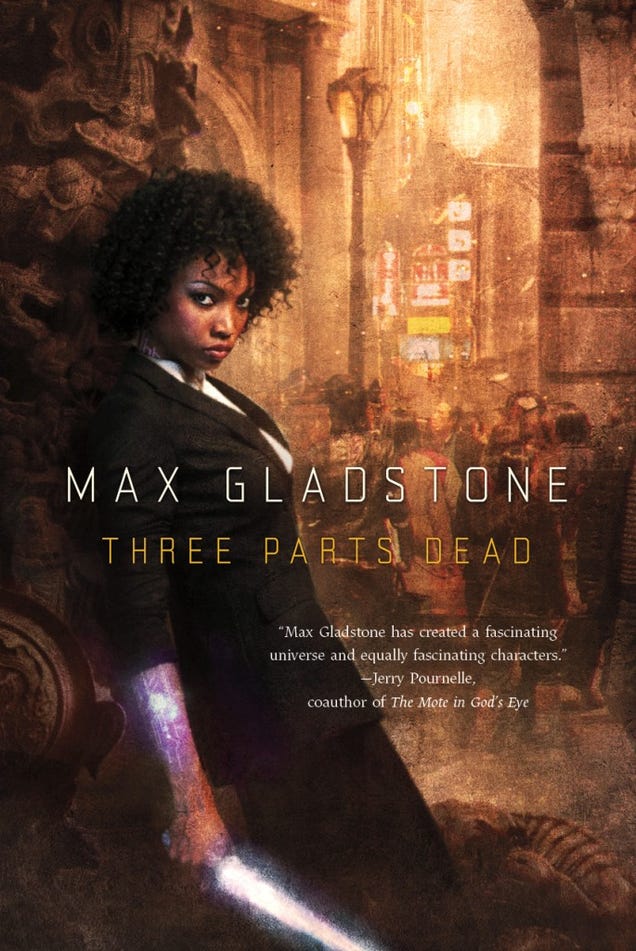
Three Parts Dead by Max Gladstone

People
recommend books to me a lot. It's hard to know when or how to fit them
all in! And then there's the worry I won't like a book that is very dear
to a dear friend's heart. For a long time, I just avoided reading books
that had been recommended to me, unless someone pushed a physical copy
into my hot little hands. (This is still the fastest way to get a book
to the top of my list.) So I started a new list to read of books friends
recommended. If you want to get in on this, you can recommend a book
on this post.
This book was recommended to me by Matt
Imagine magic as being something very much like the law - if you make a good enough argument and have the documents on your side, you can change the world. That's part of the premise of Max Gladstone's Three Parts Dead. When a god is killed in one of the last places to even have a god, lawyer-magicians on two sides show up to fight it out over how exactly he'll be resurrected, according to which contracts, and depending on what liability can be proved.
This book was recommended to me by Matt
Imagine magic as being something very much like the law - if you make a good enough argument and have the documents on your side, you can change the world. That's part of the premise of Max Gladstone's Three Parts Dead. When a god is killed in one of the last places to even have a god, lawyer-magicians on two sides show up to fight it out over how exactly he'll be resurrected, according to which contracts, and depending on what liability can be proved.
This sounds like something that, in the wrong hands, could be very dull, but it is not. Gladstone has created something here that is most similar to Earthbound urban fantasy, but set it in an entirely other world, one where humans figured out how to harness the beliefs that gave gods their powers, and bound it into contracts and power. This caused a war with the gods, in which most of the gods died at the hands of the upstart humans.
One city's god had no part in the war, although his lover joined and died. Just as the dust is settling, many years later, Kos the Everburning turns up dead. An associate from a magical necromantic firm takes on a new apprentice, Tara, who had been a student at the school for magic, but was tossed out (literally, given that the school floated above the clouds and she was unceremoniously dropped over the side.)
The counsel for the opposing side was the professor who dropped her over the side of the school to, presumably, her death, so she's got some scores to settle. But mostly, she needs to prove herself. Tara is an interesting main character - she's so invested in learning a kind of magic that will eventually strip the meat from her bones that she is willing to forsake family, connection, and almost anything to get back into that world.
Driven as she is, though, she's still sympathetic, human enough to be horrified at what one of her professors had "accomplished" to try to take him down. She's clever, and in way over her head, but knows enough to enlist the chainsmoking monk who was present when his god failed to show up, the monk's childhood friend, now an agent of Justice and also a vampire bite junkie, and a vampire pirate captain.
This book was a great deal of fun, while also having some things to say about power, about religious presence, and the effect of the void on those who once had it filled and are now looking to reclaim what made them feel whole.
Add in to that some ravenous shadows, another murder, a gargoyle who has his face stolen from him, along with his will, and some pleasing twists and turns that you'd expect from a book that, after all, hinges on something like a court case. There's plenty of action as well, particularly when the gargoyles are involved.
The concept of Justice as it is expressed in this book was particularly intriguing - after Kos' lover was killed in the war, she was resurrected, but only partially - everything that made her a goddess, a personality, or capable of bestowing grace on her followers, was stripped away, and she was turned into a force that is only concerned with tracking down malefactors as designated by the contract that brought her back. When the officers are in the grip of Justice, they lose all sense of self and get a touch of wholeness, but always without the core of connection that would make it something warm. This is what leads the officer we meet to seek out the addictive pleasures of having her blood sucked by vampires, because otherwise, she is always empty when she isn't on the job.
I don't know if this one is for everyone, but this was definitely a fantasy book meant for me. I'll be looking for the others in the series.
Sunday, 4 September 2016
Skin Game by Jim Butcher
I skipped a lot of books in this series to sit down with Skin Game as part of my ongoing attempt to read all the nominees for best novel Hugos. I'd read the first three or four Dresden Files books, mostly but not entirely enjoyed them, and really hadn't been eager to plow through the next, oh, 20 or so. (Or however many there are.)
But due to the kerfluffle last year, this ended up in the nominees, so I just went ahead and read it. I knew the big thing that had happened to Dresden over the last few books, as my husband has read them all, so some of what had happened was already spoiled.
It kind of feels like there are two things to consider here - how is this is a book, and how is this as a Hugo nominee? Because it's perfectly possible for something to be fine and even enjoyable as a book, and still not something that really feels like a worthy nominee for a major award in the field. And I guess that's pretty much where I fall.
This was a perfectly acceptable and enjoyable heist novel, Butcher seems to have mostly abandoned the way he always had Harry say some variation of "yeah, I'm a chauvinist, what of it?" in every damned book, and it depicts a world that keeps changing in major ways and isn't afraid to move the story forward. It's a fun adventure novel.
That is pretty much all it is, and all it tries to be. It's the 20th book in the series, and by itself, there's nothing that makes this one stand out from the rest. (In a way, it's a pity, because the nomination of this book means Butcher can't be nominated for a Hugo for the series as a whole when he's done with this universe. As an overall achievement over many many books, I'd probably see that as more deserving of at least recognition, if not a win. But that's not going to happen now.)
It's of course not to say that books that aren't necessarily deserving haven't made it on the Hugo shortlist before - they obviously have, although not as part of such a concerted effort to seize control of all the nominations, instead of a push to get a single author recognized. I have more sympathy with the latter, although I really prefer the chaos and disagreement of a democracy.
So, if not really a worthy Hugo nominee, is Skin Game a bad book? Definitely not. As I said, Harry didn't once go for the bullshit "it's your fault if you care about my chauvinism" defense, nor did he act it out in those ways that were so very irritating, and that's a lot more pleasant. I'm also a sucker for heist stories, and Skin Games pulls it off well. The story moves along, the reversals are convincing and satisfying, and by the end of the book, I was well pleased, if not moved or in any way expecting the book to stick with me for a long time to come.
Booklinks:
I read this book as part of an attempt to read all the Hugo Nominees
Tuesday, 7 June 2016
California Bones by Greg van Eekhout

I may be a sucker for heist books. It takes some talent to put together a satisfactory heist, mix in some interesting characters, and find ways for things to go wrong while still keeping your characters competent at what they do. California Bones doesn't hit the dizzying heights of, say The Lies of Locke Lamora, but it is very solid.
It's good enough that I've been toying with adding Greg van Eekhout to my list of authors, the ones whose books I go out of my way to read, instead of just waiting for them to pop up on my various lists. So far, I've decided not, but it's close enough that I may cave later.
Of course, as soon as I mentioned the words "William Mulholland, water mage" to my husband, he immediately added this book to his list of things to read. He loves L.A. history, and I think he'll get even more out of it than I did.
I am a big fan of books that feel thoroughly rooted in a real place and explore how it might looks with a genre overlay. Rivers of London, for example, thoroughly enthralled me. And it was one of the things I enjoyed most about California Bones. It gives a strong tactile dimension to the story, a feeling of the story taking place within a real space, just imagined slightly differently.
So, in this book, we're in the Kingdom of...Southern California? I think? Predominantly, we're in L.A., which is ruled by the Hierarch, an osteomancer of great power. (I got the feeling I should know who the Hierarch was, but I never figured it out.) It's a dangerous place to be - if you have too much magic, but aren't one of his Inner Circle, like Mulholland or Disney, you're likely to be killed and your bones eaten.
No, literally.
The main character's magic works like that too - his father was a talented osteomancer who was adapting his child from a very young age to be able to eat and retain the powers gained from various bones of powerfully magical creatures. But he wasn't powerful enough, and was killed right in front of Daniel.
Now grown up, his mother left him with a crime boss "uncle" (I was a little clear whether that was a literal uncle or a symbolic one.) He grew up being trained for petty crime, and eventually amassed a crew around himself that is rather good at heists. He's tried to stay out of the Hierarch's attention, knowing he'd be next on the menu if he was discovered.
So when he hears that the Hierarch's going to do something with a sword that Daniel's father imbued with Daniel's essence, he kind of wants it out of the Hierarch's hands. So he amasses his crew to break into the Hierarch's vault. He's not trying for power, but along the way, he just might gain some. Or lose some. Or someone.
There's also an interesting subplot about the role of bureaucracy in this magical L.A., and how one of the Hierarch's nephews, unmagical, has also tried to keep his head down, but just might run afoul of an unpredictable and brutal power structure.
The heist itself is quite satisfying, and the revelations at the end interesting. As I said, almost good enough to get it on my authors list. I'm still undecided. But this was quite a lot of fun.
Monday, 6 June 2016
Brown Girl in the Ring by Nalo Hopkinson
However, that is a story for another review, because Brown Girl in the Ring does not fit into those troublesome themes. It is an urban fantasy set in a Toronto that has been abandoned by the powers that be, as the city government moved out to the 'burbs, and the police abandoned the city. People still live there, and society has shrunk in population, but not necessarily in connection.
The main character, Ti-Jeanne, lives with her grandmother and her new baby, on the experimental farm in Toronto, where her grandmother is a local wise woman, dispensing herbal medicine, since allopathic medicine is not available within Toronto itself. Ti-Jeanne's mother left her at a young age, and the father of her child is not someone she thinks would be able to take on being a father.
The magic in this book is largely through Afro-Caribbean sources, the idea of being ridden by spirits or Gods, being chosen by one in particular, and carrying their gifts. Count Zero by William Gibson does much the same things with computers, but I prefer Hopkinson's version, because it feels like it comes from a deeper familiarity with the source material, but even more so because there is a deep tactileness that Gibson lacks.
Because the loa in Count Zero are virtual, they are interesting, but not as connected to the world around them, whereas here is a very strong sense of touch, of feel, of presence and materiality to the world of Ti-Jeanne, and her first tentative steps into the world of the supernatural.
The world of Toronto walks carefully around the power of crime boss Rudy, an older man with access to his own supernatural forces. Here we get into the creation and exploitation of zombies, along with a bowl full of very bad magic indeed.
Into this intrudes the wider world, which is still technological in ways Toronto itself can no longer be. The prime minister (or premier? I forget) needs a new heart, and all hearts these days come from pigs. As a re-election strategy, she announces she'll only take a human heart, an effort to reintroduce organ donation. Of course, when a heart is not forthcoming easily from a human, her campaign manager hires Rudy to make sure a suitable heart, with a suitable blood type, and a suitable death becomes miraculously available in time.
Rudy goes to Ti-Jeanne's former lover to perform this task, and so we come full circle. It's a book about betrayal, supernatural forces, and unexpected connections and family where you least expect it.
I can't say this is the best book I've read in a while, but it certainly is a solid one. The tangibility of the prose, the integration of fantasy into a Toronto that is still recognizable despite the changes, the signs of a world trying to find its own rules when law has left, it's all very well done. Ti-Jeanne herself is a complex, sometimes frustrating main character, trying to figure out what having a baby means, what love means, what family means, and why she keeps dreaming of death.
Wednesday, 18 May 2016
The Rook by Daniel O'Malley
People recommend books to me a lot. It's hard to know when or how to fit them all in! And then there's the worry I won't like a book that is very dear to a dear friend's heart. For a long time, I just avoided reading books that had been recommended to me, unless someone pushed a physical copy into my hot little hands. (This is still the fastest way to get a book to the top of my list.) So I started a new list to read of books friends recommended. If you want to get in on this, you can recommend a book on this post.
This book was recommended to me by LibraryHungry
I am not easily squicked. It comes from growing up with an emergency room nurse as a mother, and therefore having a different line than most people between "normal dinner table conversation" and "why the fuck would you say that while I'm eating?" There aren't many books that push those buttons for me, largely because I am not a visual thinker, and so descriptions of what gross things look like I can shrug off. (It's a bit different if we add in sound or smell.)
This book was recommended to me by LibraryHungry
I am not easily squicked. It comes from growing up with an emergency room nurse as a mother, and therefore having a different line than most people between "normal dinner table conversation" and "why the fuck would you say that while I'm eating?" There aren't many books that push those buttons for me, largely because I am not a visual thinker, and so descriptions of what gross things look like I can shrug off. (It's a bit different if we add in sound or smell.)
I bring this up because I was about two-thirds through this book before I started to tell my husband "you know what? This is really gross." Not too gross, because most of it was visual in nature, but definitely approaching the limits of what I can read while I'm eating. (Stiff was probably the only book that was too much to read while I ate. I read while I eat a lot, so this is an important consideration.)
However, despite the grossness of the threats in this book, it's mostly quite rollicking fun. We have here a British secret service made up of people with supernatural powers (including a vampire). In fact, the British government has long more or less conscripted everyone with strange powers and pressed them into some kind of service within the Checquy.
Myfanwy Thomas (who, to my perpetual discombobulation, pronounces it "Miff-un-ee" like it rhymes with Tiffany) is one of the eight people who run the Checquy, as a Rook, which means that she's essentially one of two running all internal matters. As the book starts, she has no idea who she is, but whoever she was before whatever happened happened at least knew that this utter loss of identity was coming, and has tried to leave her enough notes to keep her alive and maybe figure out who wanted her mind erased.
It's a spy novel, essentially, with lots of crazy powers running around (Myfanwy can control other people's bodies, although her former self had a serious mental block about doing so, something that does not carry over to the new Myfanwy.)
We get a lot of history of how the Checquy came into place, and a slow burn through what the conspiracy is and what the former Myfanwy had discovered before her identity went poof. There are also strange houses with chanting and purple light from which no one comes back, a dragon hatching, and the threat of the Belgians. Well, the Grafters, who are Belgian fleshmancers. Or flesh scientists? Whichever, they can do some truly creepy shit with the body, and have been enemies of the Checquy for centuries, at least until they were destroyed in a battle a couple of hundreds years ago.
It will probably come as no surprise to anyone that the next part of that sentence is "Or were they?"
It will also likely not be surprising that the threats are both from without and within.
My only real problem (and it's a small one) is that we get all these documents from the former Myfanwy to the present Myfanwy, and somehow it takes her weeks to actually sit down and read them all. If it were me, I'd be reading while I ate. I'd be reading in the car while being driven to work. I'd be reading on the fucking toilet - if all you have between your new self and possible death or more brain death, the reading of this stuff would not done when I got around to it.
Other than that, this is a fun spy story with superpowers, shading slightly on the gross side, but not terribly so. I would certainly be interested to hear what happens next, and I'm told the next book will be forthcoming soon.
Book Notes: While I was writing this review, there was a lively discussion on my facebook about other books with issues of identity and the complexities thereof. Here are some other books that people contributed as suggestions:
Unpossible by Daryl Gregory (the first story, I think)
Slaughterhouse-Five by Kurt Vonnegut
Nine Princes in Amber by Roger Zelazny
Never Let Me Go by Kazuo Isniguro
Remains of the Day by Kazuo Ishiguro
The Buried Giant by Kazuo Ishiguro
books by Virginia Woolf or Philip K. Dick
Fight Club by Chuck Palahniuk
Book Notes: While I was writing this review, there was a lively discussion on my facebook about other books with issues of identity and the complexities thereof. Here are some other books that people contributed as suggestions:
Unpossible by Daryl Gregory (the first story, I think)
Slaughterhouse-Five by Kurt Vonnegut
Nine Princes in Amber by Roger Zelazny
Never Let Me Go by Kazuo Isniguro
Remains of the Day by Kazuo Ishiguro
The Buried Giant by Kazuo Ishiguro
books by Virginia Woolf or Philip K. Dick
Fight Club by Chuck Palahniuk
Thursday, 12 May 2016
The Quick by Lauren Owen

*Some Broad Spoilers Below, But Few Specific Ones*
I feel like this novel is trying to do a lot of interesting things with vampires, but doesn't quite stick the landing on many of them. The writing is good, and the ideas are intriguing, but almost none of them are followed to the point where I was satisfied. Time and again, the really interesting stuff was dropped long before I was ready to let it go. I've mentioned that I love Daryl Gregory for his ability to follow through on the implications of an idea far longer that I would have expected. This book has the reverse - there are ideas I desperately want to see developed further, but they just keep getting dropped.
Hopefully with further books, Owen will figure out how to make her ideas work together rather than using one for a while and discarding it. There is a lot here to like, and a great deal of potential.The style of the writing seems to be deliberately borrowing from the multi-narrator effect you get from Dracula or The Woman in White. It works not badly, although like The Woman in White, the story's never quite as interesting after you get away from the characters in whom you have the most invested.
The story starts with Charlotte and James as children, brother and sister, and their experiences growing up. It shifts then to Victorian London, where James has gone as a young man to try to be a writer. In what is probably the most interesting part of the book, he starts a sexual relationship with the other man who shares his flat, and their desire and the repercussions are compelling.
It is therefore extremely unfortunate that the author then promptly kills one of the young men and turns the other into a vampire. Even more unfortunate, beyond jumping right into the Bury Your Gays trope, is the strange decision to have the vampires all be virtually sexless. There is no trace of sexual desire in any of them after this point, and given the discussion I sparked on my Facebook this morning, that's damned unusual.
So, not only does being turned into a vampire suck the sexual desire rightout of you, it also means that not only is one of the two gay characters dead, the other one's sexuality is just...dropped. Vampirism is generally all about desire, sometimes campily so, even if desire is transferred from sex to blood.
It becomes a question why the first part of your book focuses on this (and does it in an interesting fashion) and then has it disappear altogether! Unfortunately, this is only the first of several themes that are raised and then dropped.
Charlotte comes to London to try to find her brother, who is fighting giving in to his vampirism, and we're given a taste (so to speak) of that. The Gentlemen Vampires Club (The Aegolian, I think) behind James' transformation is delving into medical study of their own phenomenon, and we get slightly into a class war between the upper-fanged vampires who want to only turn the best and brightest, and the dingy biters of the streets, who are kept more or less under control in a Dickensian neighborhood, with more literal sucking dry of the poor.
Wait, I forgot to mention that it's pretty heavily implied that Oscar Wilde steals and rewrites James' play into The Importance of Being Earnest, since it is dropped mid-vamp attack on their way to visit him. But nothing's really done with that.
Meanwhile, Charlotte falls in with other roving vampire hunters, except that they don't really hunt vampires, since these vampires are much harder to kill than the ones we've come to know. Mostly they help vampire targets get the hell of the biting grounds. We get a little of what it's like to be a female performer/vampire preventer, but that's another theme that I would have liked to see a whole lot more about, not to mention the repressed love between her and her partner, the father of her former fiance. (This is the problem - this is all so interesting and really quite well written! But it's just not developed!)
From there, we focus on Charlotte's attempts to find a cure, but the pacing gets weird, and while again, there's some interesting stuff, it's not followed through on in a satisfying way. This is not a bad book. It's just somehow unfinished. If you have too many ideas, refocus. If you raise a provocative idea, follow through.
If I wanted to be a truly horrible person, I could end the review like this: it just doesn't have enough bite.
Friday, 6 May 2016
Half-Off Ragnarok by Seanan McGuire

I got this book out of the library on a whim. I follow Seanan McGuire on Twitter, where she's very entertaining, I've absolutely loved the two Mira Grant books I've read, and that particular day, I needed something that was at least a little light. My local library didn't have any of the earlier books in this series in, nor any of the earlier Toby books, so I picked this up.
It got me through a week where I was largely on trains to or from my mother, and then sitting by while she was in surgery, or in the days after, sitting by her bed while she rested. (The surgery went well, all is good.) I desperately needed something diverting at that very moment, and this book delivered that and more.
Most of all, it was fun, and it made me grin, and the family stuff was thoroughly delightful, the relationship enjoyable, and of course, all the cryptozoology just fascinating. I should also say, I read this book without having read the ones that preceded it, and had no problems.
Alex is the only son in one branch of two families prominent in cryptozoological circles, to the point of intermarriage with cuckoos, and possibly other humanoid species?. He's interested in the reptile variety of hidden monsters, predominantly, working undercover at a zoo in Ohio. He's juggling normal tasks with surveys of the local cryptozoological population and trying to keep a seven-year old girl from sneaking in to spend some time with her fiance, a giant snake.
So when a petrified body shows up, it's right up his alley, not that he can let the police know that. Of course, there are at least three species that could be killing this way, two of which are animals he wouldn't hold responsible (but would still have to stop). The other option is gorgons, one of whom is his assistant, Dee.
Alex also has to juggle family responsibilities and a relationship with a hot Australian big cat keeper that is sort of on the rocks. It's a busy book, in a good way. You feel plopped down in the middle of the life of someone who isn't a lone hero, out on his own, untouched by those around him, except for the woman swooning in his arms. (I've read too much of that recently. This was a welcome change)
Nope, this is a hero who is firmly rooted in his family, with clear priorities to keep them safe. It's a refreshing change. And so much more interesting! How boring it is to have characters who don't really care about everything, no handy buttons to push.No connections, and being able to compartmentalize everything is boring. Caring is so much more intense.
I should mention the pets. Crow is a miniature griffin, the size of a large cat, and with much of the same temperament. It's hard not to want him for your very own immediately. And the Aeslin mice, (Narnia reference?) talking mice with a worshipful reverence for members of the Price family and intense desire for snacks? Amazing. Love them so much.
At its heart, this book is a murder mystery, and the solution satisfying, from both a monster and a human perspective. It's complicated, as such things always are. It also has moments that feel genuinely dangerous.
Overall, if you want a solid urban fantasy mystery with entertaining animals and strong characters, I would highly recommend this book. I'm looking forward to reading the others in the series.
Monday, 4 April 2016
Revenant by Kat Richardson

Okay, let's start this with a confession. I had never read anything by this author before, and starting with the last book in this series was probably not the wisest thing to do. And that may be perhaps why I didn't feel as engaged as I might have liked to. I didn't have any emotional baggage to bring to this book, and as the culmination of a series, I suspect it may depend on that.
So yeah. This is going to be an unfair review, to anyone who has been reading this series from the beginning. I just have not, so from my perspective, I found it hard to connect with many of the characters, and even to really figure out what a greywalker was. (Yes, I get it that the main character, Harper, connected in some way with the supernatural, that she can see past traumas, that she's died. But is it something beyond that?)
That was my first quibble. While I truly do appreciate Richardson's choice to make this battle hard fought, and leading to many many injuries, at times, I was reading skeptically wondering what a Greywalker actually could do? It seemed to be more debilitating than offering any power or resources. I don't remember her doing very much that was helpful that was specifically related to greywalking, except for escaping a few times. And there were far more when her abilities caused her injury or mental trauma.
I am all for superpowers with drawbacks. But not having read the other books, or possibly missing something, it didn't seem like there were many superpowers here. The Houdini stuff, sure. And talking to ghosts is great. But when you run into combat as often as Harper does in this book, is there really absolutely nothing she can do there?
Right, plot. This takes place in Portugal, where Harper's boyfriend has been tracking his crazy father who is trying to plunge the world into a morass of something, for some nefarious purpose. I know there were hints he thought it was a grand one, but it wasn't very clearly explained. (This might be because I was reading electronically, so lost the ability to flip back and reread bits when I was confused.)
Harper and Quentin and vampire Carlos have to stop them, and the book is a lot of times where they get beaten up badly on the way to doing so. I phrase it like that, because it didn't feel like a build. It felt like an event, a recuperation, a lull, another event. That gradual increase of tension was never really there. Possibly because Richardson was trying to make the tension just as high at the start of the book, but that isn't a great way to go for overall structure. (Also, if you want to do that, be Mira Grant and write about zombies and do it incredibly well.)
My other main quibble was actually borne out by the afterword. When reading the sections when Harper arrived in Portugal, my exact reaction was that it read like someone went into a town using Google Streetview, and was describing it from that perspective. Then, in the afterword, the author mentions how much she used Google Streetview in her Portugal bits, and that's a problem. Not that she used it, but that she then reported it in the story, instead of integrating it. It's devoid of other sensory cues - all visual, and all visual at a remove, in that they're often reported like Harper is moving the camera around as the author must have. No sounds. No smells. None of those things that move beyond the visual into the tactile.
Doing your research is so good and so necessary. But it's a hard skill to then use all that information at the service of the story and not just try to get it all on the page to prove you did the work.
I'm being so critical, but this book wasn't terrible. It was just...disappointing. It feels like this is so close to being something really good, but better plotting and development and tension, and mastering how to use research to enrich your story instead of replace it, would make it so much better.
Subscribe to:
Posts (Atom)