I may have already mentioned that this is the first year I've bought a supporting membership so I can vote for the Hugos. This is a bit of a commitment for me, because although I do read a lot, I rarely read books close to the time they come out. Generally I get to them about two years later, so now I'm having to bump a bunch of last year's books to the top of my list.
Since the nominations were announced, I've read all the novelettes, all but one of the short stories, and this novella, the only one that was available online. I'm working on one novel and have another working its way through the library system to me. I feel like that's a good start in the two or three weeks since the nominations were announced.
"And Then There Were (N-one)" was a very enjoyable start to my Hugo Reading Trek 2018. It was the first work I read out, and I devoured it quite quickly. It took me an absurdly long time to get the (N-one) joke and then link it to Agatha Christie, but I got it early enough to know it was probably going to be a murder mystery, even before the murder happened.
In this story, a Sarah Pinsker who is not the Sarah Pinsker who is writing the story, is invited to a multiverse convention of Sarah Pinskers, hosted by the Sarah Pinsker who invented multiverse travel. It's on a small island off the coast of Nova Scotia, and the Sarahs arrive and leave from there directly, so as not to run amok on the world where multiverse travel began.
Initially, this is a story of paths not taken, of meeting hundreds of people who are you, in many important ways, of the wistfulness of seeing every forking path you never took walked by a different version of you.
But of course, a Sarah Pinsker turns up dead. The only Sarah Pinsker who is anything like an detective (an insurance investigator) is brought in by hotel staff to try to solve the murder. (Our Sarah Pinsker must be there somewhere, or at least, her Nebula is.) She interviews Sarah Pinskers, finding out more about how her life is and isn't like theirs, including who else is married to the wife she wants to get to back to soon, who most of the other Sarahs met and married as well.
There's more melancholy to this than it might sound - so far, I think that as I'm describing it, it sounds like a slamming door farce, and there are funny bits, but it's more about what you did and didn't do with your life. Or, at any rate, what Sarah Pinsker did and didn't do.
When the solution to the mystery is revealed, it's fairly satisfying, but we are left with a cliffhanger, having to decide what, were we Sarah Pinsker, we would do about the murderer. I feel like that's less of a cliffhanger than you might want it to be - do you really want to let another version of your wife be married unawares to a murderer?
I haven't read any of the other novellas, but I enjoyed this a lot and expect it to rank well on my ballot. (Our universe's Sarah Pinsker's novelette, "Wind Will Rove," is without question going to be my top choice in that category.)
Showing posts with label hugo award nominees. Show all posts
Friday, 27 April 2018
Tuesday, 13 March 2018
Starplex by Robert J. Sawyer
I will read all the Hugo nominees. I really will. At this point, I'm just under half-way done, and for the very first time, I've bought a membership so I can vote on the awards. Hopefully that'll mean I'll read last year's books this year, and not two or three years hence, which has pretty much been the way it's gone for the last little while. When you mostly get books out from the library, you're either on a ton of wait lists, or you're content being a little bit behind.
So as I continued my trek through the Hugo Best Novel nominees, I came to that run of Robert J. Sawyer nominations. He had a very fervent fanbase there for a while, and so, rarely a year went by without a nomination. I am not the biggest Sawyer fan, although I don't mind his stuff. It's straight-forward commercial fiction, and the twists are often fairly good, although his women are mostly identified by the largeness of their boobs.
(That's not really better in this book - at one point, the main character thinks about the woman he wants to cheat on his wife with with the massively unflattering description that she was so attractive he often didn't notice how intelligent she was. Dudes, if you didn't already know, this is not a compliment any woman wants to hear. I do not, and I keep saying this, mind romances or attractions that are also physical. It's when they're nothing BUT physical, and the brain attached is an extreme afterthought, that I get annoyed.)
There is a lot going on in this book, and then there's the subplot where the main character reaches middle age, and, according to the bullshit evolutionary psychology in this book, inevitably wants to have an affair, to prove his manhood. I mean, how else will you deal with hair falling out? He loves his wife and their marriage is good, but you know, he's attracted to this other woman, and what are you going to do?
You know what I like about being an adult? (I talked this one over extensively with my husband, and he was less forgiving of Sawyer than I was prepared to be.) I like that eventually you learn that while you may know people to whom you are attracted when you're an adult and in a happy, monogamous relationship (as the characters in the book are), attraction does not equal action. Eventually, you learn that you can experience attraction and do absolutely freaking nothing about it. It's totally a possibility. I assume my husband will not only be attracted to me for his entire life. I know damn well I'll sometimes find other people attractive. But you know what? I always find him attractive too, and he does me. What I have is far too awesome to ditch any time I experience pantsfeelings. (Thank you Captain Awkward for the terminology!)
I mean, people can do whatever they want with their lives, as long as everyone's aware and on board. If multiple partners are important to you, sort out your life so that's part of it, with everyone's willing consent. But this notion that that if you want to boink someone half your age, you just have to, because you're middle-aged is nonsense.
So I didn't like that subplot very much.
The rest of the book was fine. Humanity is one of four races on Starplex, a giant ship exploring the wormholes riddling the galaxy, and looking for first contact. They find more than they expected when suns, literal, huge, active suns, start coming through the wormholes, followed by dark matter creatures with whom humans, dolphins, and two alien species have very little in common.
Throw in a little time travel, some intergalactic wormholes, and a sudden attack from an ally, and there's a lot going on. I can't say any of it rocked my socks off, but it was solid SF. If only we could get to a point where not only can we imagine dark matter beings, time travel, and wormholes, we could also make the ultimate leap to seeing women as more than their boobs.
Thursday, 21 April 2016
The Hugo Nominees
Another project I have on the go is to read all the Hugo nominees. Just reading the winners seemed too easy, and I'm nothing if not ambitious. I'm far enough into this project to be undeterred by the recent year of Hugo madness. I jump around in time while reading, but here they are, in order, with links to the ones I've read and reviewed. (Those in bold were the winners for their respective years.)
The Demolished Man by Alfred Bester (read but not yet reviewed)
The Forever Machine by Mark Clifton
Double Star by Robert A. Heinlein (read but not yet reviewed)
The Big Time by Fritz Leiber (read but not yet reviewed)
A Case of Conscience by James Blish
The Enemy Stars by Poul Anderson
Who? by Algis Budrys
Have Space Suit, Will Travel by Robert A. Heinlein
Immortality, Inc. by Robert Sheckley
Starship Troopers by Robert A. Heinlein (read but not yet reviewed)
Dorsai by Gordon R. Dickson
The Pirates of Ersatz by Murray Leinster
Brain Twister by Randall Garrett
The Sirens of Titan by Kurt Vonnegut
A Canticle for Leibowitz by Walter M. Miller
The High Crusade by Poul Anderson
Rogue Moon by Algis Budrys
Deathworld by Harry Harrison
Venus Plus X by Theodore Sturgeon
Stranger in a Strange Land by Robert A. Heinlein (read but not yet reviewed)
Dark Universe by Daniel F. Galouye
Planet of the Damned by Harry Harrison
Time is the Simplest Thing by Clifford D. Simak
Second Ending by James White
The Man in the High Castle by Philip K. Dick
The Sword of Aldones by Marion Zimmer Bradley
Fall of Moondust by Arthur C. Clarke
Little Fuzzy by H. Beam Piper
Sylva by Jean Vercors
Way Station by Clifford D. Simak
Glory Road by Robert A. Heinlein
Witch World by Andre Norton
Cat's Cradle by Kurt Vonnegut
The Wanderer by Fritz Leiber
The Whole Man by John Brunner
Davy by Edgar Panborn
The Planet Buyer by Cordwainer Smith
Dune by Frank Herbert (read but not yet reviewed)
This Immortal by Roger Zelazny
The Squares of the City by John Brunner
Skylark Duquesne by Edward E. Smith
The Moon Is A Harsh Mistress by Robert A. Heinlein (read but not yet reviewed)
Babel-17 by Samuel R. Delany
Too Many Magicians by Randall Garrett
Flowers for Algernon by Daniel Keyes (read but not reviewed)
The Witches of Karres by Jason H. Schmitz
Day of the Minotaur by Thomas Burnett Swann
Lord of Light by Roger Zelazny
The Einstein Intersection by Samuel R. Delany
Chthon by Piers Anthony
The Butterfly Kid by Chester Anderson
Thorns by Robert Silverberg
Stand on Zanzibar by John Brunner
Rite of Passage by Alexei Panshin
Nova by Samuel R. Delany
Past Master by R.A. Lafferty
The Goblin Reservation by Clifford Simak
The Left Hand of Darkness by Ursula K. Le Guin
Up the Line by Robert Silverberg
Macroscope by Piers Anthony
Slaughter-house Five by Kurt Vonnegut (read but not yet reviewed)
Bug Jack Barron by Norman Spinrad
Ringworld by Larry Niven (read but not yet reviewed)
Tau Zero by Poul Anderson
Tower of Glass by Robert Silverberg
The Year of the Quiet Sun by Wilson Tucker
Star Light by Hal Clement
To Your Scattered Bodies Go by Philip K. Dick (read but not yet reviewed)
The Lathe of Heaven by Ursula K. Le Guin
Dragonquest by Anne McCaffrey (read but not reviewed)
Jack of Shadows - Roger Zelazny
A Time of Changes by Robert Silverberg
The Gods Themselves by Isaac Asimov
When HARLIE Was One by David Gerrold
There Will Be Time by Poul Anderson
The Book of Skulls by Robert Silverberg
Dying Inside by Robert Silverberg
A Choice of Gods by Clifford Simak
Rendezvous with Rama by Arthur C. Clarke
Time Enough For Love by Robert A. Heinlein
Protector by Larry Niven
The People of the Wind by Poul Anderson
The Man Who Folded Himself by David Gerrold
The Dispossessed by Ursula K. LeGuin
Fire Time by Poul Anderson
Flow My Tears, The Policeman Said by Philip K. Dick
The Mote in God's Eye by Larry Niven and Jerry Pournelle
Inverted World by Christopher Priest
The Forever War by Joe Haldeman
Doorways in the Sand by Roger Zelazny
Inferno by Larry Niven and Jerry Pournelle
The Computer Connection by Alfred Bester
The Stochastic Man by Robert Silverberg (read but not reviewed)
Where Late the Sweet Birds Sang by Kate Wilhelm
Mindbridge by Joe Haldeman
Children of Dune by Frank Herbert
Man Plus by Frederik Pohl
Shadrach in the Furnace by Robert Silverberg
Gateway by Frederik Pohl
The Forbidden Tower by Marion Zimmer Bradley
Lucifer's Hammer by Larry Niven and Jerry Pournelle
Time Storm by Gordon Dickson
Dying of the Light by George R.R. Martin
Dreamsnake by Vonda N. McIntyre
The White Dragon by Anne McCaffrey (read but not reviewed)
The Faded Sun: Kesrith by C.J. Cherryh
Blind Voices by Tom Reamy
The Fountains of Paradise by Arthur C. Clarke
Titan by John Varley
Jem by Frederik Pohl
Harpist in the Wind by Patricia A. McKillip
On Wings of Song by Thomas Disch
The Snow Queen by Joan D. Vinge
Lord Valentine's Castle by Robert Silverberg
The Ringworld Engineers by Larry Niven
Beyond the Blue Event Horizon by Frederik Pohl
Wizard by John Varley
Downbelow Station by C.J. Cherryh
The Claw of the Conciliator by Gene Wolfe
The Many-Colored Land by Julian May
Project Pope by Clifford Simak
Little, Big by John Crowley
Foundation's Edge by Isaac Asimov
The Pride of Chanur by C.J. Cherryh
2010: Odyssey Two by Arthur C. Clarke
Friday by Robert A. Heinlein (read but not reviewed)
Courtship Rite by Donald Kingsbury
The Sword of the Lictor by Gene Wolfe
Startide Rising by David Brin
Tea with the Black Dragon by R.A. McAvoy
Millennium by John Varley (read but not reviewed)
Moreta: Dragonlady of Pern by Anne McCaffrey (read but not reviewed)
The Robots of Dawn by Isaac Asimov
Neuromancer by William Gibson
Emergence by David R. Palmer
Peace War by Vernor Vinge
Job: A Comedy of Justice by Robert A. Heinlein (read but not reviewed)
The Integral Trees by Larry Niven
Ender's Game by Orson Scott Card (read but not reviewed)
Cuckoo's Egg by C.J. Cherryh
The Postman by David Brin (read but not reviewed)
Footfall by Larry Niven and Jerry Pournelle (read but not reviewed)
Blood Music by Greg Bear (read but not reviewed)
Speaker for the Dead by Orson Scott Card (read but not reviewed)
The Ragged Astronauts by Bob Shaw (read but not reviewed)
Count Zero by William Gibson (read but not reviewed)
Marooned in Realtime by Vernor Vinge
Black Genesis by L. Ron Hubbard
The Uplift War by David Brin
When Gravity Fails by George Effinger
Seventh Son by Orson Scott Card (read but not reviewed)
The Forge of God by Greg Bear
The Urth of the New Sun by Gene Wolfe
Cyteen by C.J. Cherryh
Red Prophet by Orson Scott Card (read but not reviewed)
Falling Free by Lois McMaster Bujold
Islands in the Net by Bruce Sterling
Mona Lisa Overdrive by William Gibson
Hyperion by Dan Simmons
A Fire in the Sun by George Effinger
Prentice Alvin by Orson Scott Card (read but not reviewed)
The Boat of a Million Years by Poul Anderson (read but not reviewed)
Grass by Sheri S. Tepper
The Vor Game by Lois McMaster Bujold
Earth by David Brin
The Fall of Hyperion by Dan Simmon
The Quiet Pools by Michael P. Kube-McDowell
Queen of Angels by Greg Bear
Barrayar by Lois McMaster Bujold
Bone Dance by Emma Bull
All the Weyrs of Pern by Anne McCaffrey
The Summer Queen by Joan D. Vinge
Xenocide by Orson Scott Card (read but not reviewed)
Stations of the Tide by Michael Swanwick
A Fire Upon the Deep by Vernor Vinge
Doomsday Book by Connie Willis
Red Mars by Kim Stanley Robinson
China Mountain Zhang by Maureen F. McHugh
Steel Beach by John Varley
Green Mars by Kim Stanley Robinson
Moving Mars by Greg Bear
Beggars in Spain by Nancy Kress (read but not reviewed)
Glory Season by David Brin
Virtual Light by William Gibson
Mirror Dance by Lois McMaster Bujold
Mother of Storms by John Barnes
Beggars and Choosers by Nancy Kress
Brittle Innings by Michael Bishop
Towing Jehovah by James K. MOrrow
The Diamond Age by Neal Stephenson
The Time Ships by Stephen Baxter
Brightness Reef by David Brin
The Terminal Experiment by Robert Sawyer
Remake by Connie Willis
Blue Mars by Kim Stanley Robinson
Memory by Lois McMaster Bujold
Remnant Population by Elizabeth Moon
Starplex by Robert Sawyer
Holy Fire by Bruce Sterling
Forever Peace by Joe Haldeman
City on Fire by Walter John Williams
The Rise of Endymion by Dan Simmons
Frameshift by Robert Sawyer
Jack Faust by Michael Swanwick
To Say Nothing of the Dog by Connie Willis
Children of God by Mary Doria Russell
Darwinia by Robert Charles Wilson
Distraction by Bruce Sterling
Factoring Humanity by Robert Sawyer
A Deepness in the Sky by Vernor Vinge
A Civil Campaign by Lois McMaster Bujold
Cryptonomicon by Neal Stephenson
Darwin's Radio by Greg Bear (read but not reviewed)
Harry Potter and the Prisoner of Azkaban by J.K. Rowling
Harry Potter and the Goblet of Fire by J.K. Rowling (read but not reviewed)
A Storm of Swords by George R.R. Martin
Calculating God by Robert J. Sawyer
The Sky Road by Ken MacLeod
Midnight Robber by Nalo Hopkinson
American Gods by Neil Gaiman (read but not reviewed)
The Curse of Chalion by Lois McMaster Bujold
Passage by Connie Willis (read but not reviewed)
Perdido Street Station by China Miéville
The Chronoliths by Robert Charles Wilson
Cosmonaut Keep by Ken MacLeod
Hominids by Robert J. Sawyer
Kiln People by David Brin
Bones of the Earth by Michael Swanwick
The Scar by China Miéville
The Years of Rice and Salt by Kim Stanley Robinson
Paladin of Souls by Lois McMaster Bujold
Ilium by Dan Simmons
Singularity Sky by Charles Stross (read but not reviewed)
Blind Lake by Robert Charles Wilson
Humans by Robert J. Sawyer
Jonathan Strange and Mr. Norrell by Susanna Clarke
River of Gods by Ian McDonald
The Algebraist by Iain M. Banks
Iron Sunrise by Charles Stross
Iron Council by China Miéville
Spin by Robert Charles Wilson
Learning the World by Ken MacLeod
A Feast for Crows by George R.R. Martin
Old Man's War by John Scalzi
Accelerando by Charles Stross
Rainbows End by Vernor Vinge
Glasshouse by Charles Stross
His Majesty's Dragon by Naomi Novik
Eifelheim by Michael F. Flynn
Blindsight by Peter Watts
The Yiddish Policeman's Union by Michael Chabon
The Last Colony by John Scalzi
Halting State by Charles Stross
Rollback by Robert J. Sawyer
Brasyl by Ian McDonald
The Graveyard Book by Neil Gaiman (read but not reviewed)
Little Brother by Cory Doctorow
Anathem by Neal Stephenson
Saturn's Children by Charles Stross
Zoe's Tale by John Scalzi
The Windup Girl by Paolo Bacigalupi
The City & The City by China Miéville
Boneshaker by Cherie Priest
Wake by Robert J. Sawyer
Palimpsest by Catherynne M. Valente
Julian Comstock by Robert Charles Wilson
Blackout/All Clear by Connie Willis
Cryoburn by Lois McMaster Bujold
The Dervish House by Ian McDonald
Feed by Mira Grant
The Hundred Thousand Kingdoms by N.K. Jemisin
Among Others by Jo Walton
A Dance with Dragons by George R.R. Martin
Deadline by Mira Grant
Embassytown by China Miéville
Leviathan Wakes by James S.A. Corey
Redshirts by John Scalzi
2312 by Kim Stanley Robinson
Blackout by Mira Grant
Captain Vorpatril's Alliance by Lois McMaster Bujold
Throne of the Crescent Moon by Saladin Ahmed
Ancillary Justice by Ann Leckie
Neptune's Brood by Charles Stross
Parasite by Mira Grant
Warbound by Larry Correia
The Wheel of Time by Robert Jordan (and Brandon Sanderson)
The Three Body Problem by Cixin Liu
The Goblin Emperor by Katherine Addison
The Dark Between the Stars by Kevin J. Anderson
Skin Game by Jim Butcher
Ancillary Sword by Ann Leckie
The Fifth Season by N.K. Jemisin
The Aeronaut's Windlass by Jim Butcher (read but not reviewed)
Ancillary Mercy by Ann Leckie
Uprooted by Naomi Novik
Seveneves by Neal Stephenson
The Obelisk Gate by N.K. Jemisin
All the Birds in the Sky by Charlie Jane Anders
A Closed and Common Orbit by Becky Chambers
Death's End by Cixin Liu
Ninefox Gambit by Yoon Ha Lee
Too Like the Lightning by Ada Palmer
Monday, 21 December 2015
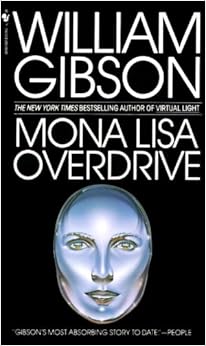
Mona Lisa Overdrive by William Gibson

I think I actually read the three books that are all in this universe in order, although Count Zero was long enough ago that I remember very little of it, except that I liked it. Neuromancer I've always had a difficult relationship with - it just persists in keeping me at arms length. I get the story, I get the characters. I just don't...get it. Why it's so hugely popular. I don't dislike it, I'm just sort of baffled.
Now, at long last, I make it to the third book, because my online SF group had it as a choice this past month. I was pleasantly surprised to find that I actually enjoyed this one quite a lot. That strange distance I found between me and the prose and the characters wasn't there, and as always when that happens, it's hard to tell if it's a change in writing style, or that I'm finally in the right mindspace for this book at this particular point in time.
I won't go so far as to say I love this book, but I did find an easier connection to it than I have to other Gibson books so far.
There are several interweaving storylines in this book. There's the daughter of a Japanese mob boss, sent to England for her own protection, who finds herself embroiled in the plans of the man she's sent to stay with, who is in the process of blackmailing some very dangerous people, including one familiar face with an unfamiliar name.
There's the comatose man jacked into a machine, whom a suspicious character leaves in the care of an ex-con he knows, who builds robots according to certain designs in his head.
There's a...shit, what's the world in Gibson's universe for the taping of human experience so others can try it out? Sim? Stim? At any rate, there's a woman who's the star of the sim world, recovering from addiction and able to communicate with the Net in ways no one else can.
There's a very young prostitute with a pimp with lofty dreams, who looks a little like the sim star mentioned above, enough so that in a convoluted scheme, it's worth someone's while to have her operated on to look just like the celebrity.
We come into the story when it's already in progress. The problem is that Count Zero was long enough ago that I don't remember whether or not these are dangling plotlines from that, or entirely new ones. At any rate, everyone's already running, and Gibson throws the reader in trying to keep up.
Strangely enough, there are also times where the plots simply fall apart without us ever really knowing what they are. Some characters are just that damned good. I am not sure what I think about this - it's interesting to watch competent characters run circles around unsuspecting others, but I do sometimes wish I'd been let in a little more on what they were foiling.
I think I get the outline, but...what were the bad guys going to do if they succeeded? They're thwarted at such a distance from the centre of power that it's never entirely clear to me. I get why the big bad wants Angie. I get why she hates her. I don't really get what she was going to do....
It's a relatively minor quibble, I suppose. I don't mind being brought in in the middle of the action. It's just that the physical action that I saw sometimes seemed so far from the motivations behind it, and I find those motivations far more interesting and less explored.
So, Gibson's still not my favourite author, but the writing style is growing on me.
Booklinks:
I read this book as part of an attempt to read all the Hugo Nominees
Booklinks:
I read this book as part of an attempt to read all the Hugo Nominees
Monday, 19 October 2015
Where Late the Sweet Birds Sang by Kate Wilhelm
I picked this book up at long last as part of my read of all the Hugo nominees. Kate Wilhelm's book won the year I was born, so I tend to figure it was a very good year. And on the whole, this is a very good book. It's chock full of ideas, and raises interesting questions about what subtle things might be lost if we fundamentally changed our ways of interacting with each other.
At the start of the book, the world is collapsing. Ecological collapse is imminent, new pandemics on the doorstop. People and animals have stopped having babies. One family out in the hills has the money to recognize the problem and set up a research lab, aimed at figuring out cloning. The problem is that cloning seems to work for a few generations, but then rapidly deteriorates.
The first generation solves the problem - clone for a few generations with new techniques, then go back to livebreeding. But the next generation is the first one of clones, and their social structures are utterly different. Six of each clone is created, exact replicas of the original family, and they are bonded in ways that go beyond sibling closeness and verge on telepathy. They can sense when others of their cohort are injured. They have their best sex with each other, as who knows your body better than another you? (Most are infertile, so sex for procreation is mostly out - and when cross-cohort sex does occur, and babies are very rarely started, the mothers are taken care of so the babies can provide the basis for new clones.)
Within this, they start to have machinery break down, and six unrelated clones go out to do a first reconnaissance. They are haunted by being away from their cohorts, and some are able to reintegrate on coming back, but at least one is put down. And here the book starts to get a little horrifying. Injury they will tend to, but mental illness upsets the minds of the others in the cohort as well, so this nascent society believes that the best solution to that route is simply to terminate the offending member.
Then we start to find out more about the breeding mothers, and it gets more horrifying - conditioned with fear so they can't leave their quarters, permanently separated from their cohorts, artificially inseminated once a month until they have as many babies as they can have, then euthanized. (Through most of the book, the main characters were male. This disappointed me slightly, given that this is written by a woman. Then we got to this section, and it was terrifying in a way that I think only a woman could have written.)
We go on to the third generation, the natural-born child of two of the clones who had been affected by the reconnaissance trip. Problems arise, not only because he doesn't fit into the society, but because the clones have been losing something without realizing it. The older generations, now being pushed out themselves, start to see that the newer clones are indeed degrading, but doing so in a subtle way - losing their capacity for abstract thought. They can do what they are taught, and well, but they can't put things together themselves. Creativity is beyond them.
This insular society is doomed to fail, and Mark, the natural-born child, needs to figure out what he can do (or wants to do) to keep the last remnants of society from disappearing.
It's a fascinating book, about the strengths and weaknesses of community over the individual, and some of it is truly chilling. It feels like science fiction from the 70s, and I mean that in a good way. This is a provocative look at unintended consequences, and where they might lead a fragile society.
Booklinks:
I read this book as part of an attempt to read all the Hugo Nominees
Wednesday, 19 August 2015
Skylark Duquesne by E.E. "Doc" Smith
Despite the controversy this year, I push on with my efforts to read all the Hugo nominees for best novel. It's coming along, I jump around in time a lot, and I enjoy doing it. It's great fun getting a larger sense over how science fiction has changed, and what sorts of books were being nominated at any given time.
It does, however, also mean that sometimes I read things that are old but not that good. Take this book, for example. It doesn't help that in reading this book, I am coming in at the end of a four book series, and Smith does very little to make the book accommodating to a new reader. At some point, some guy became, well, not ruler of earth, but ruler of...the galaxy? Sort of? Bureaucratic administrator? I'm not sure, but other races defer to him.
There are many problems here, but the biggest one is that the writing just isn't very good. The plot veers wildly from alien race to alien race, most of which want to kill all humans (excuse me: Jelmi. Jelmi is the catch-all term for humans wherever they may be found in the galaxy. Non-Jelmi seem to always want to kill or enslave them all.) It's dull, a lot of the time. The prose isn't purple, but it isn't engaging, either.
The plot is too complex. I lost track of whether or not there were three or four different races who wanted to kill all Jelmi, and were throwing all their power against the various defenses of various ships. Seriously. No clue. There were the...Chlorans, who they exterminated. The...Fer...these other dudes, who wanted to enslave Jelmi to capture their genius for invention, and then didn't realize why that didn't work. There was a rogue group of Jelmi that wanted to kill all other Jelmi. (Maybe that was the one that started with Fer, I don't remember.) There might have been another one? That might have gotten exterminated as well?
And then there's the titular character, who I guess has been the villain all the way along, and he has to work with the heroes to save mankind so he can try to take over the galaxy, and things written on the internet make this sound like it's the redemption of Mark Duquesne. Given that his final plan is for a mass eugenics program complete with death camps for the weak (although not dependent on race, and we'll talk about that in a minute), redemption...seems to me to be the wrong word. Unless we're supposed to cheer for death camps? And I really hope we never are?
The characters are pretty cardboard. Smith is, however, almost, almost, almost good with women characters. They're good shots, ninjas, scientists. One woman discovers that her true place has always been beside her husband on the battlefield instead of waiting at home. Then again, they're always the ones making the sandwiches while the men are talking, which seems depressingly accurate for the time at which this was written, if the memories of a friend about working in activist circles tell me anything.
So...is Mark Duquesne black? He's referred to as "Blackie" almost constantly. When, and incredibly lamentably, he isn't being called a "big black ape" by the leader of humanity. It seems pretty clear that he is, and the way people refer to him kept making my skin crawl. On the other hand, he is equally as intelligent, powerful, and good at planning as all the good guys, who are, naturally, white. Oh, and Asian. But "big black ape"? Did we really need to go there, Doc Smith? So, the villain is black, but the mentions of the blackness are really all the consideration of race with humanity...I mean, Jelmi.
I have read this, getting me one step closer to reading all the Hugo nominees (I'm a long way from complete, having read 112 books out of over 300.) But if you're reading this review to find out if you want to tackle this one, my advice is that it's one you can safely skip, unless you are as stubborn and as much of a completist as I am.
Booklinks:
I read this book as part of an attempt to read all the Hugo Nominees
Monday, 25 May 2015
A Fire in the Sun by George Effinger
I remember thinking that the first book in the series was interesting, but never quite entirely satisfying. Apparently either the second book is a lot better, or I was really cranky when I read the first volume. That's certainly possible. At any rate, I quite enjoyed this second venture into Marid Audran's world.
Life has certainly not gotten any easier for Marid - now on Papa Friedlander Bey's payroll and living in his house, liaison to the police for Bey, and regarded with deep suspicion from those who haven't escaped the Budayeen. A strange woman has moved in as well, claiming to be Bey's daughter and her son his grandson and heir. Bey gives Marid the job of disposing of them, but Marid hesitates to take drastic action.
Then he gets assigned to look into a rival crime boss/power broker, on an actual police case, which ends up with tragic results. And as in all good noir, when someone kills your partner, you have to do something about it. And Marid does, using his new equipment and some specialized moddies (troubling specialized moddies in a few cases) to do so.
Moddies seem a bit different in this book, more of an overlay of a personality on top of your own that a replacement one that you watch from a distance inside your skull. I think that's actually more interesting.
But where this book really gets interesting is how it's about Marid's fall into power, as much as he tries to resist it, how subtly it occurs, how unfortunately pleasurable it is. Bey is sneaky in how he brings Marid further into his organization, starting with buying Chiriga's bar from her against her will, and giving it to Marid, thus further alienating him from everyone in the Budayeen.
In the meantime, Marid has to figure out the secrets of the Phoenix File, which may have caused the death of his partner. And figure out what the other power broker is really up to.
The troubling moddies that pop up are worth mentioning - one is a whole subset of people who were taped in immense pain or anguish, to sell on the black market. The other is the same thing, only involuntarily made. Makes the whole moddy market much scarier, all of a sudden.
In a web of deceit, the flux of power, and the slow diminishment of personal integrity, Marid flounders, without even seeing that he's doing so. This is pretty much the book of a fall from grace, which makes me very interested to read the third book, to see if that's permanent, or if he can rediscover a sense of personal honour. At the moment, I don't even think he knows he's lost it.
In other words, the second book drew me in in ways the first one didn't. I'm now fully on board heading into the third. I am a sucker for noir, and this is pushing those buttons. But it's Marid's personal journey that's really grabbing me at the moment.
Booklinks:
I read this book as part of an attempt to read all the Hugo Nominees
Monday, 2 March 2015
Dreamsnake by Vonda McIntyre
*Some Major Spoilers Below*
This was a hard book to track down. My local library did not have it, nor any of the other branches. Used bookstores turned up nothing. At last, I checked the campus library catalogue, and they had it, but in off-site storage. However, I ordered it in, and at long last, have gotten to read this only a few months behind my online book club.
My overall impression is that this in an interesting book, but I really want it to be the first in a series. The reason for that is because there are so many issues that are alluded to but not really explored. If there's a later book in which these aspects are more fully developed, then, cool, I liked this a lot. If not, well, then, there's a lot of promise that is just left to wither out on the blasted nuclear desert of this future Earth. (I presume Earth - it's suggested, but I suppose not explicitly said.)
So, here I go, off to wikipedia, to see if there was every any follow-up...and, no. So, knowing that, I feel like this is an okay science fiction book, but needed more development, because some of the ideas are fascinating, but only briefly alluded to and then discarded.
We get that there was nuclear war, and there are survivors. There are people from off-world, though, and perhaps the barest suggestion that they are humans who have been so long out among the stars they aren't quite human any more. However, we never meet them, so we can't find out anything about who they are and how they work. Nor do we find out why they will only deal with the people of one City, and never anyone else.
Nor do we find out why the people of that City seem to hate genetic engineering, nor whether or not they truly do depend on inbreeding to stay alive, and if that is the case, we also don't find out how long that's been going on, or what it has done to their society. We don't know why they might have done so. We don't actually even know if they have done so.
Most of the book is like this, unfortunately, full of promise that doesn't really go anywhere.
The book itself is about a Healer who has managed to be the first in many generations to clone dreamsnakes, a small creature that gives pain relief to those in need, and eases the passage of those who are dying. She also has two terrestrial snakes, engineered to create vaccines, anti-toxins and cures for cancer in their venom. On her first trip out, one of her snakes is killed, and she becomes convinced that she will be cast out if she returns. Of course, when we do meet the people from her village, this seems utterly nonsensical, but it's one more thing that isn't explained.
At the end, she makes a major breakthrough about how dreamsnakes procreate, that challenges everything she knew. She discovers that the dreamsnakes mate in threes, at very cold temperatures. Coming from a diploid race, she'd never thought of three parents.
Which is curious, because it seems that most people on earth have settled down into triads. Virtually everyone we meet in settled relationships are in threes, either two women and one man, or two men and one woman. Given what we come to know about the dreamsnakes, the question is why and how human culture shifted to embrace this. It's fascinating. I want to know more.
But you guessed it! It's never explored.
In my book club, much was made of one triad in which one member is never gendered. Because I'd been forewarned, I was on the lookout for it, although it takes up much less of the book than I'd been expecting. People seemed to make their assumptions both on what they thought of the name, and the characteristics of that character, with people arguing that this or that was a male or female characteristic. (Personally, I've only known female Merediths, so my unconscious assumption was female, but it doesn't really matter. The uncertainty is the point, not the outcome.) It's interesting, and it's certainly something you could entirely not notice, so I'm glad I knew to look for it.
In the long run, this is interesting, and it's promising, and it's so frustrating that it strews these ideas over the ground, and then cultivates them not at all.
Booklinks:
I read this book as part of an attempt to read all the Hugo Nominees
Friday, 12 December 2014
The Forever War by Joe Haldeman
*Some Spoilers Below*
The cover blurb on the copy I was reading referred to it as the science fiction Catch-22. While The Forever War has some of the same attitudes as Catch-22, what kept popping up in my head was how much this was a post-Vietnam response to Starship Troopers. On doing the barest of research, it appears Haldeman was wounded in combat in Vietnam, and that perspective is definitely in this science fiction book. In particular, what happens when you come home.
Like Starship Troopers, combat in space takes place using exosuits. In The Forever War, however, there is much more emphasis placed on how quickly and arbitrarily your suit could kill you. While I think it's acknowledged in Starship Troopers, (it's been a long time since I've read it), there is a good portion of this book dedicated to soldiers dying in training, senselessly, in order to get them ready for further senseless deaths out there. It's not as absurd as in Catch-22. In fact, it rings scarily realistic.
There is no heroic narrative here. And absolutely no sense that anyone survives due to their skill as a soldier. It doesn't matter. War doesn't care. You can do things right and die, and you could do things wrong and get through. Or still get killed. It's brutal and short, and one of the times the main character goes into combat, he's cut down in the first thirty seconds, before he can do a single damned thing. There was nothing he could have done that would have changed that, nothing he did wrong. Nothing he did right. War doesn't care, it doesn't conform to narrative expectations, and the likeable are not killed to make a point and light a fire under a main character's ass. They're just dead.
That's the moral universe we're operating in, and rings as hollow in fiction as it does in real life. No wonder we paper it over so often with stories of heroic survival and righteous combat.
The other main theme of the book is how the world goes on without you, and the culture shock of returning. This is heightened by relativity, in The Forever War, as the main character goes through ten years of war that span over a one thousand years on Earth. When he gets back after his first hitch, the world is irrevocably changed. It is more crowded, resources more strained, mass unemployment, and mechanization.
Sexuality has also changed, and that's an interesting section of the book. Haldeman's book theorizes that sexuality is largely the result of cultural conditioning, but no less strong for that. The main character, who enters the army when heterosexuality is the norm, is somewhat startled to find 500 years in, that due to population pressures on Earth and regulations on having children, homosexuality is now almost universal. It's the main character who is the freak, as all his new recruits regard him with some distaste.
In true post-Vietnam style, at the end of the book, we find out what started the war. And it's a kick in the gut. Haldeman does a really remarkable job in this book of the absurdities of war, but even more is focused on the petty and large cruelties, a world where the military doesn't qualify you for citizenship. Instead, it comes up with stupid ways to handle problems, disregards people, and sends them to be killed. As a rebuttal to Starship Trooper, it's quite brilliant.
Booklinks:
I read this book as part of an attempt to read all the Hugo Nominees
Friday, 28 November 2014
Downbelow Station by C.J. Cherryh
This is the second C.J. Cherryh I've read in the past couple of months. I haven't tried her books since I was a teenager, when I stubbed my toe on one of her other books, found it opaque, and didn't try again. I'm glad I have given her another chance now, but I still find her books a bit, well, not opaque anymore, but a bit distant. Her characters seem kept at a distance from the reader, and that's a bit peculiar. However, under all that, they're really strong science fiction books, and if you can keep plugging until you make that connection, they're rewarding.
It took me over half the book to really get into this one. I think I knew what was going on, but it didn't have that drive of story to keep me eager to read more, and the characters remained reserved, so I wasn't reading to find out what happened to them, either. This gradually changed as the book went on, and the last two hundred pages flew by, where the first two hundred had plodded.
So keep that in mind if you're thinking about that one. If you like science fiction that focuses heavily on the procedural, before the plot or the characters kick into high gear, you'll like this fine. If you don't, well, I promise it picks up eventually, but I don't know what your personal tolerance level is.
The major issue with this book is that it does a number of things fairly well, but no one thing really excellently. In fact, most of the time, my reaction tends to be "that's neat - now, could you do something more with it?" There's a lot of surface consideration of interesting things, which are then discarded to bomp along to the next thing that is skimmed over.
Which is weird, given that this is a small story in a large canvas. Or rather, it would benefit from being smaller in scope. There is too much here, and it means many things are given short shrift that have fascinating seeds within them. Picking a few of these things and exploring them would have given a more satisfying experience than throwing the reader in at the deep end of complex politics and not giving a primer at all.
Maybe I'm starting in the middle again. I've read one other book in this universe, from much later, but I still had very little footing. But maybe examples will help. Here are a few things that I wish had been explored in more depth:
Oh, I guess that a brief synopsis might help.
We are in a galaxy where most of humanity that has left Earth lives on space stations, only two planets that can support human life having been found. The economy that has been developed is mercantilist in nature, and the Company back on Earth has little inclination to explore further, or to incorporate their farflung colonies into the profits.
So they rebel, and face off against the remaining Earth fleet of starships, led by a renegade. (I don't know how he became renegade. If the story is told, it's not in this book.) It all comes down to one of the two stations that orbit a habitable planet, Pell Station and Pell. Pell has a race of intelligence life, the hisa. The hisa seem to be vaguely humanoid, gentle, pastoral creatures. More about that in a minute.
There are a few characters whose arcs I wish had more development. The thought processes, the events, many of them seem to happen offstage, and we only occasionally peek in on them. But those seem like the interesting bits! Jon Lukas, for instance, who yearns to wrest control of Pell Station and Pell from the benevolent Konstantins, whom he seems convinced are as mercenary as he himself. How did he get this way? What is his life like? What else has he done in the past? What does he hope for the future? Other than seizing Pell, that is. We see him try to be Machiavelli with limited success, and it's interesting, but it could have been more.
Similarly, the dissatisfaction of Signy, Captain of the Norway, with the fleet, is interesting, but so backgrounded. I could have read a book just about her journey and gobbled it up. How did she get to be the lone captain with integrity in the fleet? Did the rest lost it, or never have it? How did she get the loyalty she has from her crew? Why is she so dedicated to discipline when the rest of the captains are blase about it?
These are the problems - there are fascinating stories here, but as readers, we're not allowed to get close enough to them. We're behind the velvet ropes, and this curator is having none of our shenanigans. It's frustrating, because there is so much here that's good - it's just not concentrated in any one area.
But there is such good stuff here. It's just that it's strung apart, at a deliberate distance from the readers, and I find that frustrating. Not enough to give up on Cherryh. But enough to register my slight annoyance that something that is good isn't better.
Oh wait, I said I'd talk about the hisa, didn't I? There's something brewing in my head that's not quite ready to come out yet, about contact stories with aliens being, in many cases, metaphors for contact with Natives. It's not a new thought, but reading The Inconvenient Indian recently has brought it to the front of my mind. The hisa in this case are gentle, non-violent, storytellers. I don't know what to make with this yet, and at any rate, whatever ideas are bubbling won't be about just one book, anyway. So let's just say that maybe there's a bigger post about colonialism and contact in science fiction composting in my brain, and maybe it'll come out eventually. It's not ready to just yet.
I'd also have to go back and see if all the characters are coded as white. It feels like they are, but I sometimes skim descriptive passages, a fact I admit with some chagrin.
But as a little note to myself: remember that when you just read Hyperion for the second time, the nastiest colonial impulses of humans are acknowledged, as one character relates the systematic destruction of any intelligent race the humans have come across. Stay tuned.
Booklinks:
I read this book as part of an attempt to read all the Hugo Nominees
Monday, 10 November 2014
The Sirens of Titan by Kurt Vonnegut
Ah, Kurt Vonnegut. I wouldn't say this one is his best, but I do enjoy his work. It's hard not to feel wry and comfortable in his company. Human nature, he seems to say, is well and truly messed up. The universe doesn't give a rat's ass about us. But instead of that making us bitter, it means we need to love each other more, be kinder, be connected. It's hard not to be affected by that.
This doesn't, however, have the brilliance of Slaughterhouse Five, or Cat's Cradle. It's a little more uneven than that. But still, well worth a read. If you like wry senses of humour and things happening out of left field. I happen to like both quite a lot, and so I am happy.
This is a weird one. It concerns the luckiest millionaire playboy in the world, whose father checked into a hotel and spent the next twenty years picking the right stocks and never leaving the room. The maid who cleaned that room had a child, eventually, and the secret to stock-picking was passed on to that child, Malachi Constant. He continued his father's streak until he ran into a man and his dog who only appeared on Earth every 50-odd days, having been scattered in a wave across the solar system, and only occasionally having his wave intersect the planet.
That man told Malachi he was destined to travel the solar system, and marry the dispersed man's wife. The wife wasn't too impressed, having striven to keep herself apart from society for years.
Of course, resolutions don't mean much when you're kidnapped away to join the Army of Mars and have your memory wiped. Which both of them are.
This one veers wildly from the Army of Mars, to the army attacking Earth disastrously, to Malachi (now called something else) getting sidetracked to Mercury, and eventually returning to Earth to find himself the symbol of feckless indulgence in the new religion of God the Utterly Indifferent. From there to Titan, and finding out why everything on Earth has happened the way it has, and very briefly, the meaning of life.
The plot is not the point here, of course. It's the pleasures of the prose, and the inventiveness of Vonnegut's mind. And the meaning of life is a pretty good one. You could certainly do worse. And that is always Vonnegut's pleasure - that a sense of being alone in the universe does not alienate him from people. It makes people dearer. God the Utterly Indifferent is no excuse for Humans the Utterly Indifferent. In fact, it makes being kind more imperative, more essential, more necessary.
The plot meanders, though, and the story isn't as pointed as some of his other books. This one is about the universe, and less about human nature. So I don't think it's as good or engaging as his other books. But it's still fun, if you like this author. And I do.
Booklinks:
I read this book as part of an attempt to read all the Hugo Nominees
Wednesday, 24 September 2014
Grass by Sheri Tepper
I was so behind book reviews for a while, and now I'm almost caught up. However, that means I'm now trying to review books I read a couple of weeks ago. I'm not sure how that will change this review. Let's find out!
Sheri Tepper has never been my favourite science fiction writer. I've only read two of her books, and while I thought The Gate to Women's Country was interesting feminist dystopia/utopia, I really disliked The Fresco. I thought the solutions in that one were very deus ex machina, (although the bit about impregnating right-to-life male senators with alien babies was very amusing), and that if you need to have unbiased aliens to come fix all your problems, and they'll do it perfectly and be perfectly understanding, you've just reintroduced the idea of God in alien clothes.
Grass is, I believe, from earlier in her career. So I wasn't sure what I would think of it when an online science fiction group I'm in and co-moderate decided to read it. And actually, I like it. I don't love it, but there are some interesting ideas here.
Marjorie is a Catholic on an Earth (and a galaxy) now dominated by what appears to have formerly been the Mormon church. As such, she's caught between two religious patriarchies, one of which controls her environment, and the other of which constrains her soul. Got the metaphor? Or the...symbolism? At any rate, she's caught, body and soul, in believing in a system that does her, as a woman, no favours whatsoever.
Of course, the third representative of the patriarchal trinity is present in the form of her husband, who wants complete emotional surrender, but allows her no space to be herself. So she holds herself aloof in order to salvage some threads of self.
Marjorie and her family are sent to the world of Grass, a strange human colony that seems the only one not affected by a plague sweeping through all of human civilization. The humans who have lived on Grass for a very long time have created a mock-feudal society, where the nobility spend much of their time in fox-hunts - but not fox hunts as we know them. These are much more sinister, and the creatures they ride and hunt are more than dumb beasts.
Outside the faux-feudal structure, the "peasants" have a much more interesting society that they simply fail to inform the "nobility" about. The Mormon-equivalent in this fictional universe, Sanctity, has a monastery for failed priest-trainees. Some of the work they do is to excavate alien ruins that are found all most known worlds.
The book centers on Marjorie's husband's attempts to insinuate himself into noble culture, which seems to be strange in ways completely unguessed. And on her much more successful efforts to get to know the commoners. The role of the "horses" in the hunt, the abilities of the "foxes," and the disappearance of young women during hunts all play a role in the subsequent events.
This is supposed to be a commentary on patriarchy, I'm sure, but given that we're not given any indication that the indigenous animals are gendered in anything like the same way humans are, it does strike me as curious that they pick young women exclusively. There's no indication what would make human female young more useful for their purposes than young men would be. It's a weird assumption of gendered roles that is in other ways not supported.
It's also a weird theme in two of the three Tepper books I've read that the human women can only find true emotional and sexual satisfaction from non-humans. Men seem to be constitutionally incapable of not oppressing the women around them, and aliens have none of that baggage. Of any sort of baggage related to gender or anything else that would make up our present ideas of intersectional identities. That's the idea, anyway. It's even there in a much different (non-alien) form in The Gate to Women's Country. Men are incapable of change, incapable of being partners, incapable of seeing women as equals. Pessimistic, and a bit depressing.
I'm also skeptical that we'd meet aliens that are blank slates and so totally understanding and fulfilling at the same time.
But for all that, this is a pretty solid book. The aliens are interesting, the galaxy under the continued thumb of religious patriarchy a bit heavy-handed, but intriguing for all that. It was definitely worth a read. And didn't frustrate me the way The Fresco did.
Booklinks:
I read this book as part of an attempt to read all the Hugo Nominees
Thursday, 4 September 2014
Rendezvous with Rama by Arthur C. Clarke
Some Spoilers Ahead
I enjoyed Rendezvous with Rama immensely, and also plowed through it in two days, despite reading two other books at the same time. Arther C. Clarke creates an engrossing world and populates with interesting mysteries - and to me, the most interesting was the utter lack of interest in humans, the complete irrelevancy of our actions to Rama itself. It struck me that alien contact might be like that. We always assume we'd be the centre of anyone's universe, but we may not be as interesting to others as we are to ourselves.
Another important aspect of the book to mention is the complete rationality with which all the characters act (with the possible exception of the Hermians.) Even the religious character acts swiftly, decisively, following the chain of command, and with a mind to issues larger than himself. The commander embodied this, making decisions that put peace and science above mere survival.
I might like to think First Contact would be handled like this, but somehow, I doubt it. But it is interesting to read a book premised on that idea.
This wasn't an action-based book, but I found it both fascinating and engrossing.
Booklinks:
I read this book as part of an attempt to read all the Hugo Nominees
Sunday, 24 August 2014
The Mote in God's Eye by Larry Niven and Jerry Pournelle
Solid science fiction about first contact, set in a universe where
humanity reached the stars, fractured, and has slowly knit itself back
together under imperial/aristocratic power. This doesn't actually come
through for much of the book, other than mentioning that one
of the main characters will have a title one day. And then at the end,
we're thrust into imperial politics with little preparation - it's
interesting, but a bit jarring.
Niven and Pournelle do an excellent job of creating a nuanced and alien alien race, one that is neither benevolent nor malevolent. And, for one of the first times ever (that I've seen), it's a race of aliens that has internal dissension and cultures within itself - that's a level of complexity that is normally reserved for humans alone.
And the Moties are fascinating - their outlook is alien to a North American outlook (what would Russians make of it, I wonder?) And as I said, their motivations are complex and inspire compassion if not agreement.
On the issue of gender relations in science fiction, this book does have one female character, and she has her own profession, and rebels against imperial strictures of behaviour (to a small degree.) And yet, she falls in love with the main character, the future Marquis of something-or-other at almost first sight, with little reasoning given or, apparently, expected. Two handsome young aristocrats in close quarters emit pheromones?
So that relationship is dealt with sparsely and is an extreme afterthought. As for gender amongst the aliens, the Moties have two genders, but rotate between the two, with no difference in their roles.
I enjoyed The Mote In God's Eye. Perhaps if I'd read more Pournelle, I might have gotten more out of his imperial politics, but still,, this is a solid piece of science fiction.
Booklinks:
I read this book as part of an attempt to read all the Hugo Nominees
Wednesday, 6 August 2014
Cyteen by C.J. Cherryh
*Spoilers Ahead*
This is a massive volume that is both fascinating and oddly opaque. It's a murder mystery in which the mystery is never solved. It's a consideration of the ethics of manufactured humans, without going into as much depth as it could. It's a conspiracy that is partially but not entirely explained. And it centres around a rape, which ripples through the rest of the book, and I'm not entirely convinced that it's handled well, in the end.
I am a bit at a loss. I liked parts of it a lot. I was bothered by parts of it. There were parts where I wished we'd stop dancing around big topics and just hit them, head on. Those may be explored in more depths in other books in this setting, and I may have to check them out.
In the end, I'm not sure the rape is well handled, nor its aftermath, and that does leave a bad taste in my mouth. One of the main male characters is raped by his boss, after being drugged, and near the end, we get an explanation of "oh, she was just trying to start a psychological intervention that would have been for his own good had she been able to complete it," and wow, that's not really good enough, C.J. Cherryh. I'm sure you didn't mean to make light of rape, but given what we know of what happened (fragments), and the way that it haunts him for the whole rest of his life, trying to explain it away and make his rapist understandable in those actions? Not really good enough. Not by half.
If she's going to do horrific things, don't shy away from it, and try to make her into an altruist in the last hundred pages. Own her as a complicated character who is capable of great evil. Just...don't try to lessen it. Don't.
Which is a pity, because there's much else here to like. It's a world where Earth has lost its centrality, but there are few actual other human planets. There are other settlements, but most are in space. One, however, is on Cyteen. It's risky, because the air is carcinogenic, but they've built settlements nonetheless. It's become the home of the largest research facility in, well, the galaxy. The government is made up of representatives of different utilitarian factions, and the Science representative is also the head of the Reseune research facility.
So there's a lot of politics mixed in with the science. And people who would kill for their own political agendas.
Reseune is most prominent for the creation of "azi," which stands for artificial zygote insemination. I had to look that up on wikipedia, as I don't remember ever hearing it in the book. Many people are born from artificial insemination, though. The difference is whether or not they are then programmed. There is a difference between citizens, who are raised by humans, and don't receive teaching from "tapes" until they are six. And then there are azi, who are trained from birth on tapes, and given logic structures by which to live their lives. Some azi can become citizens near the end of their lives. Most do not.
In essence, Reseune is the sole supplier of a slave population, one which is incapable of functioning outside of citizen purview. They're still custodians of all of them, theoretically to protect them from abuse. It gives them a huge amount of control. What would happen if the azi were left on their own is an open question in this book, but not a theoretical one. But it's one of those issues that's brought up and not pursued.
The director of the facility, Ariane Emory, is the aforementioned rapist. And genius. She is killed fairly early in the book. The person who confesses, it is fairly apparent, is probably not the killer. The murder mystery is not solved by the end of the book, and that disappointed me.
Reseune is staggered by this loss. According to her wishes, though, they attempt to clone her. Not just her, but her upbringing. Previous attempts to recover genius in this manner came to horrible conclusions. What will happen this time? And if the new Ari survives, how similar will she be to her predecessor? Why is she still fascinated with the young man her predecessor raped? Will she do a better job of being a person than Ari I? Or will she repeat those mistakes?
This is the centre of the book, and it is fascinating. I would be thoroughly enthralled for it if it weren't for that late attempt to shift the blame off the first Ari for a horrific act. If they'd just left that as it was, young Ari's development, and the question of whether or not she'd be who her predecessor was would have been even more powerful. What happens if you're designed to be the duplicate of someone capable of horrific acts? What does that do to you?
There are provocative ideas here. I never found it difficult to read. But the lack of follow-up on some of the provocative ideas was a bit frustrating. That paled, however, next to how upset trying to whitewash the elder Ari's actions in the final act made me. There are topics that, if you want to handle them, you can't back away from. You wanted a rape in your book, you can't try to make the rape okay after all.
It's too bad, because up to that, the long-term impact of what he'd experienced on Justin was well done, well-handled, interesting. Then I was let down. But the book is more than that. So I am torn.
Booklinks:
I read this book as part of an attempt to read all the Hugo Nominees
Monday, 4 August 2014
Neuromancer by William Gibson
I first read Neuromancer years ago, and I have to say that when I picked
it up again this time, not a single bit of it had stuck with me. I
didn't even have that eerie feeling I often get when rereading that I'd
read that exact line before.
But it's a classic of the genre. The one book group I belong to was reading it this month. So I took the book up to the bathroom and left it there for the first two weeks of the month, reading 5-10 pages at a time. Would taking the time to let small chunks seep into my memory make it have more of an impact?
I feel like I remember more of Neuromancer this time, but I still feel almost no emotional attachment to the book. It's been suggested it's because the book is too "arty" for readers who like hard SF. But I'm not the hugest fan of very hard SF, and tend to like books that take risks, if they pull it off.
It's been suggested people don't like it because they don't get noir and don't see how it draws on noir tropes. But I love noir. And I can see where he's drawing on the tropes, but he cloaks it all in such mystery that I can't even tell there's been a mystery until after the mystery has been revealed.
(And I'm presently playing in a Shadowrun game, fergoodness' sake, so it's not like cyberpunk is alien to me.)
It's just too opaque for me, too distant, too unemotional, too fascinated with its own universe to take the time to let me inside.
Maybe it's me. But I've given it a chance twice, and while I didn't hate it either time, and can remember more of it now than I did before, there's no fond place in my brain for this book.
So, Case and Molly, happy running. I probably won't be coming back on the trip with you again.
Booklinks:
I read this book as part of an attempt to read all the Hugo Nominees
Wednesday, 4 June 2014
The Left Hand of Darkness by Ursula K. LeGuin
I want very desperately to see what others have seen in this book. I
reread it this month to find out if I had just missed things on first
readings, if my frustrations and disappointments and distance would fade
away on a second visit.
But no. I remain disappointed. I continue to think that this book tries valiantly at something very difficult and amazing, and fails. I am not grabbed by the characters. Goodness knows I want to be. I loved The Dispossessed. Why don't I love this?
It's a very lonely feeling, to sit out feeling mediocre about a book that has generated such raves and such love from other people. I want in on the party!
So, why do I have problems with it? The issues are twofold:
1) I think she fails at portraying genderlessness. It's a very difficult thing, I fully admit that! It might have been miraculous had she succeeded. But to me, she never did. Instead, this book constantly read (both times) to me, as a book about a planet full of men who occasionally had babies. That would be interesting, if that was what she was going for. But I don't think it was.
For every time she added Genly saying something about how the person he was talking to was somehow a bit like a woman, there are dozens and dozens of male pronouns. And despite Genly's assertion that "he" is a gender neutral term, I call bullshit. It isn't. It has never been. The gendered assumptions packed up in such a tiny word may be unacknowledged, but they exist. If "she" is a bearer of meaning that includes gendered expectations, so is "he."
Every time someone has tried to come up with a gender neutral pronoun, the results have tended to be inelegant and strained. But I think that might be what she needed here. She could have made up a Gethenian pronoun and used it, and that would have brought the gender issue to the fore, instead of hiding it behind the male.
But even worse is the part where, even when perfectly good gender-neutral words existed in English, LeGuin chose not to use them, using instead the specifically male forms. Gethenians are not parents, they are fathers. Their children are not children, they are sons. Siblings are not siblings, they are brothers. Parents, children, siblings. Why not those words?
Males who occasionally get pregnant.
I will omit the part where every time someone first interacts with a non-Gethenian person, whether as an image or the reality, the example always starts with someone finding the female form strange and offputting. It's going to be a bit repetitive, given what I've already stated.
If LeGuin had just set this on a world that, instead of genderless, was gendered entirely male, I wouldn't be having these difficulties. It wouldn't have mattered if their masculinity was far different from the ones I know. Masculinities are rarely constant and never universal. I hoped beyond hope that I'd be swept up in the story this time, that her use of pronouns and nouns would bother me quite so much. It never happened.
2) Once the above started to get under my skin, there wasn't enough emotional attachment to the characters or the story to override it, and allow me to get immersed. It was too restrained, too cerebral, and I never really cared very much about what was going on.
The Dispossessed captured and held me. The Left Hand of Darkness left me cold. I wanted to care about Genly, about Estraven, about their world and their struggles. But whether it was my brain getting stuck on pronouns and refusing to budge, or that there wasn't enough there for me to grasp on to, I was adrift.
I didn't mind reading it. I think it is a magnificent attempt at something incredibly difficult. But for me, it never succeeded at its most basic premise, and there wasn't enough else to become enraptured by.
Booklinks:
I read this book as part of an attempt to read all the Hugo Nominees
Sunday, 1 June 2014
Past Master by R.A. Lafferty
Past Master reads like a lesser The Einstein Intersection,
which was published a mere year earlier. Both are looking at future
societies, and attempting to integrate myth and legend into the stories
they tell. But what Past Master lacks is the lyricism of Samuel
L. Delany. Similar figures, archetypes of myth and Christian legend, are present, but Lafferty tells these stories in much more prosy prose, and
having read and loved The Einstein Intersection earlier, I couldn't help but be disappointed by the story told here.
It's not bad. It's just that if you're looking for a successful integration of myth and science fiction, go with Delany.
In this book, on the golden world of Astrobe, human society has reached its zenith. Or so they thought. But more and more humans are rejecting the life of ease and comfort to live in a hardscrabble settlement, Cathead, just outside of the main city. No one can understand why. Machines live side by side with humans, and can indeed even interbreed with them. Programmed Killers stalk the streets, to take out anyone who interferes with the Astrobe dream.
In the midst of a society that seems perfect, yet is being rejected by increasing numbers, the Circle of Masters decides they need a new candidate for President. One who can be manipulated. But is honest. They pick Sir Thomas More, and pluck him forward in time. Once on Astrobe, Thomas sees the similarities between this new Eden and his own Utopia, which he insists was written as a satire rather than a practical plan. Despite this, and despite the urgings of his own disciples, Evita, the female embodiment of, well, femaleness, and her brother Adam, doomed to die again and again, More falls in love with the Astrobe dream, and vows to save it.
But is his will his own?
But while Past Master was interesting, the writing didn't live up to the promise of the ideas, and it was never a book I was eager to get back to. I didn't mind reading it, mind, but it never really grabbed me. Delany's a far better bet. Too bad for Lafferty his great idea coincided with a much better delivery of the same sort of themes.
Booklinks:
I read this book as part of an attempt to read all the Hugo Nominees
Tuesday, 27 May 2014
Stand on Zanzibar by John Brunner
That was 600+ pages of sheer eccentricity! Not in a bad way, but wow. I
love books like this, that push the boundaries in some way, play around
with indirect narrative. As long as they know why they're doing it. This
one did.
(context)
This book takes place in several different ways. Context is given from future encyclopedias, or other writings. The happening world places this world in, not context, but in an emerging flow of information, which generally manages to give immense texture to the world while being entirely devoid of plot. I kept going back to the first happening world section whenever a new character was introduced. Brunner also zeroes in on individual characters in small portraits, most of them inconsequential to the main narrative but not, naturally, to themselves. And then there are the continuity chapters, where the main story takes place.
This mishmash takes some getting used to, but is used brilliantly, and I felt energized every time I sat down to read it.
(the happening world)
Stand on Zanzibar was published in 1968.
Lady Bic Pens: Shiggies don't know how to write otherwise!
Umm...I'm trying, but I don't think I can emulate Brunner's style. So let's have some:
(continuity)
Two characters stand at the centre of this story, one, a black executive named Norman House, and a white dilettante, Donald Hogan. They share an apartment, as living space is expensive, and taking up more space a mark of extreme privilege.
Both find their view of the world upended: Norman, when he finds something that is more important than his personal advancement. Donald, when he finds out that signing up for government work might mean that they could scoop out his self and replace it any old time they wanted. Norman tries to plot the course for an entire country. Donald tries to divert the course of another.
(tracking with closeups)
This seems to stand firmly in the New Wave Science Fiction camp, if we're still using such terms, for its experiments in form, movement towards less hard science, and, I think, in theme.
Overpopulation and living space, you see, are key, and these seem like common themes from the time period, one I've run into in several previous books. Add to this a direct suspicion of urban living, and I think you have a main motif that several writers drew upon in the late 1960s and early 1970s. Urban living, in these books, was literally driving us mad. We weren't meant to be living in such close quarters with others. We couldn't adapt. The impossibility of adapting would make us crazy, and this would be acted out violently, starting a cycle where the cities devolved into dangerous madness.
(Think late Heinlein books set on earth, Alfred Bester in The Stars My Destination, Spider Robinson in several books, Robert Silverberg. I'm sure there are others, but those are the ones that popped to mind.)
Looking at it from several decades distance, this unspoken conviction that human beings could not live in cities and stay sane, and yet must, because there are too many humans, stands out sharply. We have overpopulation concerns now, but urban living in and of itself doesn't seem to be a focus of fear in the same way.
(context)
Brunner's world is heavily overpopulated, and most countries have coped with that by passing heavily restrictive eugenics legislation, with enforced abortion of defective children, and sterilization of those carrying undesirable genes. Few people seem to be fighting this in any organized way, although individuals rebel.
This is a world gone mad, where lack of ability to have children has driven some into despair, where urban living drives many to numbness, where modernity is coped with with drugs, where violence spawns randomly and terrifyingly. Two small countries may offer very different ways to change the world radically. Some, naturally, have an investment in the world as it is.
The sheer complexity of the book awes me, and the way in which Brunner paints such a rich portrait using unconventional techniques is jawdropping.
If you just want to read the continuity chapters, it's an excellent tale of politicking, spying, and jockeying for the future of the world. If you embrace the book as a whole, it is so much more. But it will not hold your hand. It will, in fact, take you out in the middle of the woods and deliberately abandon you there, and wait to see if you can find your own way out, or if you'll close the book and throw it across the room.
I liked being in those woods. I was sorry to come out.
Booklinks:
I read this book as part of an attempt to read all the Hugo Nominees
(context)
This book takes place in several different ways. Context is given from future encyclopedias, or other writings. The happening world places this world in, not context, but in an emerging flow of information, which generally manages to give immense texture to the world while being entirely devoid of plot. I kept going back to the first happening world section whenever a new character was introduced. Brunner also zeroes in on individual characters in small portraits, most of them inconsequential to the main narrative but not, naturally, to themselves. And then there are the continuity chapters, where the main story takes place.
This mishmash takes some getting used to, but is used brilliantly, and I felt energized every time I sat down to read it.
(the happening world)
Stand on Zanzibar was published in 1968.
Lady Bic Pens: Shiggies don't know how to write otherwise!
Umm...I'm trying, but I don't think I can emulate Brunner's style. So let's have some:
(continuity)
Two characters stand at the centre of this story, one, a black executive named Norman House, and a white dilettante, Donald Hogan. They share an apartment, as living space is expensive, and taking up more space a mark of extreme privilege.
Both find their view of the world upended: Norman, when he finds something that is more important than his personal advancement. Donald, when he finds out that signing up for government work might mean that they could scoop out his self and replace it any old time they wanted. Norman tries to plot the course for an entire country. Donald tries to divert the course of another.
(tracking with closeups)
This seems to stand firmly in the New Wave Science Fiction camp, if we're still using such terms, for its experiments in form, movement towards less hard science, and, I think, in theme.
Overpopulation and living space, you see, are key, and these seem like common themes from the time period, one I've run into in several previous books. Add to this a direct suspicion of urban living, and I think you have a main motif that several writers drew upon in the late 1960s and early 1970s. Urban living, in these books, was literally driving us mad. We weren't meant to be living in such close quarters with others. We couldn't adapt. The impossibility of adapting would make us crazy, and this would be acted out violently, starting a cycle where the cities devolved into dangerous madness.
(Think late Heinlein books set on earth, Alfred Bester in The Stars My Destination, Spider Robinson in several books, Robert Silverberg. I'm sure there are others, but those are the ones that popped to mind.)
Looking at it from several decades distance, this unspoken conviction that human beings could not live in cities and stay sane, and yet must, because there are too many humans, stands out sharply. We have overpopulation concerns now, but urban living in and of itself doesn't seem to be a focus of fear in the same way.
(context)
Brunner's world is heavily overpopulated, and most countries have coped with that by passing heavily restrictive eugenics legislation, with enforced abortion of defective children, and sterilization of those carrying undesirable genes. Few people seem to be fighting this in any organized way, although individuals rebel.
This is a world gone mad, where lack of ability to have children has driven some into despair, where urban living drives many to numbness, where modernity is coped with with drugs, where violence spawns randomly and terrifyingly. Two small countries may offer very different ways to change the world radically. Some, naturally, have an investment in the world as it is.
The sheer complexity of the book awes me, and the way in which Brunner paints such a rich portrait using unconventional techniques is jawdropping.
If you just want to read the continuity chapters, it's an excellent tale of politicking, spying, and jockeying for the future of the world. If you embrace the book as a whole, it is so much more. But it will not hold your hand. It will, in fact, take you out in the middle of the woods and deliberately abandon you there, and wait to see if you can find your own way out, or if you'll close the book and throw it across the room.
I liked being in those woods. I was sorry to come out.
Booklinks:
I read this book as part of an attempt to read all the Hugo Nominees
Friday, 11 April 2014
Tau Zero by Poul Anderson
Warning: Some Spoilers Below
I'm reading this book as moderator of a discussion on Sci Fi Aficionadoes. No one has chimed in yet on the discussion. It's a little lonely. The reason I'm bringing that up is because Tau Zero was the winner of our "Time Travel" theme, which has me a little bit...befuddled. I mean, yes, they travel through time, but in the same direction as the rest of us. At near light speed, so, you know, faster, or slower, or whatever. But in one direction. I guess that's time travel, but by that logic, every book that is in any way linear is about time travel.
It's a quibble, I suppose.
So, on the ship the Leonora Christine, on her way to colonize a new world, something goes very, very wrong with the decelerators. The accelerators are fine, but they can't stop. They are pretty much doomed to drift onwards while millennia and then billennia (is that a word?) pass them by. And if they keep drifting, or, even, increase their velocity, how long can they outlast the human race as a whole? Will they ever be able to stop? And what would they find then?
I think I might have had less of a quibble about it being time travel if the ship ever came back into sync with the rest of the universe before heat death and birth of a new universe. If they'd managed to slow down and encounter a post-human race, to have time travelled in the sense that they have been utterly left behind and have to deal with the future future future shock, I would have argued that that sense of being displaced would have made it more time travel in my books.
So that's the science fiction premise. But the characters are not really strong enough to keep this one afloat. It's fine, but if you're going to look at people in this kind of pressure cooker, it seems to demand more character-driven drama, less science. I look at Spider Robinson's Variable Star, which includes some of the same emotional elements, and I remember those elements for their impact on specific people, people I can pick out of my memory and cherish, or love, or pity, or hate. That seemed like a better exploration of individual reactions to what happened, and Tau Zero is more focused on how you keep a tight ship running.
I like Poul Anderson generally, but I can't say this is one of my favourites. It needed stronger characters to stand up against a very interesting concept, and I don't think any of the characters will stick out in my mind.
Booklinks:
I read this book as part of an attempt to read all the Hugo Nominees
Subscribe to:
Posts (Atom)