Pages

Wednesday, 9 May 2018

The Collapsing Empire by John Scalzi

First of the Hugo-nominated novels I've read this year! It feels very odd to have read a book in the year after its release. It's not my usual M.O., and that takes some getting used to. I'm very accustomed to being late to the party, but now I'm, not early, but here at a reasonable time. I do have to pick up the pace, though - there are a lot more Hugo-nominated books and novellas to read!

Since it's the first, I don't know where it ranks among the others yet, but I do have to say that it was a thoroughly enjoyable read. I  generally like Scalzi's work, so that's not particularly surprising, but as the first book in a series, this does a really good job of setting up the universe and the pressing problem all the characters have, and leaves off at a good tipping point, where things just got more difficult.

That's a completely uninformative general impression, so let's see if I can do better. The human empire that spans star systems is made possible by the Flow, more or less highways that allow ships to break the speed limit of light. They've been in place for thousands of years, and so has the dynasty that has ruled humanity in a rough mercantilist/religious/political consolidation of power. People mostly live on stations orbiting planets. Earth is long ago lost, and there are few other planets whose surfaces are amicable to living outside, rather than in orbit or far underground.

Most of the Flow leads through the Hub, where the emperox has their throne. But despite the seeming stability, a scientist on End, a world at the butt-end of nowhere, has been studying it and is sure that the Flow is about to collapse, severing all the worlds from each other, destroying power structures, and, over the long run, dooming the vast majority of the habitats to death.

We follow a number of characters through this - Cardenia, a daughter of the previous emperox who was born out of the line of succession, but suddenly becomes the most powerful person in human space when her half-brother and the presumed heir dies suddenly, shortly before her elderly father does. Marce, the son of the scientist on End, sent to make it to the emperox to report before the Flow from End closes forever. (Notable, not the Flow to End, not yet.) Kiva, the daughter of a powerful shipping family, delightfully profane in her language, and out to screw her family's rivals - the ruthless and unscrupulous Nohamapetans, the eldest son of whom the new emperox is being heavily pressured to marry. And also screw whichever people cross paths with her and are willing to tumble into bed.

So here we have a situation that could doom everyone, but some people don't want to see it. Others are perfectly fine with seeing it, so long as they profit. There is a competing theory about what is happening to the Flow going around, with intricate consequences. Finding a balance between altruism and practicality is difficult, particularly when you have a lot of people who don't mind seeing everyone else die, so long as they get theirs. (Which shows a particular but realistic lack of imagination.)

Scalzi juggles all these plotlines deftly, and of course, because it's him, reading it is relatively quick and quite delightful. The story bounces along, and he refrains from giving a slam dunk smack-down to the baddies at the end (I do enjoy those, but it's good to take a bit of a break from them.)  It's far more ambiguous an ending than many of his books, and I am looking forward to reading more in this universe. Since it's the first book I read out of the Hugo-nominated novels this year, I don't know where it'll place in my ballot, but I thoroughly enjoyed this book.

Tuesday, 8 May 2018

My Brilliant Friend by Elena Ferrante

Being at least marginally aware of books, I'd heard of this series long before I got anywhere near reading it. I knew that the identity of the author was unknown. (It's since been revealed, but I find it hard to care one way or the other.)  I'd heard that her writing about girls and women was powerful and realistic. I knew that the list of holds at the library was truly daunting. It was fully years before that hold list subsided to the level that I could finally get this book out without being worried that it would almost immediately be recalled from me.

I settled in, to see if this book lived up the hype and the mystery. And truly, I was not disappointed. This was nothing like what I was expecting, but it felt like it captured something of a particular time and place (hopefully well, I have no lived experience of post-war Italy to compare it to), of relationships between girls growing up, about ambition and restraint, about the ways in which the body becomes the public face of a person, and how girls are affected in different ways by early sexualization of their time on the streets.

We follow two girls, Lila and Lena (Lila's name is actually shortened to Lina, except to the  narrator, Lena, who calls her Lila, if you follow me.)  They are girls in a working-class neighborhood of Naples, and the boundaries of the neighborhood are the boundaries of their world. They are friends from an early age, although Lila is prickly and challenging - just the kind of challenging Lena needs to actually try some things by thinking of what her friend would do.  Their neighborhood is bossed around by a man many hate and fear, a man who turns up dead early in the book, and although someone is arrested for the crime, Lila is unconvinced.

But this is not a mystery novel. That question exists in the background, as does whether or not a woman who lives upstairs from the girls' families had an affair with a prominent local, or is making it up. That one gets more resolved, but it's not about true or false. It's about the neighborhood, the way in which people know each other's lives and do not, about the stories that assume the weight of truth.

Much of the book is about expectations for women in the particular time and place in which the girls grow up. The boys might want them as girlfriends without knowing what that means, but young men approaching an age of independence have their eyes on them as well - Lila responds with a knife, which Lena respects without knowing why.

And where the title comes in - Lila is brilliant, soaking up information in school. Sparked by competition with her friend, Lena works harder to accomplish what comes to Lila as easily as breathing - but when their teacher goes to each family trying to get them to send the girls for further schooling, Lena's parents reluctantly agree, while Lila's do not.

At first, Lila keeps up through the library, but eventually her attention flags. Lena, with the minimal encouragement from her family and trying to stay ahead of her friend in early days, begins to excel more and more, eventually going to what seems to be the equivalent of high school as well. She is set apart from most of the girls in the neighborhood, whereas Lila has to deal with a couple of older suitors, at least one of them who continues to pursue her despite being threatened by the knife, with her parents browbeating her to accept his suit. We can see that potential trainwreck heading towards marriage. It is diverted onto slightly better tracks, but still ones that see Lila heading for wifedom and motherhood, while Lena struggles to juggle what she knows and what she's learning.

None of this unfolds at a breakneck pace. This isn't a plot heavy book - it's a book that is about the life of these girls in this neighborhood, as the world starts to become a larger place for both of them, although still bounded by the expectations of those around them. I really enjoyed this, and was glad it finally came in at the library!

Friday, 4 May 2018

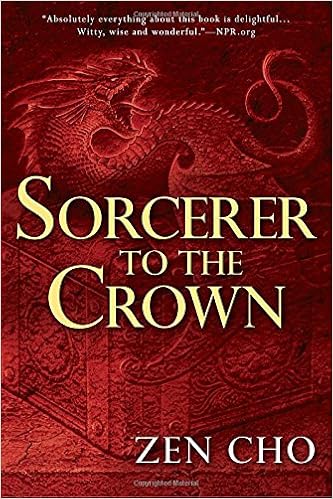
Sorcerer to the Crown by Zen Cho

Image result for sorcerer to the crownI picked up Sorcerer to the Crown more or less at random - I'm sure it was on one of my lists, but I can't remember which one. As it was by a new author, I didn't know what to expect. I was very pleasantly surprised. This was thoroughly delightful. I don't necessarily feel knocked off my feet, but I do feel happily transported to a world that is both familiar and strange - and when we're talking about historical fantasy, that is no mean trick.

What we have here is a look at Victorian England, with its racialized and gendered ideology of natural social hierarchy intact, but with magic. White men have held the power in magic in England for a long time, just as they have in politics. Women's magic they dismissed as trivial (for household things) or dangerous (too difficult for their frail forms.) Magic done by people of other races? Simply impossible to think of - or at least it was until the Sorcerer to the Crown took on an apprentice, a young black man.  Even more shocking came the day when the Sorcerer died, and the young man, Zacharias, took on the staff and office of his mentor.

Undeniably magical, Zacharias is nonetheless regarded with suspicion. How dare he be Sorcerer Royal? Isn't there something unseemly about that? And how did his former master die, anyway? And why has magic in England been drying up? These things are all undoubtedly connected, or so the gossip mill runs. And they are, but not in the way the white men in the book quite think they are.

Into this mix comes Prunella, who attended a girls' school for magic - well, scratch that. A Girls School for Restraining Magick, would be more accurate. She's very good at it, but also not white, and without family, so now she is more of a servant than anything else. She thinks of herself as a trusted friend and confidante of the headmistress, and is brought up short when she more or less gets sent to the scullery when Zacharias pays a visit, and Prunella magically separates two girls who are fighting, thus embarrassing the school.

Outraged, she collects her late father's effects and leaves, discovering in the process that the seven stones he left her are actually familiar eggs - more precious than anything in magic-starved Britain.  Meanwhile, Zacharias suffers both from nightly attacks of weakness that are not immediately explained, and from assassination attempts from those who hate him having his position.

Of course, England cannot be merely insular. They are also intruding themselves into the internal affairs of another nation without properly examining the context, more than willing to believe the male leader that the women on his island are evil witches who should be controlled by their rightful patriarch. Zacharias is uncomfortable with this, but not as uncomfortable as everyone is when the leader of the "witches" shows up and wreaks havoc, for better reason, but with no more real understanding of the internal politics of England than the English have of her island.

I found this book particularly delightful, particularly Zacharias' friend with the unexpected familiar, and other shenanigans about a familiar Zacharias' rival as Sorcerer Royal might have brought back in an *ahem* untraditional manner. I can't say it was deep, but Cho's got an excellent knack for melding Victorian identity politics with the idea of magic and familiars and Fairyland, and I was quite satisfied by the whole lot. 

Wednesday, 2 May 2018

Creation by Katherine Govier

So, John James Audubon...asshole or humongous asshole? I mean, are we at usual levels of assholishness, or does he really truly achieve a new high score?

If this particular fictional take on his life is to be believed, he was self-obsessed, narcissistic, using, callous, cheating, with little care for others other than himself, except when he feels like it. I don't know about you, but the idea of spending as much time as a three hundred page book with this jerk doesn't sound so interesting.

Yet...I'm not entirely sure that the author thinks he's as much of a colossal asshat as I did. And I only had her words to go on!  Add to that the fact that I found much of this book severely overwritten, with a narrator that was partially from our time, but not overtly, and I was frustrated by this entry on the 100 Novels to Make You Proud to Be Canadian list from the CBC. I wasn't really sure how it would make me proud to be Canadian either, because I'm not sure any of main the characters are Canadian, although it took place on the shores of Labrador. But the locals mostly came across as rapacious in their plunder of the natural world around them.

(I'm being unreasonably nitpicky - I just haven't been overly impressed with that list overall. It is far too heavily weighted towards books that came out less than five years before the list was published, and there are a bunch of them I either have been ambivalent towards or have outright hated, so far. I keep wondering if I should give this list up, but then I wouldn't have anything specifically Canadian I was drawing from when I picked books.)

Back to Audubon. He lies all the time. He frequently puts his son who is travelling with him in mortal peril because he needs the birds - he is then tortured about it, right up until he spots another bird he could try to kill his son in pursuit of. He feels vaguely bad about having asked his other son to give up his life to serve his father's obsession, but not bad enough to do anything about it. Similarly, he feels vaguely bad about having left his wife without financial resources most of her life, while also cheating on her non-stop, but again...not enough to do anything about it.  He gets unreasonably angry when the woman he wants as a mistress wants anything of her own, for instance, drawing things that aren't lessons he set for her. He doesn't feel bad about that. Just possessive, and for possessive read, wants complete ownership of a woman he is attracted to.

I mean, ugh. I almost put this book down and didn't finish it numerous times. I don't really care about the greatness of his mission. I'm sure he did good work, but it sounds like he was such a loathsome human being that I really don't give that much of a shit. (Or maybe he wasn't, or maybe the author didn't mean to make him so damn unlikeable, but wow, did I hate him.)

Yes, we have despoiled the natural world. Yes, it's good that we have drawings of birds before they disappeared. It's good he was concerned about species going extinct (I'm being charitable in assuming that is not ahistorical). But you know, like everything else...he feels vaguely bad about it, but isn't willing to do anything to address it that isn't really for his own greater glory.

I'm not a fan of this book. Of the character, of the writing, of the positioning of the author in the narrative in a way that doesn't commit enough if she really wants to insert herself. Go whole hog or not at all, please.

Tuesday, 1 May 2018

Killing Gravity by Corey J. White

*Spoilers Below*

Killing Gravity is another relatively short book I got from the Tor.com newsletter a few months ago. It came together with Witches of Lychford, and I was happy to read both. Of the two, I think I prefer this one, but neither is bad. I found Witches a little lacking, but not in any drastic ways. And Killing Gravity is quite a solid science fiction novel, if a bit on the shorter side.

We have a main character, Mars, who escaped from military intelligence and experimentation when she was fairly young. She's been on the run since, wielding a telekinetic power with more than killing force. As in, crushing spaceships is not beyond her. We meet her stranded in a spaceship, losing air, after having fought off an attacking force with the power of her mind. We also meet her amazing pet, Seven, who is very endearing.

Mars is rescued by the motley crew of scavengers who come across her wreckage - a nonbinary captain, a former soldier, and his burly lover. Most of them hit on Mars within seconds, but don't take it personally when she doesn't reciprocate. They're mostly willing to welcome her as part of the crew, but Mars' deep-down knowledge that people are always trying to kill her leads her to push that overture away.

Then she finds out that the person who sent the most recent assassin after her was another girl from the military base she'd escaped from - the one who'd helped her escape, as a matter of fact, and whom Mars was pretty sure she'd seen die in front of her eyes.  So after another attack, she heads for the last known location and finds her long-lost compatriot. And, it turns out, sister.  But the family reunion is short-lived, and that sets up Mars for a showdown with the man in charge of the facility where she'd been kept, trained, and tortured.

Also, the crew she'd shipped with so briefly is taken in by the same guy, just to lay more bait, so of course she has to go in. The rest of the book is pretty bloody, but the whole thing holds together fairly well. It feels like it could have been the first act of a much longer book, but instead it's the first book in a series.

It is, of course, a riff on found family, the relationships you create with people who you find along the way. It reminds me a bit of Firefly, in tone - Mars isn't all that far off from River, just further along in figuring out who she is and what she can do.  Seven is a really fun addition - I am often a sucker for pets in books, and Seven definitely ranks up there.  I enjoyed the pre-existing relationships between the crew that Mars pointedly refuses to join, and that gender diversity was incorporated fairly casually.

It's not the greatest work I've ever read, but quite solid. If you like space-based stories of human finding homes while fighting off those who want to control them, this might be up your alley.

Friday, 27 April 2018

And Then There Were (N-one) by Sarah Pinsker

I may have already mentioned that this is the first year I've bought a supporting membership so I can vote for the Hugos. This is a bit of a commitment for me, because although I do read a lot, I rarely read books close to the time they come out. Generally I get to them about two years later, so now I'm having to bump a bunch of last year's books to the top of my list.

Since the nominations were announced, I've read all the novelettes, all but one of the short stories, and this novella, the only one that was available online. I'm working on one novel and have another working its way through the library system to me. I feel like that's a good start in the two or three weeks since the nominations were announced.

"And Then There Were (N-one)" was a very enjoyable start to my Hugo Reading Trek 2018. It was the first work I read out, and I devoured it quite quickly. It took me an absurdly long time to get the (N-one) joke and then link it to Agatha Christie, but I got it early enough to know it was probably going to be a murder mystery, even before the murder happened.

In this story, a Sarah Pinsker who is not the Sarah Pinsker who is writing the story, is invited to a multiverse convention of Sarah Pinskers, hosted by the Sarah Pinsker who invented multiverse travel. It's on a small island off the coast of Nova Scotia, and the Sarahs arrive and leave from there directly, so as not to run amok on the world where multiverse travel began.

Initially, this is a story of paths not taken, of meeting hundreds of people who are you, in many important ways, of the wistfulness of seeing every forking path you never took walked by a different version of you.

But of course, a Sarah Pinsker turns up dead. The only Sarah Pinsker who is anything like an detective (an insurance investigator) is brought in by hotel staff to try to solve the murder. (Our Sarah Pinsker must be there somewhere, or at least, her Nebula is.)  She interviews Sarah Pinskers, finding out more about how her life is and isn't like theirs, including who else is married to the wife she wants to get to back to soon, who most of the other Sarahs met and married as well.

There's more melancholy to this than it might sound - so far, I think that as I'm describing it, it sounds like a slamming door farce, and there are funny bits, but it's more about what you did and didn't do with your life. Or, at any rate, what Sarah Pinsker did and didn't do.

When the solution to the mystery is revealed, it's fairly satisfying, but we are left with a cliffhanger, having to decide what, were we Sarah Pinsker, we would do about the murderer. I feel like that's less of a cliffhanger than you might want it to be - do you really want to let another version of your wife be married unawares to a murderer?

I haven't read any of the other novellas, but I enjoyed this a lot and expect it to rank well on my ballot. (Our universe's Sarah Pinsker's novelette, "Wind Will Rove," is without question going to be my top choice in that category.)

Monday, 23 April 2018

The Obelisk Gate by N.K. Jemisin

My mother-in-law got me a copy of The Obelisk Gate, bless her, prompted by my husband, who knew how much I'd loved The Fifth Season. I let it sit in limbo for a few months, not because I was worried about whether or not it would be good, but because I wasn't sure my heart could take it at any given moment. Finally, the news that the Hugo nominees were to be announced made me get on it, because I'm voting for the first time this year, and I was pretty darned sure The Stone Sky would be nominated. And I was not going to read that without having read this.

So, my heart prepared for further breaking, I picked it up. And I loved it almost as much, although it was less heart-breaking at times than skin-crawling. And by "at times," I mean "every Schaffa chapter."  Ohhh, the Schaffa chapters.

*shudder*

Creepy as all hell, and Jemisin would drop little bits in his train of thought, and my gorge would rise, because I'd read the first book not all that long ago, and I knew darned well exactly what the meaning behind the meaning was, and that it was horrific.

This book moves between whatever Schaffa has become (I've got a pretty good idea, but I'd find it hard to put in precise terms), Essun as she joins a new comm full of orogenes, located underground as the Season becomes more deadly, her daughter Nassun who, along with her murderous father, travel to a satellite Fulcrum, where her father hopes she can be cured of the disease of orogeny, and an unnamed narrator, who is gradually revealed to be Hoa, the small boy/stone eater Essun met last book.

If I just railed on Winterson for not understanding that science fiction and fantasy can be complex, this book would be one I'd hold up as Exhibit A for what this genre can be like, dammit. Nothing here is simple, and oh, so much of it hurts. Essun tries not to become part of the comm she is in, fearing endings like those that have claimed her sons previously. People react in ways expected and unpredictable, and are occasionally deadly.

Nassun, for quite a while, still loves the father who killed her brother, and hates the mother who was cruel in order to help her learn to hide - the intricate anguish of hurting children because it is what you think they need to survive is precise and devastating. Love is a thing for easier times, except it isn't, it survives even in harshness. And, easy and hard, it can be perverted or wielded in destructive ways, passing lessons of enslavement and oppression through generations that live in the interstices of every conversation.

But the world is built here as well, skilfully, as Essun learns from Alabaster what she can do with the obelisks, and why orogene children have had their talents bent towards the earth, instead of exploring the wider world of what no one remembers to call magic. Nassun learns some of the same lessons all by herself. Mother and daughter hurt those around them, sometimes by accident, sometimes on purpose.

And the moon is coming back. It is coming back from where it was flung, and its return could mean a return to stability or an end to humanity, which might give the stone eaters a chance to become the dominant species on a surface too inhospitable to flesh and blood.

I'm caught up. The nominees have been announced. But I need a month or so before I'm recovered enough to read The Stone Sky.