Pages

Tuesday, 4 September 2018

Crow Lake by Mary Lawson

There have been a couple of things that have bothered me about books I've read over the last couple of years, and I'm delighted to say that this book neatly sidesteps both of them. The first is the Canada 100 list I'm slowly making my way through - I have complained repeatedly that it's far too weighted towards the five years before the list came out, and that the books on it are frequently not very good. (Outright bad, in a couple of cases.)  And then came along Crow Lake, which is on that list, and relatively recent, but was, to my immense satisfaction, very, very good.

The other gripe I've had is thematic - I've read at least two books recently that dealt with death and grief in ways that felt off-handed and slightly flippant. They definitely felt like neither had been written by people who'd dealt with grief or known what it is to live with it, the complexities of that situation. So imagine how happy I was when this book, which started off with the death of both parents of the narrator, dealt sensitively and completely with the ways in which it both defines and doesn't define your life afterwards. They ways in which it never goes away, but that doesn't mean it's all you are, either.

There's one other thing that this book does well, before I launch into a description of the plot. I sometimes have trouble with books where you have main characters who will just not fucking say what they need to say, will avoid conversation for the sake of the plot. I wasn't sure if it was that I am too impatient with people who aren't good at communicating, or if the authors weren't doing enough to make me understand why these characters weren't communicating.

I've decided, after reading this book, that it is the fault of those authors. Sorry. I say that because this book similarly has a main character who has a hard time talking about her feelings, who has bottled up what she thinks she knows about her family and used it as a weapon, mostly against herself. And yet, it felt right this time, because Mary Lawson let me close enough to the character to understand why, the particular cracks and chips in her coping techniques that had led her to this spot. She didn't irritate me, because I understood her, and many authors aren't skilled enough, or don't care enough, to do so, and so their characters who withhold information don't feel true.

Okay, time to put these things I really liked about Crow Lake into context. It is the story of four children. First, two brothers, just done and about to be done high school, and their much younger sisters, one still in diapers. They live in Northern Ontario, and were a stable, happy family until both parents are killed in a car accident. From there, the town tries to help, but no one is sure what to do. An aunt comes from rural Quebec and proposes to take them back and split them up between families, but the narrator, the older of the sisters, is so traumatized by the prospect of losing what is left of her family that the oldest brother decides to forgo teacher's college to keep the family together.

This is interspersed with the reminiscences of the character (Kate?) as she is in her late twenties, a newly minted assistant professor of biology at a university in Toronto, and we see how this child who turned inwards and was unable to deal with any more change has calcified into a woman who has taken her need for stability and her inability to admit she needs things, and woven them into a story about the tragedy of her family. We don't get to see what the full tragedy is for a long time, and it's wrapped up with another family in the Northern Ontario town that has much more sorrow in their lives, in the midst of daily cruelties.

In particular, there is now a distance between the narrator and her brother Matthew, the second oldest boy, clever and good at school in a way that Luke, the one who stepped away from education to keep everyone together, was not. He loved the rock pools and sparked her love of biology as a girl. She resents something he's done, and we don't know why, but it has put a distance between her and her family, and so, she believes, has her education. She's invited back up for her nephew's birthday party, and reluctantly brings the man she's been dating.

The book goes back and forth between these two time periods, and you know early that a couple of things happened with her brother, but not what they were. When they were finally revealed, and revealed to be as much about her perception and even more, her expectations of him, it was deeply satisfying, particularly when she was called on her assumptions by several people.

This is not a book with a large story, but it does a stellar job at the story of one family, and how early trauma has shaped these four children, and how those children both do and do not allow more change into their lives, do and do not adapt to altered circumstances, do or do not deal with fears of losing more people they love.

Friday, 31 August 2018

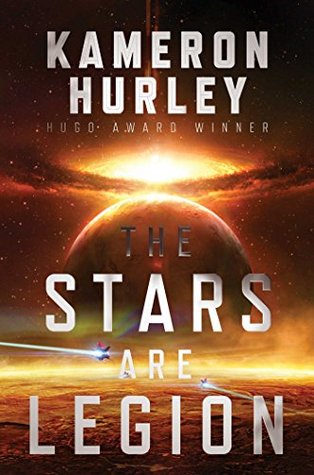
The Stars Are Legion by Kameron Hurley

Whenever I go into Bakka Phoenix in Toronto, I try to pick up a book by an author I've never read, but have heard of. Often, this means an author I've somehow started following on Twitter, without having delved into their books. I always mean to someday, and this is a way I can. So in the spring, this was the book I picked up. It got put aside while I read the Hugo nominees (the release of the longlist a few days ago shows how close this book came to being part of that reading project), but I finally picked up Kameron Hurley's work and read it.

I don't know where I would have ranked The Stars of Legion on my Hugo ballot, had it made it on, but it would definitely have been a worthy addition to that list - and I've said before that the best novel nominees were a very strong bunch. This was a lot of fun, often troubling and a little gross, with great emotional arcs and lots of betrayal.

The world Hurley has created here is very compelling, and twisty. On ships that are worlds, or worlds that are ships, the Legion moves through space. If it had a central mission, that seems like it was lost long ago. The action take place on the outer rim of the Legion, where a ship/world (the Mokshi) broke out of the inner core and stayed. It's in much better shape than most of the worlds/ships on the outer rim, and so everyone wants it, for that, and for any weapons it might hold.

These are huge places, and those who live on the levels near the surface of the worlds know little of the many, many levels closer to the middle. They don't even really have myths about them - things have gone on so long that there are no stories of places they're trying to reach, of the people below them, only of the wars that have raged between worlds as warlords try to conquer other worlds to strip to save their own.

I say people, but it is a fact that all the people in these worlds are women, and, like many other things that have been lost (if they have been lost) is even the idea of men. By which I mean, it comes up not even once. Women on the ship sometimes give birth to large furry cogs that the ship needs, but if babies are born, they are female, and have always been female and will always be female. This is not a universe where an alternative idea exists.

The story centers around two women - Jayd, the daughter of Anat, warlord of Katazyrna, and Zan, a woman without a memory, although those around her seem to remember her just fine. She has small glimpses, enough to both desire Jayd, and not trust her, and this is exacerbated by everything that happens. Zan is told that she is a general who is the only one to have ever penetrated the defenses of the Mokshi, and that she must go back to do it again, for Katazyrna is slowly dying, and Mokshi is not. (This is not a battle to transfer a people to another world, but to sacrifice the life of another world in order to prolong the life of one's own.)

Zan is there as part of Jayd's plan comes to fruition, and she is sent to be wed to another warlord, but as such plans often do, it does not survive first contact, and Jayd is left alone to try to continue her scheme, while Zan is thrown down a refuse chute to the bottom of the world, and must slowly, painfully, climb her way back out, through different levels that have entirely different cultures, past interior geography that is as complex as you would expect to find on the exterior of a planet.

In the refuse, she finds an old, deformed woman who might know a former version of her, and on her travels, she finds two other women who grumble but will not abandon her. As Zan creates a community, Jayd grows more alone with the tatters of her previous plan, trying to snatch a victory while being unutterably alone. It all hinges, yet again, on how these women give birth, and what they can give birth to, other than children. To a world? What are these worlds, anyway?

The answer comes briefly at the end, and it's so delightfully intriguing that I didn't need more. Although I wouldn't mind knowing more, either. We get some clues to an answer to how these worlds have changed, how these women have changed, how adaptation works through untold time hurtling through space with other worlds near enough to attack and plunder. Is there another way?

We get a glimpse of possibility, but no firm answers. But this wasn't an unsatisfying end - one journey is done, and another is beginning.

Wednesday, 29 August 2018

The Sharing Knife: Legacy by Lois McMaster Bujold

I love Lois McMaster Bujold. Just love her books, the complexity and the particular knack she has for writing a third act that pushes beyond what most authors would have taken for an end point, to see the larger repercussions. The Vorkosigan books are very dear to my heart, and while I've only read The Curse of Chalion from her main fantasy series, I loved that too. So when I saw this at the library book sale last year, I had to snap it up, even though it was second in a series, and there was no sign of the first book on the SF/F table.

More so than many of her other books, though, this was a difficult entry into the series. With the Vorkosigan books, I have picked up ones at different points in the series, and not had too difficult a time knowing where I was and what was going on, at least in broad strokes. But in this book, there's a lot of underlying assumptions that I still don't entirely get, and that made it harder to love the story the way I wanted to. I still ended up liking it, but it definitely does not feel as good as other books by Bujold I have read.

Also, I really should stop reading books from midway through series.

I say that, but it's unlikely to happen.

As we start this book, a couple has just been married, and they're obviously from different worlds - she's a farming woman, he's a much older...uh, necromancer? Kinda? Patroller who kills abominations that spring up with the help of knives into which souls have been bound, anyway. Souls given voluntarily, I should add.

I am led to believe that this relationship was regarded with suspicion by Fawn's folk, but that they eventually, if grudgingly accepted it. That is nothing to the suspicion they are under as they return to the...Lakewalker? Is that the name? camp, where the main male character, Dag's, mother throws a fit, him out of the house, and everyone tells him just to send his farmer sidepiece back to her family, and that farmers can't even really marry - although Fawn and Dag are, through a magical binding that she shouldn't know how to do.

The book bounces between Fawn at the camp, and Dag as he's sent away to take care of one of the magical abominations, which is innovating in ways that are very worrisome to Lakewalkers and farmers alike. Fawn follows, eventually, and yet again is able to do things no one else thinks to do because she's not steeped in ways things "should" be done. But they come back to camp with suspicion still around them.

This is fine, as fantasies go. The people are complicated, and Bujold finds interesting answers, as she always does. It's just not as deep or as interesting as some of her other books, so while I didn't mind reading it, I'm not itching for the next one, as I usually am after finishing one of her works.

Monday, 27 August 2018

Rollback by Robert Sawyer

It's been over a week since I finished this book, which is definitely going to slightly change how this review will come out. If I'd written it as soon as I had finished, this would likely be a lot more ranty, and I am still annoyed, but the anger has lost its heat. It's too bad, because I was pretty worked up about this book, and, in particular, how it treats the female characters and what story it centers and how it's a retread of a theme that has come up in other Sawyer works but does nothing new with it. Oh wait, maybe the anger is coming back. I've reached the level of annoyance, anyway.

What bothered me right away is something that I couldn't quite put my finger on, until I was discussing it with my husband, and he said that in one of his creative writing courses, the prof had given some advice he'd taken to heart. To wit: "the story should be about the person with the most at stake."  Which is damned good advice, and it explains why I've been annoyed with a few other books as well.

So let's look at the story and see who has the most at stake here. The main characters are Don and Sarah, who are in their late eighties, at the age where they don't know if they'll be around in a year or two. They celebrate their sixtieth wedding anniversary just as exciting news breaks - forty years earlier, roughly, a message had been received from a nearby star system. Sarah was the one who cracked the code and discovered the message the first time.

The new message is encrypted in a different way, and a billionaire offers to pay for a rejuvenation therapy for Sarah so that she can try to solve this puzzle too. She agrees, but only if Don gets the treatment as well. Unfortunately, the treatment takes for Don, but not for Sarah, so he returns to being biologically about 25, which she remains 87, and with the greatest puzzle of her professional career in front of her.

So, who has more at stake? The woman who has to face her own mortality in a fresh and cruel way while her husband will live for decades more, and still has to figure out what the aliens sent and why and for whom? Or the husband, who was to deal with his wife continuing to grow older, the difficulties of appearing young but being old, and whether or not he'll fall dick first into a comely grad student? (Spoiler alert: he does.)

(Also bothering me is that this is no less than the third book by Sawyer that has the same plotline of a man discovering he'll outlive his wife by many, many years. It's more fully developed here, but Sawyer, we've done this before, as we've done the man irresistibly attracted to an intelligent young woman who reminds the protagonist of his wife when she was younger. Can we find a few new tricks?)

And of course the beautiful young grad student that Don cheats on his wife with falls for him fully, so fully that while she's pissed when she finds out he's actually 87, married, and worse, married to her academic idol, she takes him back.

You know what would have been more interesting? If Don and Sarah had had an honest and painful discussion about vastly unmatched sex drives when one spouse is biologically 25 and the other is 87 and come to some sort of agreement. You know what isn't interesting? Sarah being a saint and not having any real problem (shown, anyway) with the treatment failing or Don fucking around on her. You know what? She'd be justified in being mad.

Knowing your wife's going to die and you are still young, that's a story. But when you add in the SF angle of this book, the SETI message, then this is definitely a story where Sarah has the most at stake, and neither she nor the grad student are afforded much depth or any ability to be really mad at Don. This is his story, and it's frustrating, because it's far from the most interesting part of the book, and the reaction of the women to him is frankly eyebrow-raising, if not outright unbelievable.


Friday, 24 August 2018

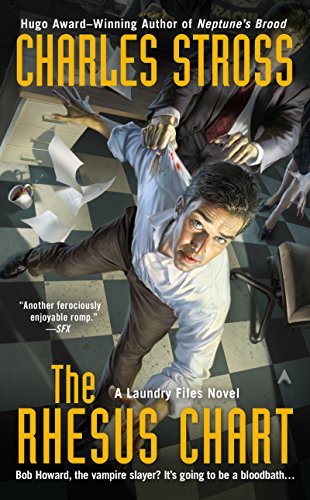
The Rhesus Chart by Charles Stross

Perhaps it would be inevitable that the Laundry would have to deal with vampires, eventually. Or would they? After all, everyone knows that vampires don't exist...and they seem particularly sure of it in that bureaucratic branch of the British civil service that deals with gibbering horrors and threats from beyond.

Seem a bit fishy? Well, it will to Bob, too. If you've read any of the Laundry books before, then of course you'll know Bob. I have read them all out of sequence, but this one is a little further than I'd read before, and, I think, the book right after the last Laundry book I got, putting me more or less on track? The big disaster where Cthulhu takes over the world is still on the horizon, and in the meantime, the Laundry is doing everything it can to keep that day at least a little further off. Including sending Bob's wife, Mo, on increasingly taxing missions with her magic violin that does nasty things.

Meanwhile, Bob is still sort of in the Laundry, and sort of in the next level up, which does more deniable things, and which the average Laundry-dweller knows nothing of. I was delighted to see that the reverend character, one of Bob and Mo's friends that Bob got unfortunately embroiled in the occult in the last book, is back. As are some of Bob's old red-tape mates from the bureaucracy. And, of course, the security zombies.

Stross also brings back a character from near the beginning of the series, Bob's ex-girlfriend, Mhari, now working for a banking/investment research firm. As is often the case in this series, young people with a lot of computer knowledge and little wisdom can use computing power in ways that have unfortunate outcomes - in this case, leaving one, and then many, of their research team with what is eventually dubbed PHANG syndrome, by someone who obviously really, really needs the acronym to make a vampire joke.

They can be burned by sunlight, influence impressionable minds, and drinking human blood brings on something like an orgasm - oh, but it turns out it's because you've set up a link to an extraterrestrial creature which has established a branch office in your mind and uses the blood to suck the victim's brain dry, while keeping its host happy. That part...not so great. As is said repeatedly, once most people have figured it out, they've done the decent thing. This inadvertently creates a natural selection where few remaining vampires who've lived centuries are psychopaths.

Bob, in his off hours, is doing an extra-work project, because they're all required to spend 10% of their working time on their own projects without actually being given 10% of their time to do so. In so doing, he accidentally discovers the start of the investment thinktank vampire incursion on London, and marshals all his resources - only to find out that Mhari is a few steps ahead of him.

Added in to the mix of new vampires and old vampires is a wonderful but brief jaunt into what a 1950s public occult awareness campaign might have looked like - the reverend, whose name I still can't remember, is given the job of updating it for a digital age.

As is always the case with this series, I had a lot of fun reading the book. I can't say it's the deepest thing ever, but they're always worth some time, and provoke a fair number of wry grins. I also particularly liked the appearance of a demanding cat. And the take on vampires was interesting - I liked the explanation for why vampires are evil killers quite a lot.

Thursday, 23 August 2018

In Other Lands by Sarah Rees Brennan

I can't believe I forgot to review this book! I read it several weeks ago, as one of the last few I had to go before casting my Hugo ballot, and quite enjoyed it. Somehow, however it never made it on to my review backlog, and I only just realized it. Hopefully, I haven't forgotten too much about it.

In Other Lands was nominated in the new YA category. I had not read anything by this author before. What I got out of it was thoroughly enjoyable, even though there were moments where things rang a little off, or didn't altogether hang together. Still, they were all flaws I could forgive, and enjoy the rest of the book. (I think I read later that this was somethinf the author wrote to distract herself from other projects, and was writing to make herself happy, and yeah, this reads very much like that, and that seems like a great way to go.)

Elliott Schafer finds himself on a field trip in an actual field, but with a wall none of the other kids can see. Since he dislikes all the other kids, he's amenable when he's asked to climb over it and join a magical camp for children. But not so much a summer camp, an army camp. Elliott decides to join the much-less prestigious camp for future counselors of the military leaders, although it seems apparent many of the new people wish he'd just go away. Elliott is used to that, though, and stays.

Almost as soon as I met Elliott, it felt like he was Eustace Clarence Scrubb who stayed Eustace Clarence Scrubb (from some of the later Narnia books), although over time you come to learn that Elliott has laudable qualities as well. He's just stubborn, prickly, kind of a jerk to be around, and vastly emotionally unintelligent - until a few occasions where he is preternaturally emotionally intelligent, and those didn't quite jibe, but I still liked what Brennan was trying to do with those moments. They just didn't...quite fit right.

Let me give you an example. This book spans years of Elliott going home in the summer and coming back in the fall. As many books like this do, absolutely. One of his relationships falls apart, and Elliott is upset, but emotionally enough aware to know, in great detail, that it is not anyone's responsibility to love him back just because he loves them, and that that is putting his shit on them, and that it really is a situation where it is no one's fault.

This makes me want to cheer, it really does! We see this kind of maturity and emotional intelligence so rarely! But then Elliott doesn't get, for most of the book, that one character really is his friend. I mean, really, really is his friend, because he doesn't understand actions at all. That these both co-exist in the same character? It strains credulity a bit, but I also do like those moments where Elliott is emotionally mature, and understands these sorts of things. Even though it doesn't seem likely.

However, I didn't need this book to be perfect, and the occasional feelings of discrepancy were small next to the pleasures - Elliott's general pacifism, and the way he bullheadedly tries to steer this entire new society into patterns that disdain militarism. The treatment of sexuality, and Elliott's emergence as a bisexual character without shame or worry - although it also strained credulity that Elliott could be very attentive to some things, yet not notice a particular attraction for that length of time. I also liked that the queer characters didn't have to do it all through subtext and not quite acting on anything!

(Some of these things sound like things that, in a much better world, would be bare minimum things, but some of them are still so rare as to be almost revolutionary.) In the long run, this was a lot of fun, and I enjoyed it a lot. It wasn't near the top of my ballot in the YA category, but it was refreshing, enjoyable and flawed. Much like Elliott, I guess.

Monday, 20 August 2018

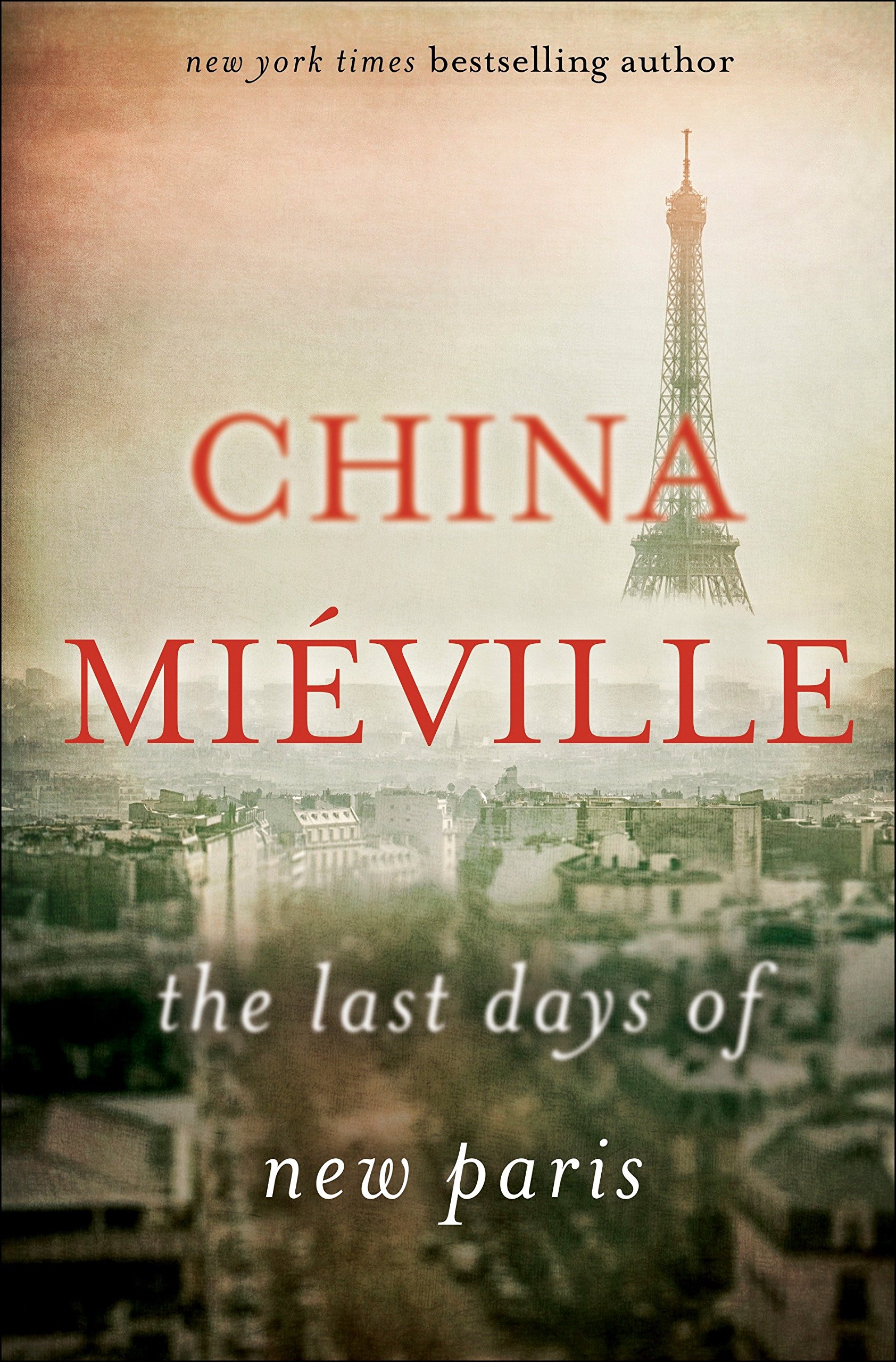
The Last Days of New Paris by China Mieville

China Mieville's books are often dense with ideas and prose, and I love it. There is only one of his books that I've read so far that fell flat, and the rest have been right in my sweet spot of challenging and interesting, pulling me into a rich and slightly grungy world, pungent and full of interesting ideas, people, and revolutions. Always revolutions.

This particular book makes me wish I knew more about art history, and specifically, about surrealism and its place in history before and during WWII. I have done little scraps of research once I discovered the notes at the back of the book, which helped me google some of the relevant pieces of art, but this has only really made me want to learn more. I know there are things I'm only half comprehending because it's not the area of my expertise.

But from what I know, and what I glean, Mieville's doing something very interesting here, playing with an alternate history or alternate world (I say the latter because of the endnote, where the author intrudes as narrator) where a surrealism bomb set off in Paris during the Occupation drastically changes the landscape and inhabitants of the streets. Laid over top of that are some thoughts about art in the service of the state, in the service of revolution, in the service of enjoyment and in service of itself. Or not in service at all, and here is where I wish I knew more about the philosophies underpinning this era, these people, because what I do understand is so intriguing.

The story of New Paris at present (1950) are interspersed with the earlier story of Jack Parsons who gets stuck in Paris on his way to Prague, toting a bomb that can harness ideas and set them free - he was going to animate the Golem of Prague, but when he can't do that, he falls in with the surrealists and becomes intoxicated with the energy of what they're creating, even as he disdains it for creating little real change in the world.

Back in 1950, the rest of the story is that of Thibaut, who joined the Main a plume after his parents were killed, and has an uncanny instinct for what is surrealism and what is not. He loses comrades to the Nazis who control part of Paris, while they are under siege by the manifs that arose in the aftermath of the detonation of Parson's bomb - surrealist artifacts come to life. (There is a French wikipedia page for the real-life/our-world Main a plume, but not an English one, that I can see, but my mediocre French was enough to get the gist of it - it was a real group of surrealists in the absence of some of their most vital members, in Paris during the occupation.)

Thibaut gets along with the manifs when few others can, and the creations the Nazis try to make out of their own art seem to not have the life necessary to take permanent form. Which doesn't stop them from continuing to try, along with the help of a traitor priest eager to turn to the powers of Hell if it means more personal power.

(The digression about the place of Hell in this twist of allegiances was particularly enjoyable.)

Thibaut meets a woman with a camera that seems to have a particular effect on manifs and their kin, who says she's there to document New Paris as its last days descend - it cannot last, she insinuates, and Thibaut feels the balance tilting. They come across an exquisite corpse (which I didn't realize was an art as well as a writing game, silly me) that doesn't like Sam, the woman, but is okay with Thibaut. Together they go further into art, further into Paris, further into peril, and the threat of a new style of art that will obliterate everything before it in pursuit of...?

That's not a question mark because I don't know. It's a question mark because the last section, the last art, was so powerful a metaphor, so unforgiving and merciless of things that should never be forgiven, can never be forgotten, but does it in such a sneaky way, that it had a great impact.

Look, this is a weird book. Mieville's books always are. But it's the exact kind of weird I adore, and the deeper issues that are layered in here have captivated me. I'll see you later - I'm off to explore surrealist art some more.